Adult vaccine schedule: which shots adults need and when
The US adult vaccine schedule in force for 2026, by age and situation: flu, Tdap, MMR, HPV, hepatitis B and more, with doses and intervals.
In this article9

What vaccines do adults need and how often?
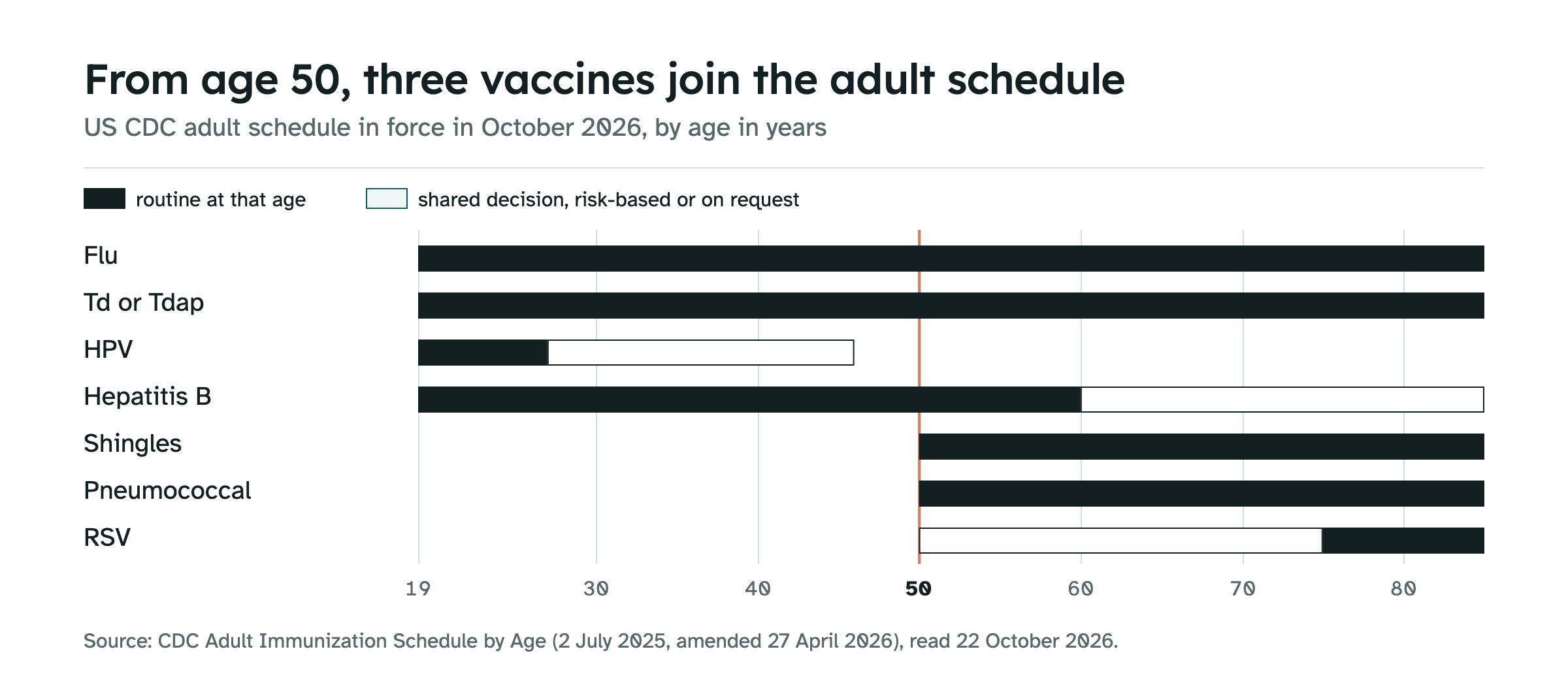
The adult vaccine schedule of the US Centers for Disease Control and Prevention (CDC) covers vaccines for people aged 19 or older against many diseases, but only two recur on a fixed rhythm for nearly every adult: influenza once a year and tetanus-diphtheria every 10 years.[1] The rest depend on your age, your vaccination record, pregnancy, your job, travel plans and health conditions. The table summarizes the schedule by age as the CDC page showed it on 22 October 2026.
| Vaccine | 19–26 years | 27–49 years | 50–64 years | 65 years or older |
|---|---|---|---|---|
| Influenza (flu) | 1 dose every year | 1 dose every year | 1 dose every year | 1 dose every year; any one of HD-IIV3, RIV3 or aIIV3 preferred[2] |
| Tdap or Td | 1 dose Tdap, then Td or Tdap every 10 years | same | same | same |
| MMR | 1 or 2 doses if born in 1957 or later and no evidence of immunity | same | same | same |
| Varicella (chickenpox) | 2 doses if born in 1980 or later and no evidence of immunity | same | 2 doses with an indication | 2 doses with an indication |
| Hepatitis B | 2, 3 or 4 doses depending on vaccine | same | same until 59 | from 60 with risk factors or on request |
| HPV | 2 or 3 doses through age 26 | 27 through 45: shared decision | not applicable | not applicable |
| Shingles (recombinant zoster) | only with an immunocompromising condition | same | 2 doses | 2 doses |
| Pneumococcal | with risk conditions | with risk conditions | 1 dose PCV20 or PCV21, or PCV15 plus PPSV23 | same |
| RSV | in pregnancy, seasonal | in pregnancy, seasonal | 50 through 74 with increased risk: 1 dose | 75 or older: 1 dose |
"Shared decision" is the CDC's term for shared clinical decision-making: the vaccine is not routinely recommended at that age, and you and your clinician decide together whether it makes sense for you. The schedule also carries COVID-19, with doses tied to a season's vaccine, and hepatitis A, meningococcal, Hib, mpox and polio entries, which apply to adults with a specific indication or a gap in their record.
These rules come from a US authority. In other countries, the national health authority publishes its own adult schedule, and the ages, products and intervals can differ. The vaccines that start at 50, shingles, RSV, pneumococcal and the preferred flu vaccines after 65, are only summarized here; each deserves its own decision.
Can I get the HPV and meningitis vaccines together?
Yes, the HPV vaccine and the meningococcal vaccines can be given on the same day. The CDC's general best-practice guidance defines simultaneous administration as several vaccines given on the same clinic day, at different injection sites and not mixed in one syringe, and states that experimental evidence and extensive clinical experience support it.[3] The same guidance notes that giving every vaccine a person is eligible for at one visit increases the chance of being fully vaccinated.
The two meningococcal vaccines answer different questions:
- MenACWY protects against four groups of meningococcal bacteria. It is recommended for first-year college students who live in residential housing and were not vaccinated at 16 or older, for military recruits, for travel to countries where the disease is hyperendemic, and for some medical conditions such as asplenia or HIV.[2]
- MenB protects against group B. For healthy people aged 16 to 23 it is a shared decision, given as 2 doses at least 6 months apart; people with certain conditions need 3 doses and boosters.
- Both on one day: the CDC notes say MenACWY and MenB may be given at the same visit, at a different site if feasible. A combined vaccine, Penbraya, can replace the two separate shots when both are due on the same day.
HPV vaccination is routine through age 26. One point needs planning: during pregnancy the CDC advises waiting with HPV vaccination until after the pregnancy, and MenB is also usually delayed unless the risk is high. If you are pregnant or planning a pregnancy, raise both before the appointment.
Do adults need 1 or 2 MMR vaccines?
Most adults born in 1957 or later who have no evidence of immunity need 1 dose of the measles, mumps and rubella (MMR) vaccine; certain groups need 2 doses at least 4 weeks apart.[2] Evidence of immunity means one of four things: birth before 1957, documented MMR vaccination, a lab test showing immunity, or lab-confirmed disease. A remembered case of measles without a lab result does not count.
The CDC notes list 2 doses for these adults without evidence of immunity:
- students at colleges and other postsecondary institutions
- international travelers
- household and close contacts of people with a weakened immune system
- health care personnel born in 1957 or later
- people with HIV whose CD4 percentage is at least 15% and CD4 count at least 200 cells/mm³ for 6 months[2]
If you already had one dose and belong to one of these groups, one more dose completes the series. MMR is a live vaccine, so it is not given during pregnancy or with a severely weakened immune system. A person who is not immune to rubella and is pregnant gets the dose after delivery, before leaving the hospital or birth center. If your records are lost, a lab test showing immunity counts as evidence, and your clinician can say whether testing or vaccination is more practical where you live.
What is the recommended adult immunization schedule for 2026?
The adult schedule the CDC names as current in October 2026 is the one dated 2 July 2025, amended on 27 April 2026 to add the April 2025 RSV recommendation of the Advisory Committee on Immunization Practices (ACIP).[1] A note at the top of the CDC page explains why there is no newer version. On 16 March 2026, a federal court in Massachusetts issued a preliminary order in American Academy of Pediatrics et al. v. Kennedy et al. that stayed every ACIP vote from the June, September and December 2025 meetings. The same order also stayed the Acting CDC Director's 5 January 2026 memo that revised the childhood schedule.
For adults, this has three practical consequences:
- Searching for "2026 schedule" can surface outdated or contested versions. The reference is the page CDC labels as current, with its own date.
- RSV now starts at 50 for people at increased risk. The April 2025 recommendation, adopted by the Department of Health and Human Services (HHS), set 1 dose for adults aged 50 to 74 with an increased risk of severe RSV and 1 dose for everyone 75 or older.
- Some entries still name last season's products. The COVID-19 row, for example, refers to the 2024–2025 vaccine, so the CDC's separate COVID-19 page and your pharmacist are the place to check which product is offered this season.
Court proceedings can change this status again. The date printed on the CDC page you are reading is the most reliable sign of which version applies.
What vaccines are adults supposed to get?
Beyond age, five situations change which vaccines an adult is advised to get. These are the ones the CDC notes name most often.
Pregnancy
During each pregnancy, 1 dose of Tdap is recommended, preferably early in weeks 27 to 36.[2] An RSV vaccine (Abrysvo) is recommended between 32 weeks and 36 weeks plus 6 days from September through January in most of the continental US, unless the baby will receive an RSV antibody instead. A flu vaccine is part of the yearly recommendation. MMR and varicella vaccines are not given during pregnancy; a missing dose is given after delivery.
Work in health care
Health care personnel without evidence of immunity need 2 doses of MMR and 2 doses of varicella vaccine, and the CDC counts health care and public safety work with a reasonably expected exposure to blood as a hepatitis B risk factor.
Study and travel
College students and international travelers without evidence of immunity need 2 MMR doses. Travel to countries where hepatitis A or B is common adds those vaccines, and travel to regions with frequent meningococcal disease adds MenACWY. Multi-dose series take weeks to months, so they are easier to finish when planned early.
Age 60 or older and hepatitis B
Hepatitis B vaccination is routine from 19 through 59. From 60, the CDC recommends it for people with risk factors such as chronic liver disease, HIV, dialysis or sexual exposure risk, and for anyone who asks for it; people 60 or older with diabetes decide together with their clinician.
A weakened immune system
Adults from 19 with an immunocompromising condition are advised to get the 2-dose shingles vaccine, and HPV is given as 3 doses even if the series started at 9 to 14. Live vaccines such as MMR and varicella are not given with a severely weakened immune system.
Adult vaccines
Adult vaccines come with different numbers of doses and minimum gaps, and the gap is what decides how far ahead you need to plan. The table shows the standard adult series from the CDC notes.[2]
| Vaccine | Doses | Standard timing |
|---|---|---|
| Hepatitis B (Heplisav-B) | 2 | at least 4 weeks apart |
| Hepatitis B (Engerix-B, Recombivax HB, PreHevbrio) | 3 | 0, 1 and 6 months |
| Hepatitis A (Havrix or Vaqta) | 2 | 6 to 12 months (Havrix) or 6 to 18 months (Vaqta) apart |
| HPV, series started at 15 or older | 3 | 0, 1 to 2, and 6 months |
| MMR, when 2 doses apply | 2 | at least 4 weeks apart |
| Varicella | 2 | 4 to 8 weeks apart |
| Shingles (Shingrix) | 2 | 2 to 6 months apart |
| Pneumococcal PCV15 followed by PPSV23 | 2 | PPSV23 at least 1 year later |
| MenB, healthy adults 16 to 23 | 2 | at least 6 months apart |
| Tdap, then Td or Tdap | 1 + boosters | booster every 10 years |
A combined hepatitis A and B vaccine (Twinrix) covers both in 3 doses at 0, 1 and 6 months, which helps when both are due. For MenB, the CDC notes say to use the same brand for every dose.
Vaccines schedule
A personal vaccine schedule starts with your own record, not with the full CDC table. Write down which vaccines you have documentation for, then compare each row of the age table with that list. Five questions settle most gaps:
- Do I have a record of a Tdap dose, and when was my last tetanus shot?
- Do I have proof of two MMR doses or immunity, and do I study, travel or work in health care?
- Did I start an HPV or hepatitis B series that was never finished?
- Am I pregnant, planning a pregnancy, or living with a condition that weakens the immune system?
- Am I 50 or older, which adds shingles, pneumococcal and possibly RSV?
An unfinished series is usually not a reason to start over. The CDC's best-practice guidance states that, with some exceptions, for example oral typhoid vaccine, an interrupted schedule does not require restarting the series or adding extra doses.[3] Longer gaps than recommended usually do not lower the final antibody level, although full protection only comes once the last dose is given.
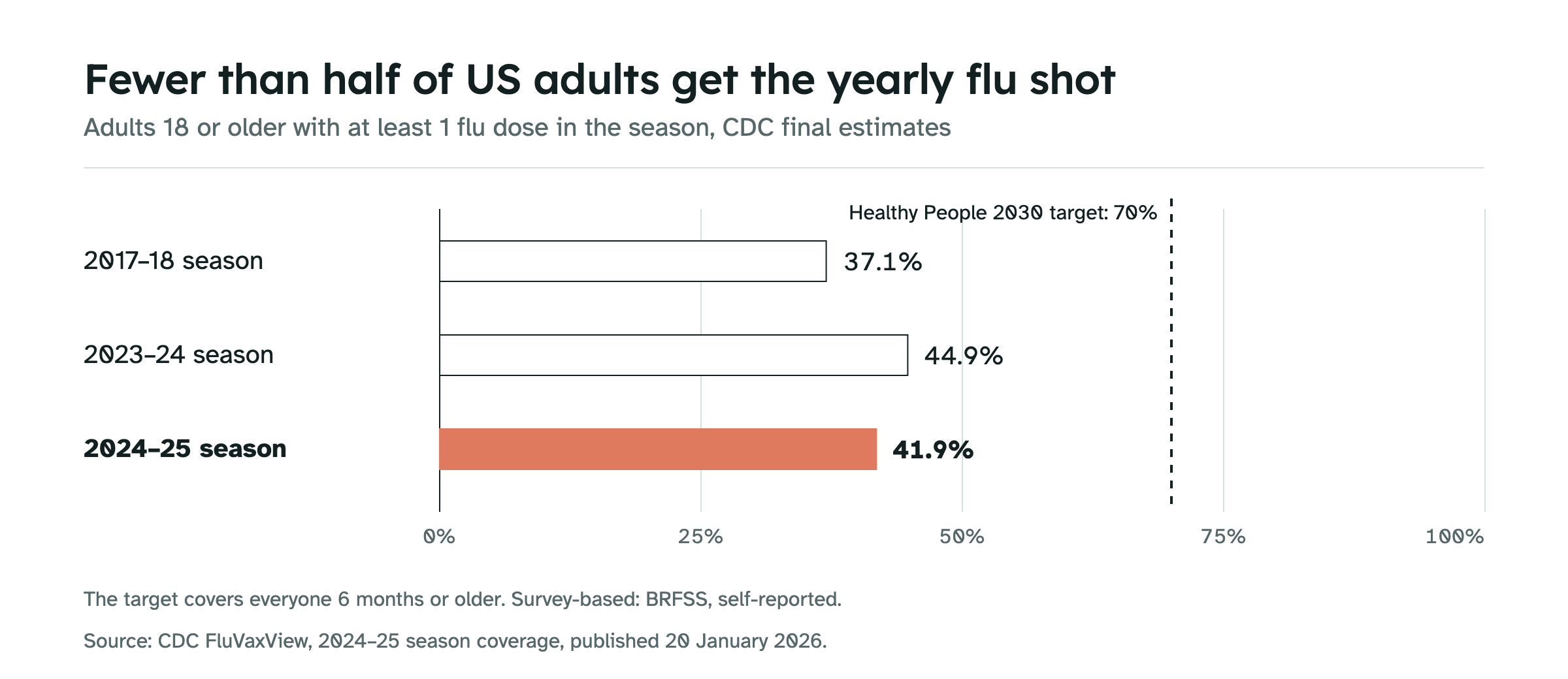
Many adults fall behind on even the yearly vaccine. In the 2024–25 season, 41.9% of US adults got a flu vaccine, 3.0 percentage points fewer than in 2023–24 (44.9%), according to the CDC's final FluVaxView estimates published on 20 January 2026.[4] The national Healthy People 2030 target is 70% flu vaccination coverage for everyone 6 months or older.[4]
The next step is to take your list to a licensed clinician or pharmacist, who can check your records, contraindications and the products available this season. In the US, the federal vaccine finder[5] searches pharmacies by ZIP code. Whether a vaccine is covered depends on your plan; our guide to checking insurance coverage[6] walks through the questions to ask. If you are on Medicare, our guide to Medicare Part B costs[7] explains this year's premium and deductible, and our methodology page[8] explains how sources for pieces like this one are chosen.
Frequently asked questions
How often do adults need a tetanus shot?
After the primary series, the booster is due once a decade. For any wound other than a clean, minor one, such as a deep or dirty wound, a booster is given if the last dose was more than 5 years ago.
Do adults need the Tdap vaccine if they had it as a teenager?
One Tdap dose at age 10 or older counts. After that, either Td or Tdap is used for the 10-year boosters, and a new Tdap is given in every pregnancy.
Can adults over 26 get the HPV vaccine?
Yes, adults aged 27 to 45 can get it after a shared decision with their clinician. It is not routinely recommended at that age, so the conversation weighs your own situation.
Is there a vaccine schedule for adults with no vaccination records?
The CDC schedule counts documented doses or lab evidence of immunity. For MMR and varicella, a clinician can order a blood test instead of repeating doses when records are missing.
Do these recommendations apply outside the United States?
No. They are the US CDC schedule; other countries publish their own adult schedules, which may use different ages, products and intervals.
Sources
Medical disclaimer. The content on Elenra is general information. It is not medical advice, diagnosis or treatment and does not replace a consultation with a doctor or another qualified health professional. Talk to your doctor before you start, change or stop any medication or treatment. In an emergency, call your local emergency number. Medical disclaimer
Related reading
All Prevention →Shingles vaccine: who should get it, side effects and cost
Who the CDC advises to get the Shingrix shingles vaccine, how common its side effects are, how long protection lasts and what two doses cost.

What not to do before a PSA test: sex, cycling and medicines
What not to do before a PSA test: no ejaculation or hard cycling for 2 days, keep taking finasteride and tell your clinician, wait out an infection.