How to check whether your insurance covers a treatment
A step-by-step guide to checking whether your insurance covers a treatment, from coverage checks and prior authorization to appealing a denial.
Contents

What does insurance not cover?
Even a comprehensive health plan does not pay for everything, and the exclusions are rarely random. Most plans, whatever their country or structure, carve out whole categories of care, and the reason a treatment is recommended often matters as much as the treatment itself. Knowing the common exclusion categories before you schedule anything can save you a difficult conversation about a bill later.
- Services judged cosmetic, or not medically necessary for the diagnosis a clinician has documented
- Uses of an approved drug that the regulator has not licensed (so-called off-label use), unless the plan chooses to cover them
- Medications a plan has left off its formulary, the official list of drugs it will pay for
- Services excluded by law, which no plan in that system is allowed to cover for that purpose
GLP-1 medications, the drugs originally developed for type 2 diabetes and later approved for weight loss, show how sharply these lines can fall. In the United States, Medicare is prohibited under current law from covering drugs for obesity treatment alone. Medicaid coverage is optional for the states, and 13 state Medicaid programs covered GLP-1s for obesity under fee-for-service as of January 2026, down from 16 a few months earlier as several states withdrew for budget reasons. Among large employers, coverage remains limited as well. Yet the same medications are covered when prescribed for their other approved indications, such as type 2 diabetes, cardiovascular disease risk reduction, or obstructive sleep apnea.[1]
That contrast is the single most useful thing to understand about exclusions: the drug did not change, the diagnosis code did. An exclusion is often a statement about the documented reason for treatment, not about the medication or procedure itself. This is why the same colonoscopy or prescription can be fully covered for one person and declined for another, and why the questions worth asking your plan are about the indication, not only the item.
What does insurance actually cover?
Before looking at gaps, it helps to know the baseline. In the United States, plans sold through the Health Insurance Marketplace must cover a defined set of ten essential health benefits, including prescription drugs, emergency services, hospitalization, laboratory services, and mental health and substance use disorder services. Marketplace plans must also cover a set of preventive services, such as screening tests and immunizations, at no cost to you when you use a provider in your plan's network.[2] You can compare plans, their covered services and their costs on the official Marketplace site before you enroll.[3]
- Marketplace plans: ten essential health benefits, plus free in-network preventive services such as screenings and vaccinations
- Medicare: federal health insurance for people 65 or older who meet citizenship or residency requirements, and for some younger people with disabilities, End-Stage Renal Disease, or ALS[4]
- Medicare Part B telehealth: covered services such as office visits, outpatient psychotherapy, depression screenings and medical nutrition therapy, with the same cost-sharing as an in-person visit
The telehealth rules show how specific coverage answers get. Medicare Part B covers certain telehealth services, and after the Part B deductible you pay 20 percent of the Medicare-approved amount, the same as you would for the equivalent in-person service. Through December 31, 2027, Medicare covers telehealth delivered from anywhere in the United States, including your home.[5]
Costs a plan does not pay are not always simply lost. Under IRS Publication 502 (2025), unreimbursed medical and dental expenses can potentially be counted when itemizing deductions, which is one reason to keep explanations of benefits and receipts.[6] The honest summary is that coverage always depends on three things together: your plan type, whether the provider and facility are in network, and the documented medical reason for the treatment.
Why does insurance not cover diagnostic colonoscopy?
Colonoscopy is the clearest example of how one procedure can land in different coverage buckets. The test itself is identical whether it is done for routine screening or to investigate a symptom. What differs is the documented reason, and in the US Medicare system that reason changes both the billing category and what you pay.
| Situation | Medicare Part B coverage |
|---|---|
| Routine screening, no findings | Covered once every 24, 48, or 120 months depending on your risk; you pay nothing if your provider accepts assignment[7] |
| Polyp or tissue found and removed during screening | You pay 15 percent of the Medicare-approved amount for the provider's services, and in a hospital outpatient setting or ambulatory surgical center also 15 percent facility coinsurance; the Part B deductible does not apply[7] |
| Follow-up colonoscopy after a positive stool-based or blood-based screening test | Covered as a screening test, at no cost if your provider accepts assignment[7] |
| Colonoscopy done to investigate symptoms | Generally billed as diagnostic care under ordinary cost-sharing rules rather than as a free preventive service |
The reason for the test, not the test itself, usually decides coverage. A procedure that would have been free as screening can carry meaningful cost-sharing once it is documented as diagnostic care. Before you schedule, ask your clinician which category your procedure falls into and what that category typically costs under your plan. Ask even when the answer seems obvious, because it depends on your specific plan and risk profile.
How to appeal insurance denial
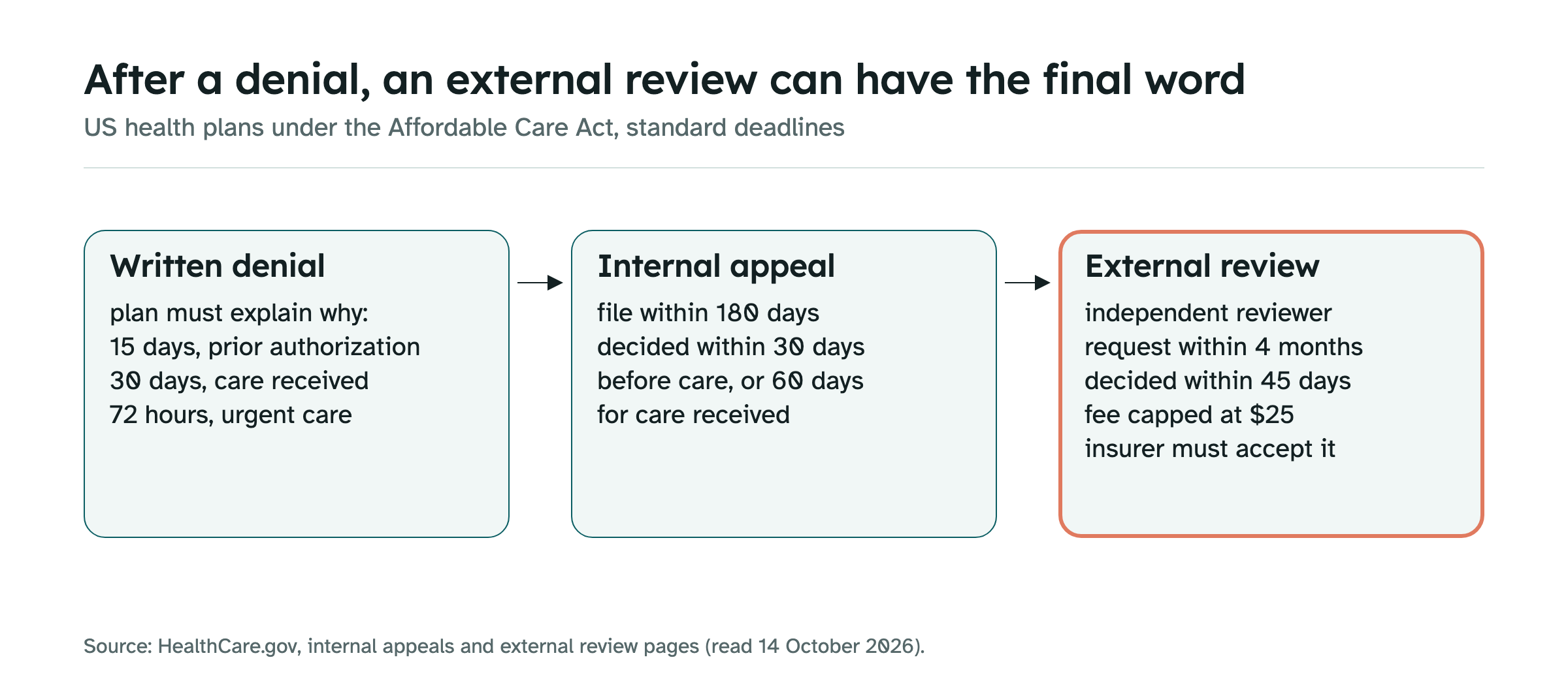
A denial letter is not the end of the process. Under the Affordable Care Act, most US health plans must tell you in writing why a claim was denied and how to appeal, and you have the right to a full and fair review. Your insurer must notify you of a denial within 15 days if you are seeking prior authorization, within 30 days for medical services already received, and within 72 hours for urgent care.[8]
- File your internal appeal within 180 days of the denial notice, attaching anything that supports the medical need, such as a letter from your doctor
- The plan must decide an internal appeal within 30 days for a service you have not yet received, and within 60 days for a service you have already received[8]
- If the internal appeal fails, you can request an external review by an independent organization within 4 months of the final denial
- Standard external reviews are decided within 45 days, expedited reviews within 72 hours; any fee is capped at 25 dollars, and your insurer is legally required to accept the reviewer's decision[9]
You do not have to do this alone. You may appoint a representative, such as your doctor or another medical professional, to file an external review on your behalf, and your state's Consumer Assistance Program or Department of Insurance can help you file either kind of appeal.[9] Keep copies of everything: the denial letter, your appeal, any doctor's letters, and notes from every phone call, with dates and names. If the timeline would seriously jeopardize your life or your ability to function, you can ask for an expedited process rather than waiting for the standard one.[10]
Insurance coverage check
An insurance coverage check comes down to five steps: get the codes, ask four specific questions, get the answer on record, check the formulary and confirm the rules on official sources. The theme running through it is specificity: vague questions get vague answers, and coverage decisions turn on codes and plan rules that you are entitled to know.
- Ask your clinician's office for the exact procedure code and diagnosis code before you call, because coverage answers depend on those codes, not on the everyday name of the treatment
- Call member services and ask four specific questions: is this service covered for this diagnosis, is prior authorization required, is this provider and facility in network, and what will I owe
- Ask for the answer in writing or at least a reference number for the call, so a promise made on the phone can be traced later
- For medications, check your plan's formulary, the official list of covered drugs, rather than relying on a general statement that prescriptions are covered
- Use official sources such as the Marketplace site or Medicare's coverage and sign-up pages rather than informal forums, where rules from other plans or other years are often repeated as if they were universal
One more habit worth forming: re-check before each new plan year. Formularies, networks and coverage rules change, sometimes several times within a single year, as the back-and-forth over GLP-1 coverage in Medicaid programs during 2025 and 2026 shows.[1] An answer that was correct last January may not be correct this January, and Medicare's own sign-up and coverage pages are the right place to confirm the current rules for your situation.
Prior authorization
Prior authorization is approval from a health plan that may be required before you get a service or fill a prescription in order for it to be covered.[11] It is a checkpoint, not a verdict: the plan is asking whether the service is medically necessary under its rules before it agrees to consider payment. Importantly, the request is made by your clinician's office, not by you, though you can and should ask whether one has been submitted and what it said.
- Under the federal claims rules, your plan must respond to a prior authorization request within 15 days, and within 72 hours for urgent care[8]
- If a request is denied, you can appeal it through the internal and external review process described above
- Approval makes payment more likely, but it is not a guarantee: the service still has to be delivered as approved and billed correctly
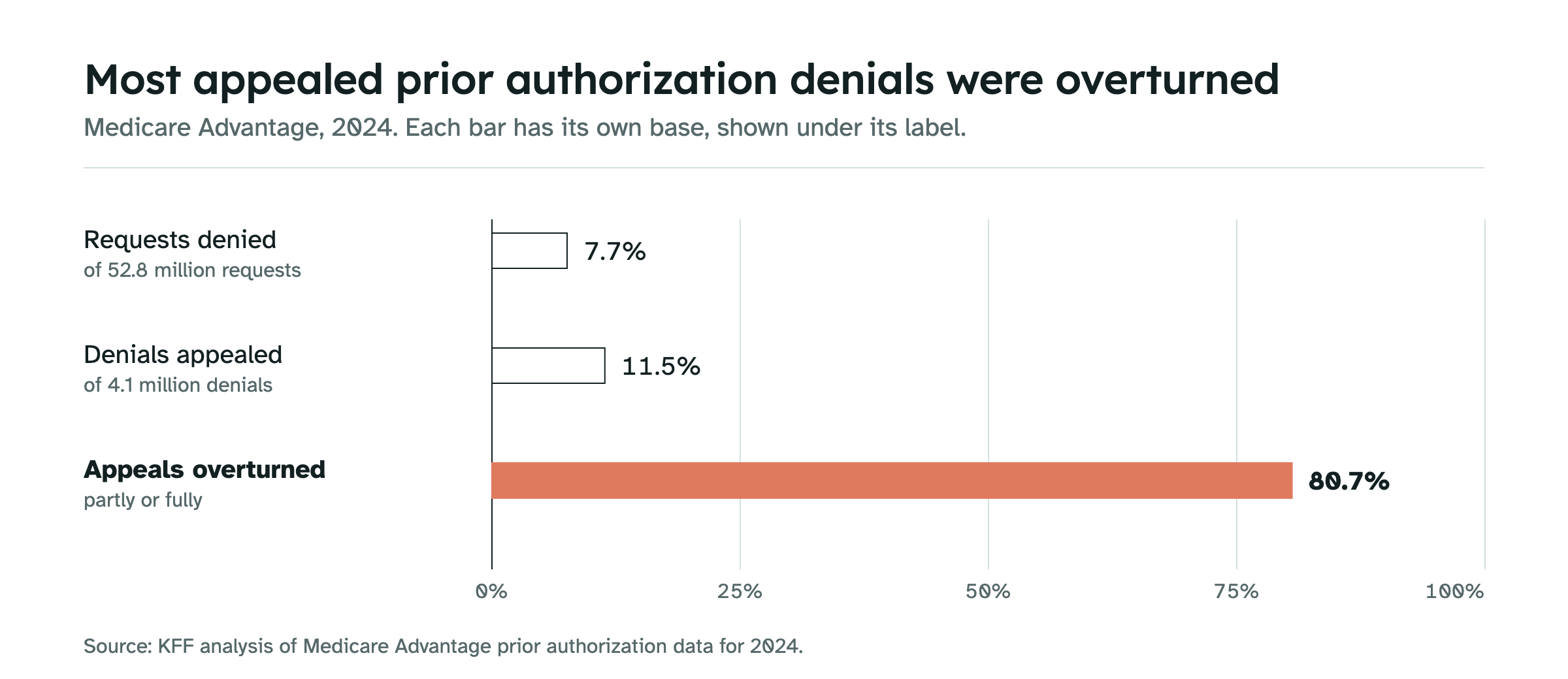
The scale of this system is easy to underestimate. In 2024, nearly 53 million prior authorization requests were submitted to Medicare Advantage insurers on behalf of their enrollees, and insurers denied 4.1 million of them, about 7.7 percent, in full or in part. Only 11.5 percent of those denials were appealed. Yet when patients did appeal, 80.7 percent of the appeals were partially or fully overturned in 2024, a pattern that has held every year since 2019.[12] The reassuring reading of those numbers is also the practical one: a denial is a step in a process, not the final word, and the people who appeal often win.
Next steps: take your questions to a clinician or pharmacist
The checks in this article work best as a short written list you bring to an appointment, not as a memory exercise. Before your next visit or pharmacy pickup, write down five things: the name of the treatment, its procedure or diagnosis codes, whether prior authorization is needed, the expected cost to you, and the appeal contact from your plan documents. A licensed clinician or pharmacist can match the treatment to the documented medical reason, which is often what decides coverage, and a clinician's office is also the right place to start or chase an authorization request.
- Treatment name and its procedure or diagnosis codes
- Whether prior authorization is required, and if so, who has submitted it
- Your expected share of the cost under your current plan year
- The appeal contact and deadline from your plan's denial or coverage letter
The rules described here are specific to the United States. Other countries organize coverage differently, often through national or statutory systems with their own approval pathways, so readers outside the US should check their national health portal or insurer's process rather than applying American timelines and appeal rights. Coverage rules also shift quickly enough that any figure in this article should be confirmed against the current official source before you rely on it.
Frequently asked questions
How can I find out if my insurance covers a treatment before I get it?
Ask your clinician for the exact procedure and diagnosis codes, then call your plan's member services and ask specific questions: is this service covered, is prior authorization required, is this provider and facility in network, and what will you owe. Ask for the answer in writing or a reference number, and re-check before each new plan year because formularies and networks change.
Does insurance cover GLP-1 medications for weight loss?
It varies widely, and the stated reason matters. Medicare is prohibited by law from covering drugs for obesity alone, and only 13 state Medicaid programs covered GLP-1s for obesity treatment as of January 2026, while most large employer plans limit coverage. The same drugs are generally covered for type 2 diabetes, cardiovascular disease and sleep apnea, so a documented medical indication can change the answer.
Why is a diagnostic colonoscopy billed differently from a screening colonoscopy?
A screening colonoscopy is a preventive service: Medicare Part B covers it once every 24, 48 or 120 months depending on risk, at no cost when the provider accepts assignment. If a polyp or tissue is removed, you pay 15 percent of the Medicare-approved amount. A colonoscopy done to investigate symptoms is billed as diagnostic care under ordinary cost-sharing rules rather than as a free preventive service, though a follow-up colonoscopy after a positive stool-based screening test is still covered as screening.
What should I do if my insurance denies coverage?
In the US, your plan must tell you in writing why the claim was denied and how to appeal. Start with an internal appeal, which the plan must decide within 72 hours for urgent care, 30 days for care you have not yet received, or 60 days for care already received. If the internal appeal fails, you can request an external review by an independent organization within 4 months; standard external reviews are decided within 45 days, or within 72 hours when the case is medically urgent, and the insurer is legally required to accept the reviewer's decision. Your doctor can file on your behalf.
Does prior authorization guarantee my treatment will be paid?
No. Prior authorization makes payment more likely but does not guarantee it. In 2024, nearly 53 million prior authorization requests were submitted to Medicare Advantage insurers on behalf of their enrollees, and about 7.7 percent were denied in full or in part.
Can I deduct medical costs my insurance did not cover?
In the US, some costs a plan does not pay may count as deductible medical and dental expenses. IRS Publication 502 (2025) lists which expenses qualify and the rules for including them on a tax return, so check the current-year publication or ask a tax professional before claiming them.
Do these coverage rules apply outside the United States?
No. The rules described here, including appeals rights and Medicare and Marketplace coverage, are specific to the United States. Other countries organize health coverage differently, through national health systems, statutory insurance or private plans with their own verification and appeal procedures, so readers elsewhere should check their national or insurer pathways.