Shingles vaccine: who should get it, side effects and cost
Who the CDC advises to get the Shingrix shingles vaccine, how common its side effects are, how long protection lasts and what two doses cost.
In this article8

Can you get a shingles vaccine at a pharmacist?
Yes, in the United States you can get the shingles vaccine at a pharmacy. The Centers for Disease Control and Prevention (CDC) states that Shingrix is available in doctor's offices and pharmacies. A doctor or pharmacist can give it as a shot in the upper arm.[1] The federal vaccine finder lets you search pharmacies near you by ZIP code.[2]
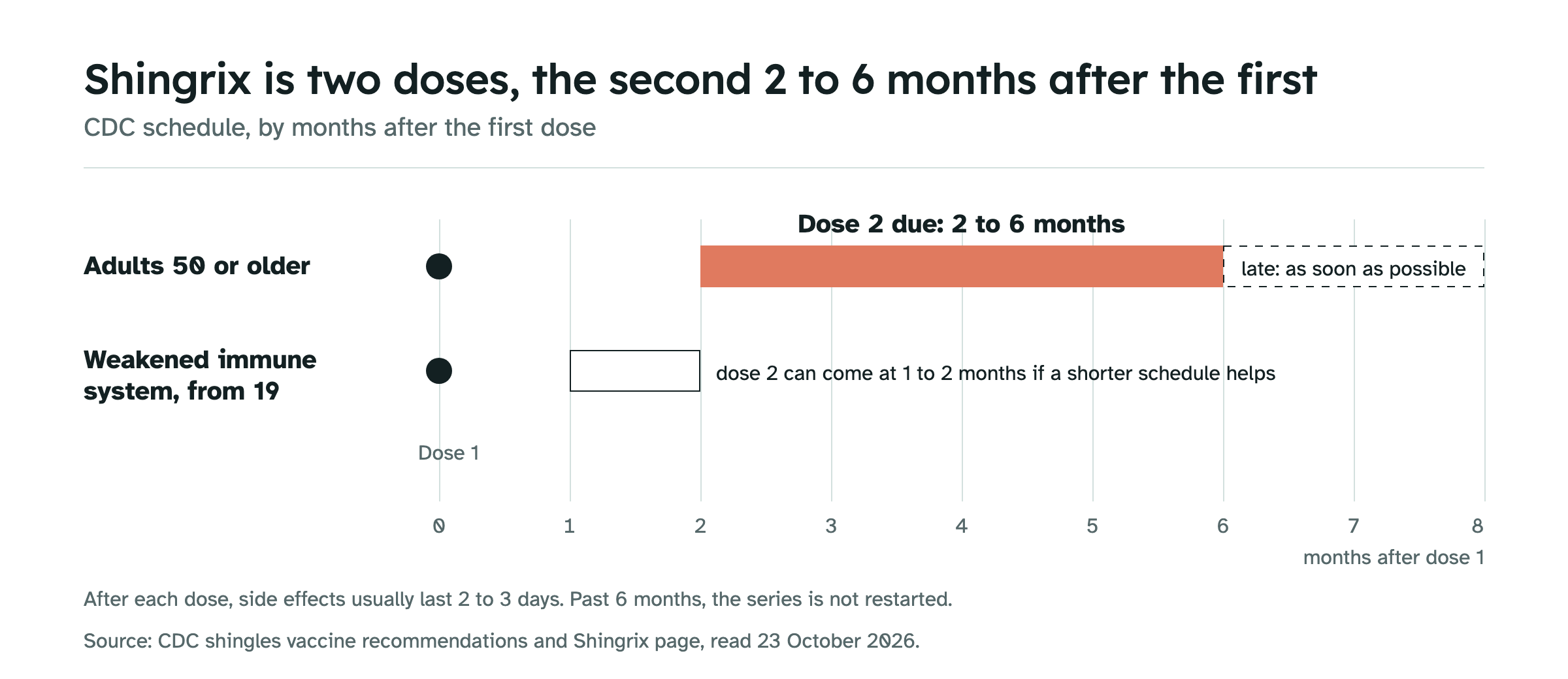
The series is the same wherever you get it: two doses, with the second one due two to six months after the first. If more than six months have passed, the CDC advises giving the second dose as soon as possible rather than starting again.[3] Booking the second appointment when you get the first one makes the gap easier to keep.
For people on Medicare, it matters how the vaccine is billed: it is covered under Part D, the drug benefit, not under Part B.[4] Before the appointment, it helps to check that the pharmacy bills your plan and has both doses in stock.
What are the benefits of the shingles vaccine?
The main benefit of the shingles vaccine is a much lower risk of shingles and of its most common complication, long-lasting nerve pain. About 1 in 3 people in the United States will have shingles in their lifetime, and the risk rises with age, according to the CDC.[1]
That complication is called postherpetic neuralgia (PHN): pain in the area where the rash was, which can last for months or years after the rash has gone. The CDC summarizes the trial results, including 91% protection against PHN in adults 50 or older and 68% to 91% in adults with a weakened immune system:[1]
| Group | Protection against shingles | Protection against PHN |
|---|---|---|
| Healthy adults aged 50 to 69 | 97% | 91% (all adults 50 or older) |
| Healthy adults aged 70 or older | 91% | 89% |
| Adults with a weakened immune system | 68% to 91%, depending on the condition | not stated |
Source: CDC shingles vaccination page, read on 23 October 2026.[1]
A vaccine that is 97% effective does not make shingles impossible. It means that in the trial, vaccinated people had 97% fewer cases than people who got a placebo.[1] A small number of vaccinated people still develop shingles.
How long does shingles vaccine protection last?
Shingles vaccine protection lasts for years. In people aged 70 or older with a healthy immune system, immunity remained high for at least seven years after vaccination, the CDC states.[1]
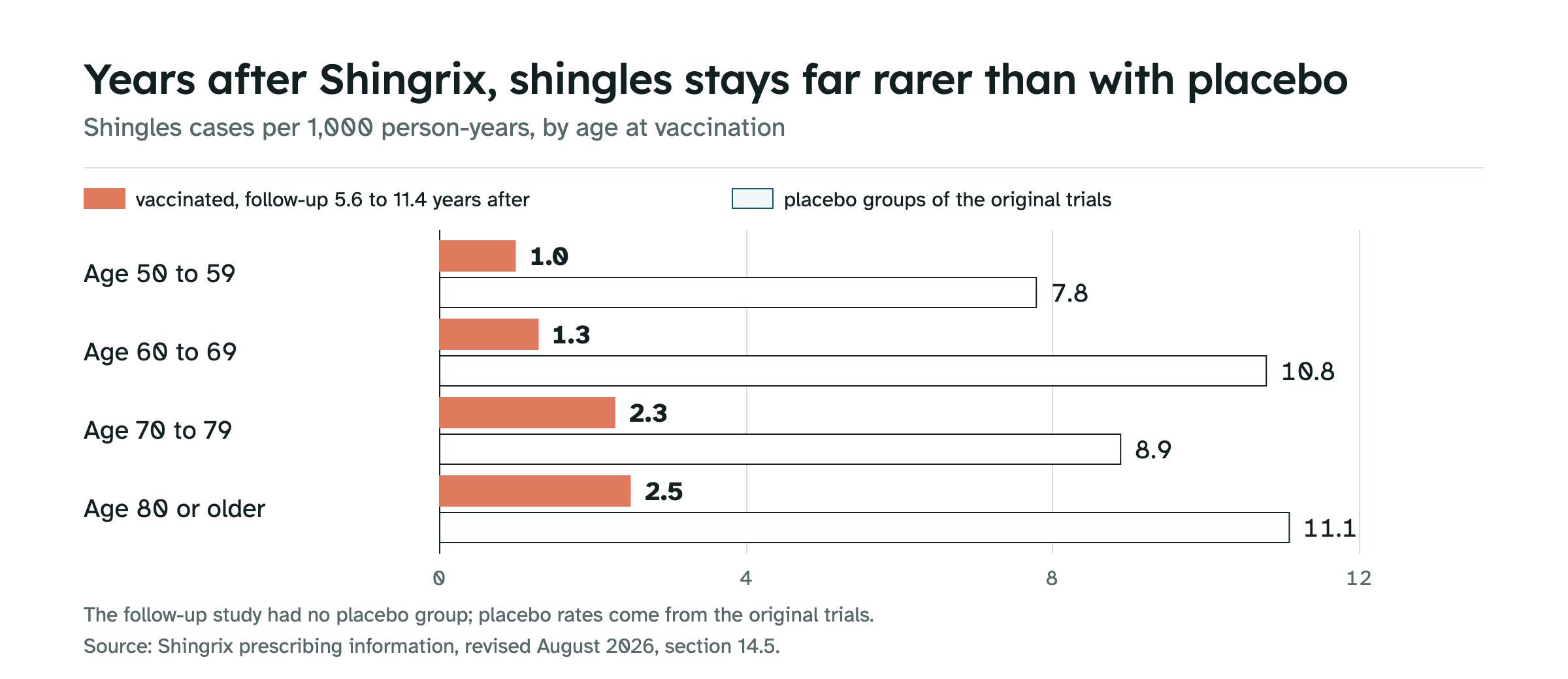
Longer data come from a follow-up study described in the Shingrix prescribing information, revised in August 2026. It followed 7,273 people who had received both doses in the original trials, up to a median of 11.4 years after vaccination.[5] The table compares their shingles rate with the original trials.
| Age at vaccination | Follow-up study, vaccinated | Original trials, vaccinated | Original trials, placebo |
|---|---|---|---|
| 50 to 59 | 1.0 | 0.3 | 7.8 |
| 60 to 69 | 1.3 | 0.3 | 10.8 |
| 70 to 79 | 2.3 | 0.8 | 8.9 |
| 80 or older | 2.5 | 1.0 | 11.1 |
Cases of shingles per 1,000 person-years, from the Shingrix prescribing information, section 14.5.[5]
Two things can be read from these numbers. The rate in the later years is higher than in the first years after vaccination, which suggests that some protection fades over time. But it stays well below the rate in people who were never vaccinated in the trials. The follow-up study had no placebo group of its own, which is why the comparison uses the original trials. The CDC recommendation remains the two-dose series.[3]
Shingrix side effects
Shingrix side effects are common: most people have a sore arm, and many have muscle pain, tiredness or a headache for a few days. The CDC explains that the vaccine causes a strong immune response, and that the side effects usually go away on their own within two to three days.[1] They can keep you from your usual activities for that time, so a quiet day after each dose is worth planning.
The prescribing information lists how often each reaction appeared within seven days of either dose in trial participants aged 50 or older:[5]
| Side effect | Share of people aged 50 or older |
|---|---|
| Pain at the injection site | 78% |
| Muscle pain | 45% |
| Tiredness | 45% |
| Redness at the injection site | 38% |
| Headache | 38% |
| Shivering | 27% |
| Swelling at the injection site | 26% |
| Fever | 21% |
| Stomach or gut symptoms | 17% |
Severe pain means pain at rest that prevents normal everyday activities. Severe pain at the injection site affected 10% of people aged 50 to 59, 7% of those aged 60 to 69 and 4% of those aged 70 or older.[5] Side effects were more common in younger people, and the CDC advises getting the second dose even after a reaction to the first. Over-the-counter painkillers such as ibuprofen or acetaminophen can be used for the discomfort.[1]
One rare risk is Guillain-Barré syndrome (GBS), a serious disorder of the nervous system. The prescribing information reports a study of Medicare beneficiaries aged 65 or older: about 3 extra GBS cases per million doses in the 42 days after vaccination. After the first dose the figure was about 6 per million, and after the second there was no increased risk.[5] The CDC notes that shingles itself also carries a very small increased risk of GBS.[1]
According to the CDC, you should not get Shingrix if you:[1]
- have ever had a severe allergic reaction to a vaccine component or to an earlier Shingrix dose
- currently have shingles
- are pregnant, in which case vaccination waits until after the pregnancy
A cold is no reason to wait, but with a moderate or severe illness the CDC advises waiting until you have recovered. Side effects can be reported to the Vaccine Adverse Event Reporting System (VAERS) at 1-800-822-7967 or on its website.
Shingles vaccine cost
The shingles vaccine has a private-sector list price of $242.67 per dose, or about $485 for both doses, on the CDC Adult Vaccine Price List last updated on 1 October 2026.[6] The manufacturer reports this price to the CDC. The lower CDC contract price of $135.41 per dose applies only to public immunization programs; private providers and individuals cannot buy at it.[6]
What you actually pay depends on how you are covered:
| How you are covered | What you pay for Shingrix |
|---|---|
| Medicare Part D | Nothing: no copayment and no deductible |
| Medicaid | May or may not be covered; ask your insurer |
| Private health insurance | Often covered, but a cost may remain depending on the plan |
| No insurance | The pharmacy's or clinic's own price; the manufacturer, GlaxoSmithKline, may provide the vaccine to eligible adults who cannot afford it |
Sources: Medicare.gov and the CDC shingles vaccination page, read on 23 October 2026.[4][1]
Medicare Part D covers all adult vaccines recommended by the Advisory Committee on Immunization Practices (ACIP) that Part B does not, and charges no copayment or deductible for them.[4] With a private plan, three questions help: is the vaccine covered in full, is the pharmacy or clinic in network, and are both doses billed the same way? Our guide on how to check whether your insurance covers a treatment[7] walks through those questions step by step.
These are US prices. In other countries, cost and access depend on the national health system, and the pharmacy's or clinic's current quote is the reliable reference.
Shingles vaccine age
The shingles vaccine is recommended from age 50 for adults with a healthy immune system. For adults who are or will be immunodeficient or immunosuppressed because of a disease or its treatment, it starts at 19.[3] There is no maximum age.[1] For people with a weakened immune system, the second dose can be given one to two months after the first if a shorter schedule helps.
Several situations do not change the recommendation, according to the CDC:[3]
- You had shingles before. You can still get Shingrix, once the rash has gone; it can help prevent a future episode.
- You had Zostavax. That older vaccine has not been available in the United States since 18 November 2020; Shingrix can follow at least 8 weeks after it.
- You don't remember having chickenpox. No test is needed: more than 99% of adults aged 50 or older worldwide have been exposed to the virus that causes it.[3]
In the US, these recommendations are part of the CDC's adult immunization schedule, which our guide to the adult vaccine schedule[8] covers for every age group. Other countries set their own ages. In England, for example, the NHS offers it to people turning 65, to everyone aged 70 to 79 and to adults from 18 with a severely weakened immune system. For the age groups, the two doses are given 6 to 12 months apart; with a severely weakened immune system, 8 weeks to 6 months apart.[9]
The next step is to take three questions to a licensed clinician or pharmacist. Does my age or health put me in a recommended group? Is there a reason to wait? How will my plan pay for both doses? Our methodology page[10] explains how the sources for pieces like this one are chosen.
Frequently asked questions
Do I need the shingles vaccine if I already had shingles?
Yes. The CDC recommends Shingrix for adults 50 and older whether or not they had shingles before, because shingles can come back. The rash should be gone before the first dose.
Can I get Shingrix at the same time as a flu shot?
The CDC states that Shingrix can be given at the same visit as other adult vaccines, including COVID-19 vaccines, at a different injection site. Giving it together with the adjuvanted flu vaccine Fluad is still being studied.
What happens if I miss the second Shingrix dose?
The series does not start again. If more than six months have passed since the first dose, the CDC advises getting the second dose as soon as possible.
Does Medicare Part B cover the shingles vaccine?
No, the shingles vaccine falls under Medicare Part D. With Part D coverage you pay nothing for it.
Do these recommendations apply outside the United States?
No. They are the US CDC recommendations. Other countries publish their own, with different ages and intervals; the NHS in England, for example, starts at 65.
Sources
Medical disclaimer. The content on Elenra is general information. It is not medical advice, diagnosis or treatment and does not replace a consultation with a doctor or another qualified health professional. Talk to your doctor before you start, change or stop any medication or treatment. In an emergency, call your local emergency number. Medical disclaimer
Related reading
All Prevention →Adult vaccine schedule: which shots adults need and when
The US adult vaccine schedule in force for 2026, by age and situation: flu, Tdap, MMR, HPV, hepatitis B and more, with doses and intervals.

What not to do before a PSA test: sex, cycling and medicines
What not to do before a PSA test: no ejaculation or hard cycling for 2 days, keep taking finasteride and tell your clinician, wait out an infection.