What not to do before a PSA test: sex, cycling and medicines
What not to do before a PSA test: no ejaculation or hard cycling for 2 days, keep taking finasteride and tell your clinician, wait out an infection.
In this article9
- How often should you have a PSA test?
- What not to do before a PSA blood test?
- How do doctors interpret PSA test results?
- How to prepare for a prostate exam?
- What should men not do before a PSA test?
- What should I expect during my first prostate exam?
- Does ejaculating lower your PSA
- Frequently asked questions
- Sources

How often should you have a PSA test?
How often you have a PSA test depends on your last result and on a decision you make with your clinician, not on a fixed yearly rule. The American Cancer Society (ACS) says men who choose screening and have a PSA below 2.5 ng/mL (nanograms per milliliter) may only need a retest every 2 years. Men at 2.5 ng/mL or higher should be screened every year.[1]
Whether to start at all is a separate choice. The US Preventive Services Task Force (USPSTF) calls periodic PSA screening an individual decision for men aged 55 to 69 and recommends against it from age 70.[2] The ACS starts the conversation earlier for men at higher risk. That means age 45 for African American men and for men whose father or brother had prostate cancer before 65.[1]
These are US recommendations. Other countries run their own screening policies, so the interval that applies to you depends on where you are treated.
What not to do before a PSA blood test?
Before a PSA blood test, do not ejaculate, do not do hard exercise such as a long bike ride, and do not stop a medicine without asking. Each of these can move the number for reasons unrelated to the prostate's health. A falsely high result can lead to more tests than you need.
PSA, short for prostate-specific antigen, is a protein made by the prostate that the test measures in the blood. MedlinePlus explains that releasing semen can increase PSA levels and make the result less accurate.[3] The National Cancer Institute (NCI) names vigorous exercise, such as cycling, alongside ejaculation as causes of a short-lived rise.[4]
| Before the test | What it does to PSA | What to do |
|---|---|---|
| Ejaculation (sex or masturbation) | Brief rise | Avoid for 24 hours (MedlinePlus) to 2 days (NCI) |
| Vigorous exercise such as cycling | Brief rise | Avoid for about 2 days |
| Prostate infection or inflammation | Raised for a month or two | Test after it has resolved |
| Recent prostate biopsy | Raised for a month or two | Ask when to retest |
| Finasteride or dutasteride | Lowers PSA | Tell the clinician; keep taking it |
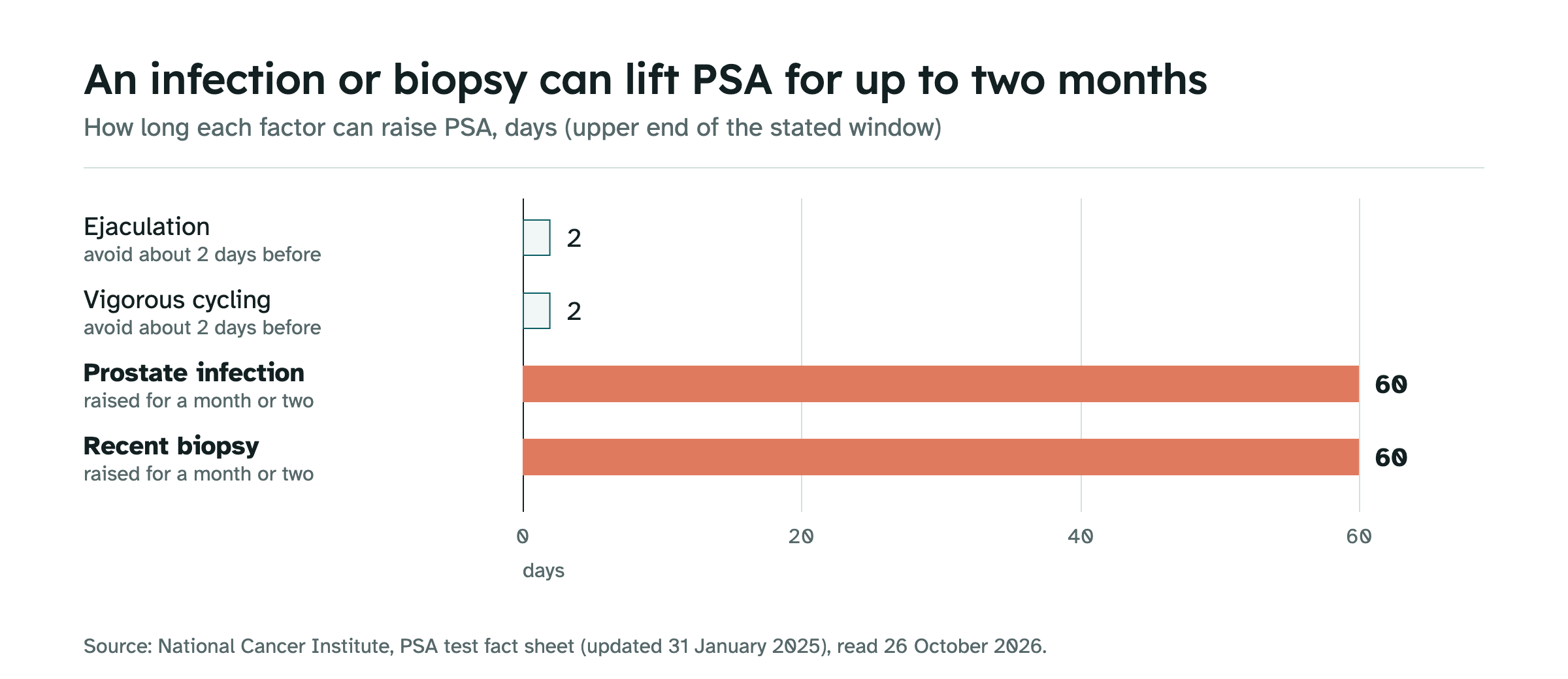
Sources: MedlinePlus and the NCI PSA fact sheet, read 26 October 2026. The two bodies give different abstinence windows; 2 days covers both.
How do doctors interpret PSA test results?
Doctors read a PSA result as a signal to weigh, not as a diagnosis. According to the NCI, a level above 4.0 ng/mL is generally considered abnormal, although some doctors use a higher cutoff such as 5 ng/mL for older men and a lower one such as 2.5 ng/mL for younger men.[4]
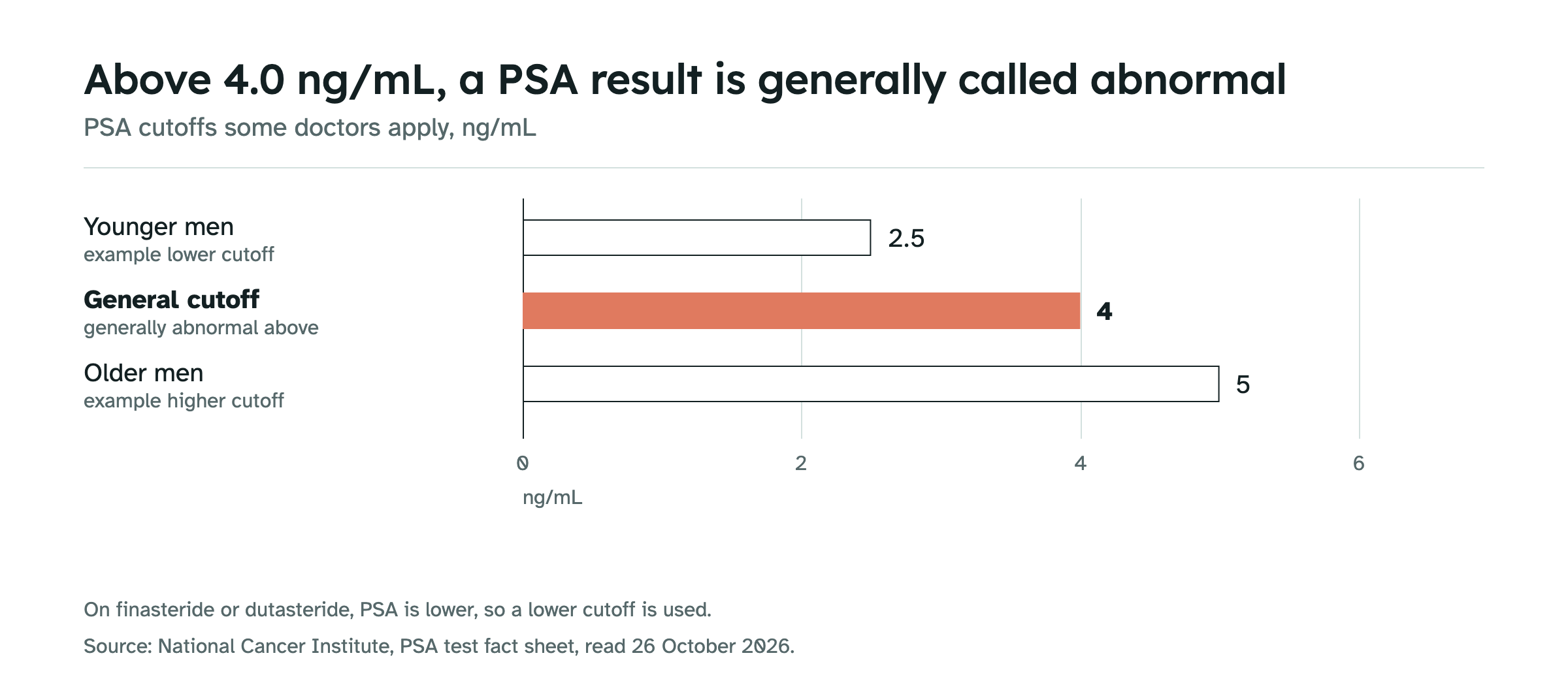
The same NCI fact sheet notes that men taking finasteride or dutasteride are judged against a lower cutoff, because these drugs lower PSA. MedlinePlus lists finasteride for an enlarged prostate (benign prostatic hyperplasia, BPH) and male pattern hair loss, and dutasteride for BPH.[5][6] A man on either drug whose PSA looks normal may still need a closer look, which is why the clinician needs your full medicine list.
A high reading has many possible causes. MedlinePlus lists BPH, prostatitis, urinary tract infections and certain medicines next to prostate cancer, and states that the test itself cannot tell which one is behind the number.[3] What a raised value means at your age and what comes next is covered in Elenra's men's health guides.
How to prepare for a prostate exam?
To prepare for a prostate exam, plan the timing and bring information rather than changing anything about your body. A screening visit can include two checks: the PSA blood test and, in some cases, a digital rectal exam (DRE). The ACS notes that a DRE may be done as part of screening, while the PSA test is the main one.[1]
- Book the blood draw for a day after at least 2 days without ejaculation or a long, hard bike ride.
- Write down every medicine and supplement you take, including finasteride, dutasteride and hair-loss treatments.
- Note any recent urinary infection, prostate infection, catheter or biopsy, with dates.
- Write down earlier PSA results with their dates, if you have them.
- List questions about what you would do with a high result, because that choice shapes whether screening fits you.
If other blood work is drawn at the same visit, its own rules still apply. A testosterone test, for example, depends on the time of day, as the guide to testosterone blood test timing explains.
What should men not do before a PSA test?
Men should not stop or skip a prescribed medicine before a PSA test unless the prescriber says so. MedlinePlus is explicit on this point: tell your provider about the medicines you take, but do not stop taking any of them unless your provider tells you to.[3] Pausing finasteride or dutasteride would not give a "cleaner" result; it would change the baseline the clinician is used to reading.
Do not test in the middle of a prostate or urinary infection either. The NCI notes that infection or inflammation of the prostate, or a recent biopsy, can keep PSA raised for a month or two, and that testing generally waits until such conditions have resolved.[4] A result taken during that window is hard to interpret and is often repeated anyway.
What should I expect during my first prostate exam?
During a first prostate screening visit, expect a conversation, a routine blood draw and, possibly, a short physical exam. For the blood test, MedlinePlus describes a needle draw from a vein in the arm that usually takes less than five minutes, with little risk beyond slight pain or bruising.[3]
If a DRE is part of the visit, the clinician inserts a gloved, lubricated finger into the lower rectum to feel the prostate for lumps or enlargement, as the NCI describes it.[7] It is brief, and you can ask the clinician to explain each step before it starts.
The conversation matters as much as the tests. The USPSTF asks clinicians to discuss the potential benefits and harms of screening before men decide.[2] MedlinePlus lists those harms plainly: a high PSA can lead to a biopsy with risks such as bleeding, infection or difficulty urinating, and to finding cancers that would never have affected your health.[3] If cost is part of your decision, Elenra explains how to check whether your insurance covers a test or treatment.
Does ejaculating lower your PSA
No, ejaculating does not lower your PSA; it can raise it for a short time. MedlinePlus states that releasing semen can increase PSA levels, and the NCI lists ejaculation among the causes of a transient rise.[3][4] The effect is the reason for the abstinence window before the test, not a way to change a result.
A slightly high reading after recent ejaculation is therefore a reason to repeat the test, not to panic. The NCI notes that after an abnormal result in a man without symptoms, the doctor may recommend another PSA test in 6 to 8 weeks to confirm the finding.[4] Take your list of medicines, recent infections and timing to a licensed clinician, who can decide whether a retest makes sense.
Frequently asked questions
How long should you avoid ejaculation before a PSA test?
MedlinePlus advises 24 hours without sex or masturbation, and the National Cancer Institute suggests avoiding PSA-raising activities for 2 days. Waiting 2 days covers both.
Can I exercise before a PSA test?
Light activity is not named as a problem, but the National Cancer Institute says vigorous exercise such as cycling can raise PSA for a short time. Skipping hard rides for about 2 days before the draw avoids that.
Do I need to fast before a PSA test?
Neither MedlinePlus nor the National Cancer Institute lists fasting as part of PSA test preparation. If other blood tests are drawn at the same time, ask whether those need fasting.
Should I stop finasteride before a PSA test?
No. Keep taking it unless your prescriber says otherwise, and make sure the clinician reading the result knows you take it, because finasteride lowers PSA.
Sources
Medical disclaimer. The content on Elenra is general information. It is not medical advice, diagnosis or treatment and does not replace a consultation with a doctor or another qualified health professional. Talk to your doctor before you start, change or stop any medication or treatment. In an emergency, call your local emergency number. Medical disclaimer
Related reading
All Prevention →Shingles vaccine: who should get it, side effects and cost
Who the CDC advises to get the Shingrix shingles vaccine, how common its side effects are, how long protection lasts and what two doses cost.

Adult vaccine schedule: which shots adults need and when
The US adult vaccine schedule in force for 2026, by age and situation: flu, Tdap, MMR, HPV, hepatitis B and more, with doses and intervals.