Testosterone blood test: cost, time of day and which value counts
Testosterone blood test cost without insurance ($16 to $75 cash, Sept 2026), the best time to draw, result times, and total vs free testosterone.
Contents
What does testosterone test for?
A testosterone test measures how much of the hormone testosterone is present in a blood sample. Testosterone is often thought of as a male sex hormone, but it occurs in both sexes, in women in much smaller amounts. In everyone, it influences sex drive and supports the building and maintenance of muscle and bone. In men, it additionally controls, among other things, the growth of body hair, the production of sperm and the formation of new red blood cells.[1]
- Sexual desire (libido) in women and men
- Building and maintaining muscle mass and bone density
- In men: production of sperm and formation of new red blood cells
- In men: growth of body hair and deepening of the voice during puberty[1]
In practice, total testosterone is usually measured. It covers all forms of the hormone in the blood, both the portion bound to proteins and the free portion. In addition, there are tests for free testosterone and bioavailable testosterone. Both are ordered less often, but they can give a clearer picture for certain medical questions.[1]
| Test type | What it measures | How common it is |
|---|---|---|
| Total testosterone | bound and free testosterone together | the most common type of test[1] |
| Free testosterone | only the unbound, immediately active portion | less common, may help diagnose certain conditions[1] |
| Bioavailable testosterone | free testosterone plus the portion loosely bound to proteins other than SHBG | not commonly done[1] |
A single lab value does not by itself indicate a medical condition. Reference ranges differ from lab to lab because different measurement methods are used, and even healthy people sometimes have values outside the range. Only together with symptoms, additional values and further examinations does a clear picture emerge, which a clinician can interpret with you.
How much does a low testosterone test cost?
A testosterone blood test without insurance costs between $16 and $75 for a single test in the United States. That is the cash price at direct-to-consumer lab providers, where the clinician's order is usually included; the figures come from the price comparison by Blood Test Comparison, last updated on 1 September 2026. It gets considerably more expensive when the same test runs through a hospital lab: billed amounts there can reach $150 to $700[2].
| Provider or setting | Cash price | Notes |
|---|---|---|
| Mito Health | $16 to $21[2] | blood draw included |
| DrSays (LabCorp network) | around $21[2] | draw fee included |
| Marek Diagnostics | around $42[2] | direct provider |
| Ulta Lab Tests | around $43[2] | direct provider |
| Quest Diagnostics | $75[2] | large US lab |
| Hospital lab | $150 to $700[2] | billed amount, not a fixed price |
Such direct tests can be ordered online without seeing a clinician first: the clinician's order is included in the single-test price, and the blood is drawn at a lab or partner facility. If the test runs through insurance instead, it is usually covered when a clinician orders it because of symptoms or a known condition; the negotiated in-network price then typically falls around $25 to $50. If you want to check with your insurer beforehand, you can mention billing code CPT 84403[2]. Our insurance guides explain how deductibles and coinsurance change what you pay.
- Single test or bundle: bundles that include testosterone alongside dozens of other markers cost $99 to $499 in total[2]
- Draw fee: some providers list a low test price and bill the blood draw separately[2]
- Setting: independent labs and direct providers are much cheaper than hospital labs[2]
- Cash or insurance: the cash price without insurance is often lower than the out-of-pocket amount that remains through insurance[2]
These figures come from the United States, where lab tests are frequently billed as direct cash-pay services. In other countries, costs and coverage depend on the respective health system. Prices also change frequently; the provider's current quote before booking is always the reliable reference.
How long do testosterone tests take?
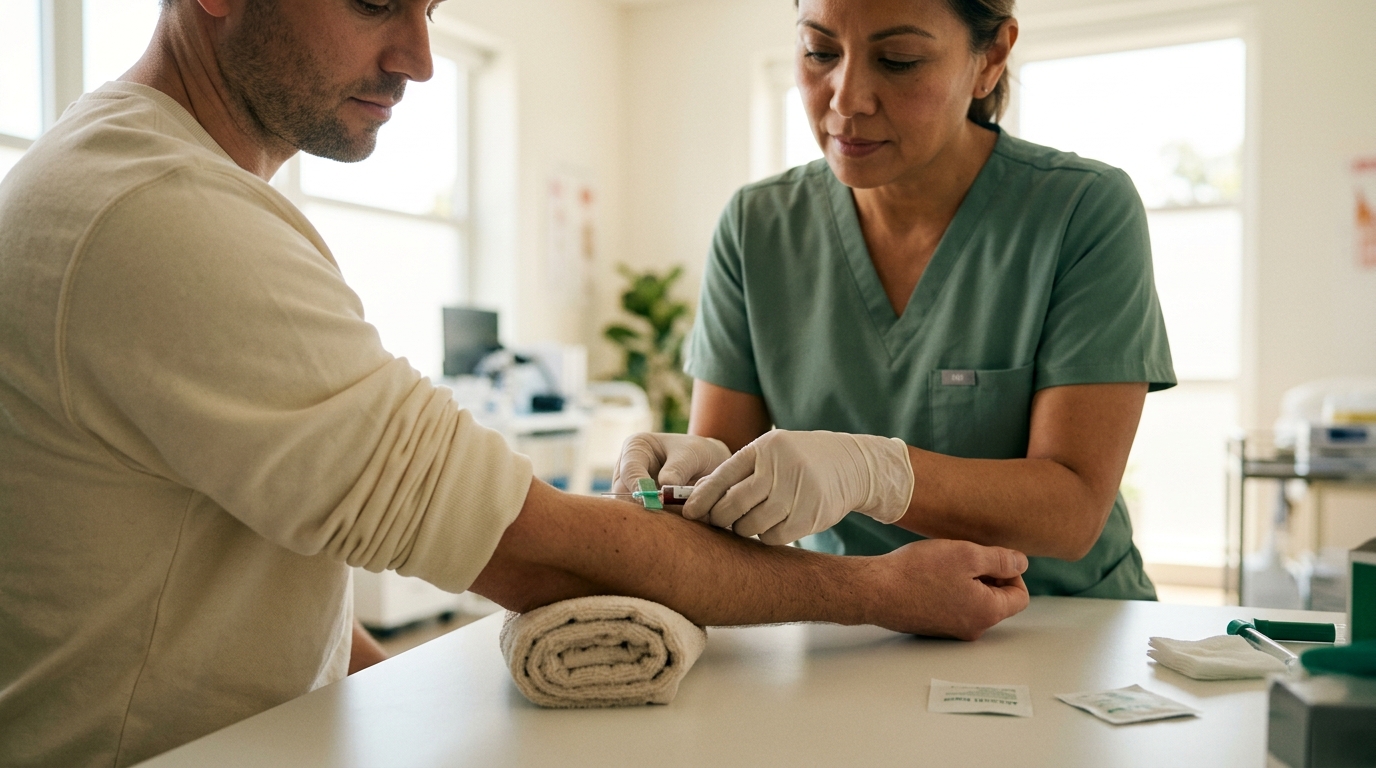
A testosterone test takes less than five minutes for the blood draw itself. In a medical facility, a professional takes the sample from a vein in your arm with a small needle, and you may feel a slight sting. The appointment should be in the morning, between 7 and 10 AM: testosterone levels are typically at their highest at that time, so values are comparable[1].
- Book an appointment, ideally between 7 and 10 AM
- Check in at the lab, with a photo ID and, if applicable, the test order
- A band around the upper arm makes the vein easier to see
- The needle is inserted briefly and a small amount of blood flows into a tube
- You may feel a slight sting when the needle goes in or out; afterwards the draw is complete and you can leave[1]
The result typically arrives within one to five business days, depending on the lab and measurement method. Immunoassays, the most common method, are often finished within one to three business days. The more precise mass spectrometry (LC-MS/MS), which the Endocrine Society recommends especially for women and very low levels, may take slightly longer[3].
| Measurement method | Typical time to result |
|---|---|
| Immunoassay, the most common method | 1 to 3 business days |
| Liquid chromatography-tandem mass spectrometry (LC-MS/MS) | usually somewhat longer than immunoassay |
| Total time, depending on lab and method | one to five business days[3] |
For some questions there are also at-home tests, in which you collect a blood or saliva sample yourself and mail it to a lab. Talk to your clinician beforehand about whether such a test fits your situation, and follow the instructions for collecting the sample and returning the kit exactly, so the result remains usable.[1]
Is it worth getting a testosterone test?
A test is worth it when there is a concrete reason, not as a routine check when you feel fine. The American Urological Association (AUA) recommends measuring total testosterone in men with matching symptoms or signs. For a diagnosis of testosterone deficiency, the guideline strictly requires two separate measurements on different days, each in the early morning, both below 300 nanograms per deciliter (ng/dL). In addition, symptoms or signs must be present: a low value alone is not enough for the diagnosis.[4]
- Persistent symptoms such as unexplained exhaustion, declining sexual desire or erectile dysfunction
- Bone loss or anemia without an identifiable cause
- Diabetes, long-term use of opioids or corticosteroids
- Unfulfilled desire for children in men, or a pituitary gland disorder
- Monitoring during ongoing testosterone treatment, there every 6 to 12 months[4]
The distinction matters because the typical complaints are unspecific: chronic fatigue, ongoing stress or a depressive mood can produce the same symptoms. The AUA guideline cites estimates that up to a third of men who receive testosterone do not meet the diagnostic criteria, and that up to 25 percent were not tested before treatment started[5]. A measurement before any treatment is therefore the crucial step, so that therapy only begins with a justified indication.
In women, the test is mostly used for signs of too much testosterone, such as increased body hair or menstrual irregularities. A morning draw keeps values comparable here too; your clinician can say whether the timing in your cycle matters for your question.
Can you fail a drug test for testosterone?
No. According to the drug-testing provider American Screening, standard workplace drug tests, such as the widespread 5- or 10-panel tests, screen for drug categories like cannabis, cocaine, opioids, amphetamines and phencyclidine. Anabolic steroids and testosterone are not part of that standard panel; detecting them requires a separate, more elaborate laboratory analysis using mass spectrometry. A negative drug test therefore says nothing about whether someone has taken steroids.[6]
Competitive sport is different: anti-doping controls exploit the fact that testosterone is a hormone the body produces itself. Instead of merely checking for its presence, the labs compare the ratio of testosterone to epitestosterone in the urine, a closely related steroid the body produces in a roughly fixed proportion. Anti-doping labs use a ratio above 4 as the trigger for a confirmation test, not as a positive result on its own. Supplied testosterone suppresses the body's own epitestosterone via the natural feedback loop and pushes the ratio up.[6][7]
- Sports federations and anti-doping programs in Olympic, college and professional sport
- Military facilities, though there usually only on concrete suspicion and with a separate sample
- Some police departments and training academies
- A narrow circle of safety-critical employers with their own testing programs[6]
Two caveats. First, an elevated ratio alone is not proof, only the trigger for a confirmation analysis, such as isotope-ratio mass spectrometry, which distinguishes the body's own testosterone from supplied testosterone. Second, a medically prescribed testosterone treatment is something different from unauthorized use; confirmed findings in testing programs generally go through a medical review first before any consequences follow.[6]
Is total testosterone a good test?
Total testosterone is a good first test, but it has a methodological limit: around 98 percent of the hormone in the blood is bound to proteins. According to the AUA guideline, roughly half is loosely bound to albumin and about 44 percent is firmly bound to sex hormone-binding globulin (SHBG); only about 2 percent circulates freely. Only the free portion can act directly on cells; the bound portion is barely available to the body[4].
For most people, total testosterone is a reliable baseline, and it is the standard test labs offer most often. It gets tricky when the SHBG level is strongly altered: if SHBG binds a lot, the free portion drops even though total testosterone looks normal. Conversely, the free portion can be elevated without the total value standing out. In those situations, free testosterone gives the clearer picture.
SHBG levels shift with age, obesity, liver disease and thyroid disorders, and any of these can make total testosterone a poor stand-in for how much hormone the body can actually use[3].
Testosterone measurements also vary by method. The AUA notes that a value of 250 ng/dL counts as low by the guideline but may be flagged as normal by the lab, because the lab's reference range is based on a population sample. With such a discrepancy, the guideline recommends relying on the absolute value. For very low levels, such as in women, mass spectrometry is considered the more accurate method than the widespread immunoassay.[4]
What are the symptoms of high free testosterone?
Symptoms of high free testosterone include extra body or facial hair, male-pattern hair loss, acne, irregular periods and voice changes[1]. High testosterone is more common than low testosterone in women, which is why the test is mostly used for that purpose in them[3].
- Increased body or facial hair growth
- Hair loss on the head following the pattern of male-pattern baldness
- Persistent acne
- Irregular or absent menstrual periods
- Voice changes
- Infertility (difficulty getting pregnant)[1]
In women, a common cause is polycystic ovary syndrome (PCOS), a hormonal disorder in which the ovaries produce more androgens; the World Health Organization estimates that it affects 8 to 13 percent of women of reproductive age[3]. Other causes of high values include ovarian cancer or other ovarian problems, adrenal gland disorders such as congenital adrenal hyperplasia (CAH) and pituitary gland disorders[1].
In men, very high values are less common and should be checked by a clinician. Possible causes include steroid use, a tumor in the testicles or an adrenal gland disorder such as congenital adrenal hyperplasia[1].
An elevated lab value alone is not a diagnosis. Changed values can have serious causes but also temporary or harmless ones, so an unusual result belongs with a clinician, who can clarify the cause with further tests; treatment then follows the underlying condition, not the single value. As a next step, take your symptoms, the time of the blood draw and your results as a list to a licensed clinician or pharmacist and go through them together. Related Elenra guides cover lab test panels and kits, reading your lab results and testosterone in men's health.
Frequently asked questions
Do you need to fast for a testosterone blood test?
Usually not. Fasting is not required for routine testosterone testing; follow the lab's or your clinician's instructions if they ask for a fasting draw.
What time of day is best for a testosterone test?
Between 7 and 10 AM. Testosterone levels are typically at their highest in those hours, which keeps results comparable between draws.
What is the difference between total and free testosterone?
Total testosterone counts all testosterone in the blood, including the large share bound to proteins such as SHBG. Free testosterone is the unbound part, about 2 percent, which the body can use directly.
How much does a testosterone test cost without insurance?
About $16 to $75 for a standalone test at direct-to-consumer labs, as of September 2026. Hospital labs can bill $150 to $700 for the same test.
Is one low testosterone result enough for a diagnosis?
No. The AUA guideline requires two separate early-morning measurements below 300 ng/dL, combined with symptoms or signs, before testosterone deficiency is diagnosed.