How much does Medicare Part B cost in 2026?
Medicare Part B costs $202.90 a month in 2026, plus a $283 deductible and 20% coinsurance. See the IRMAA brackets up to $689.90 and the late-penalty math.
Contents
How much should Medicare Part B cost per month?
In 2026, Medicare Part B should cost $202.90 per month for most people. That is the standard premium the Centers for Medicare & Medicaid Services (CMS) announced on November 14, 2025, an increase of $17.90 from $185.00 in 2025.[1] CMS estimates that the income-related surcharges affect only about 8% of people with Part B, so most enrollees pay the standard amount.[1]
Part B is the medical insurance half of Original Medicare. It covers physicians' services, outpatient hospital care, certain home health services, durable medical equipment, and other medical services that Part A (hospital insurance) does not cover.[1] The premium is due every month, even in months when you use no Part B services.[2] Medicare is US federal health insurance for people 65 or older who meet citizenship or residency requirements, with earlier eligibility for some people with disabilities, End-Stage Renal Disease or ALS, so these dollar amounts describe US rules only.[3]
Premium, deductible and coinsurance amounts are reset every year, so the 2026 figures are the current reference point, not a permanent price. The table shows how the two core amounts changed from 2025 to 2026.
How much does Part B Medicare cost per month?
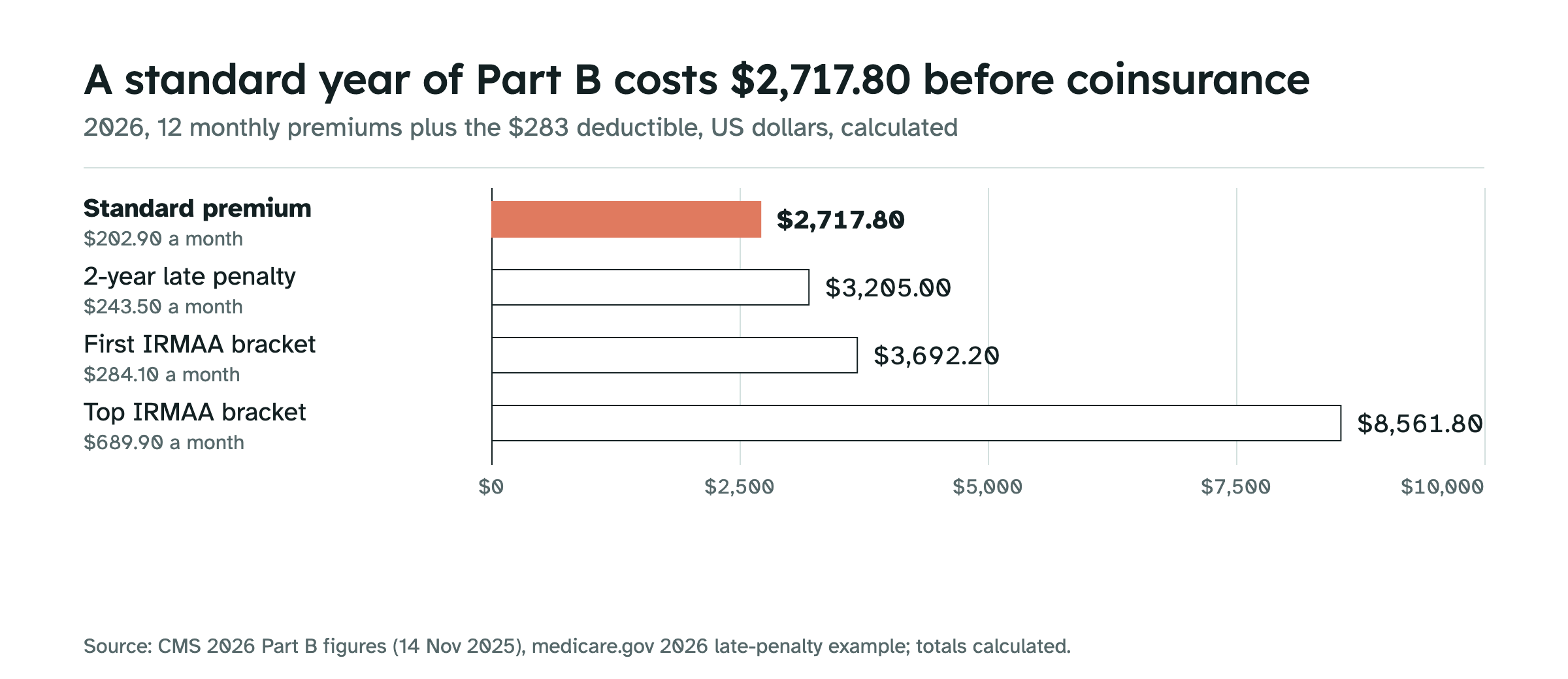
In practice, Part B costs the $202.90 monthly premium plus what you pay for the care you use: an annual deductible and, after it, coinsurance on each covered service.[2] As a formula for a year at the standard rate: yearly Part B cost = 12 × $202.90 premium + $283 deductible + 20% of the Medicare-approved amount for covered services after the deductible. The fixed part alone is $2,717.80 a year, about $226 a month, before any coinsurance.
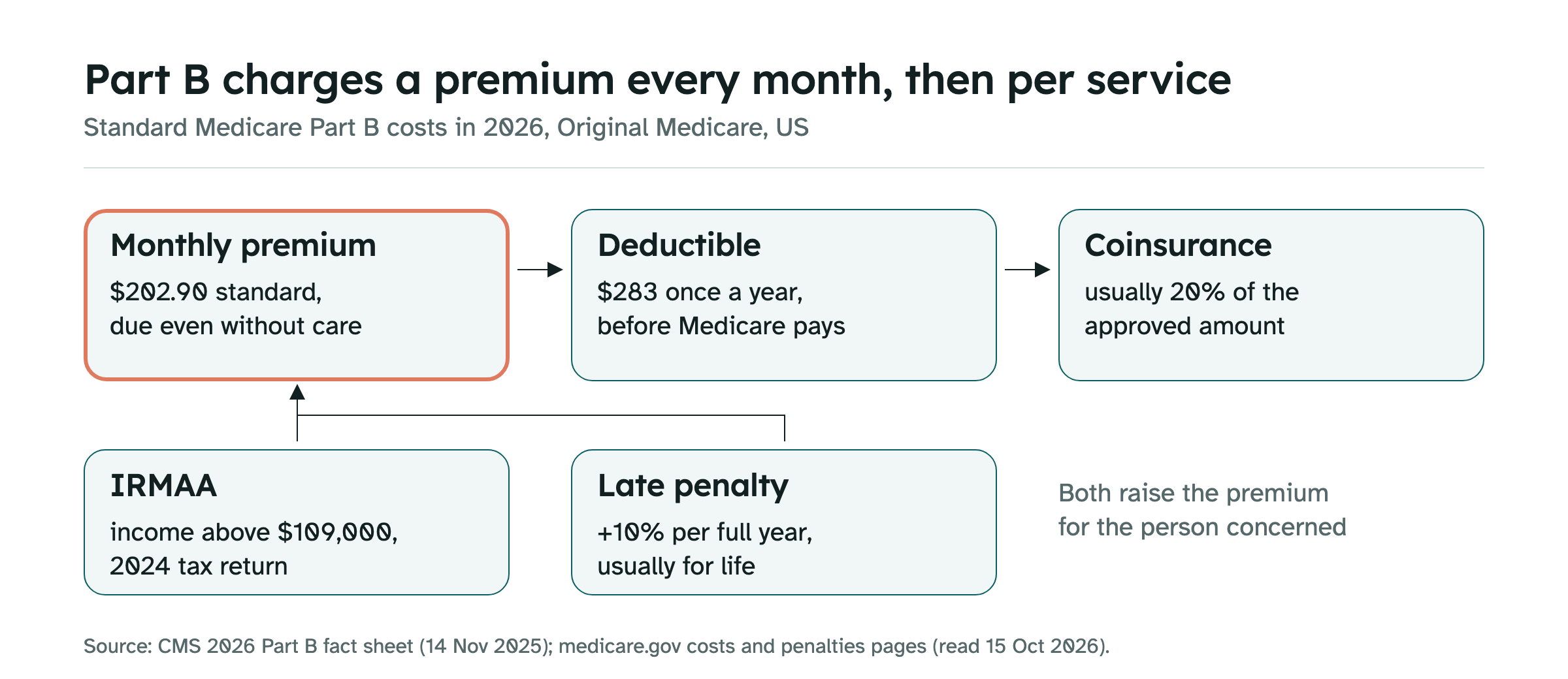
- Annual deductible: $283 in 2026, an increase of $26 from $257 in 2025. You pay this amount once each year before Original Medicare starts to pay.[1]
- Coinsurance: after you meet the deductible, you usually pay 20% of the Medicare-approved amount for each covered service or item, as long as your provider accepts the approved amount as full payment.[2]
- Telehealth example: Part B covers certain telehealth services, and after the deductible you pay 20% of the Medicare-approved amount, generally the same as you would for the same visit in person.[4]
What you owe for a specific service also depends on factors Medicare lists: whether you have other insurance, how much your doctor charges, whether the doctor accepts assignment, the type of facility, and where you receive the service.[4] For covered clinical laboratory services, you pay nothing, and there is no yearly limit on out-of-pocket spending in Original Medicare unless you have supplemental coverage such as a Medigap policy or a Medicare Advantage plan.[2]
Medicare Part B premium 2026
The 2026 Part B premium is $202.90 a month, and the standard deductible is $283, both set under provisions of the Social Security Act, the federal law that governs Medicare financing.[1] CMS attributes the increase mainly to projected price changes and assumed utilization increases consistent with historical experience. It also states that, without action on spending for skin substitutes (products used to treat certain wounds), the premium would have risen about $11 more per month; changes in the 2026 Physician Fee Schedule are expected to cut that spending by 90% without affecting patient care.[1]
One group pays a different standard amount. Since 2023, people whose full Medicare coverage ended 36 months after a kidney transplant, and who do not have certain other insurance, can elect to keep Part B coverage limited to immunosuppressive drugs by paying a premium. For 2026, that standard immunosuppressive drug premium is $121.60 per month.[1]
A late sign-up is the other way the premium itself goes up, and unlike IRMAA it does not reset each year.[5]
- The penalty is an extra 10% for each full 12-month period you could have signed up for Part B but did not.[5]
- It is not a one-time late fee. It is usually charged for as long as you have Part B, which for most people means for life.[5]
- Generally, you will not pay the penalty if you qualify for a Special Enrollment Period or enroll in a Medicare Savings Program.[5]
Medicare's own 2026 example shows the effect: someone who waited two full years (24 months) to sign up, without a Special Enrollment Period, pays a 20% penalty. That adds $40.58 to the standard $202.90, giving $243.48, which Medicare rounds to the nearest 10 cents, so the monthly premium is $243.50 for 2026 and the penalty continues for as long as the person has Part B.[5] That is a reason to check your enrollment window early.
Medicare Part B coverage
Medicare Part B coverage has two broad parts: medically necessary services to diagnose or treat a condition, and preventive services. For many preventive services, including the yearly wellness visit, you pay nothing when the provider accepts assignment.[6]
Covered services include physician and outpatient hospital services, durable medical equipment such as wheelchairs and walkers, and a range of telehealth services. Through December 31, 2027, Medicare covers telehealth you can get from anywhere in the United States, including your home. Medicare's examples include outpatient psychotherapy, depression screenings, cardiac and pulmonary rehabilitation, cognitive assessments, diabetes self-management training, medical nutrition therapy, advance care planning and caregiver training services.[4]
- Covered: medically necessary doctors' services, outpatient care, some home health services, durable medical equipment, and many preventive services.[7]
- Covered with cost sharing: telehealth visits, usually 20% of the approved amount after the deductible.[4]
- Not covered by Original Medicare: hearing aids and exams for fitting hearing aids, under both Part A and Part B. You pay all costs for these, though some Medicare Advantage plans offer extra hearing benefits.[8]
Medicare Advantage plans must offer at least the same coverage as Original Medicare, and some add vision, hearing or dental benefits that Original Medicare does not include.[8] How the two routes compare on cost and coverage is covered in Medicare Part B vs Medicare Advantage.
IRMAA
IRMAA, the income-related monthly adjustment amount, is a surcharge on the Part B premium for higher incomes. In 2026 it applies above $109,000 of modified adjusted gross income for individual filers or $218,000 for joint filers, and it raises the total monthly premium to between $284.10 and $689.90.[1] Part B premiums have been income-based since 2007, and CMS estimates the surcharge affects roughly 8% of people with Part B.[1]
The 2026 IRMAA brackets are set by the tax return from two years earlier, which generally means the 2024 return. The table shows the total monthly premium for each bracket.[1]
| Individual income (modified adjusted gross income) | Joint income | Total monthly Part B premium 2026 |
|---|---|---|
| Up to $109,000[1] | Up to $218,000[1] | $202.90[1] |
| Over $109,000 to $137,000[1] | Over $218,000 to $274,000[1] | $284.10[1] |
| Over $137,000 to $171,000[1] | Over $274,000 to $342,000[1] | $405.80[1] |
| Over $171,000 to $205,000[1] | Over $342,000 to $410,000[1] | $527.50[1] |
| Over $205,000 to under $500,000[1] | Over $410,000 to under $750,000[1] | $649.20[1] |
| $500,000 or more[1] | $750,000 or more[1] | $689.90[1] |
Married people who lived with their spouse at any time during the year but file separate returns face a steeper scale: the total premium is $649.20 a month above $109,000 and below $391,000 of income, and $689.90 at $391,000 or more.[1]
If your income has dropped because of a life-changing event, the surcharge may not reflect your current situation. Events the Social Security Administration names include marriage, divorce, the death of a spouse, and loss of income. You can ask Social Security to reconsider using Form SSA-44 (Medicare Income-Related Monthly Adjustment Amount – Life-Changing Event), and you can contact the agency if you disagree with a determination.[9]
- Confirm your own premium and surcharge with the Social Security Administration, which determines the exact amount each person pays.[1]
- Check current-year figures and coverage details on medicare.gov, the official CMS site, since amounts are reset annually.[2]
- For individual questions about enrollment, penalties or IRMAA, contact the Social Security Administration or a State Health Insurance Assistance Program, which offers free counseling in each US state.[3]
This article explains the published rules and figures; it cannot assess an individual situation and is not personal advice. For decisions about your own coverage, take these figures to the Social Security Administration, a State Health Insurance Assistance Program, a licensed benefits counselor, or a clinician or pharmacist who knows your care needs. If a specific treatment is the question, check whether your insurance covers it before you book.
Frequently asked questions
What is the Medicare Part B premium for 2026?
The standard monthly premium is $202.90 for 2026, an increase of $17.90 from $185.00 in 2025. CMS announced the figure on November 14, 2025. Most people pay the standard amount; those with higher incomes pay more through IRMAA.
What is the Medicare Part B deductible in 2026?
The annual Part B deductible is $283 in 2026, up from $257 in 2025. After you meet it, you typically pay 20% of the Medicare-approved amount for most covered services, and the exact amount also depends on whether your provider accepts assignment.
What is IRMAA and who has to pay it?
IRMAA, the income-related monthly adjustment amount, is a surcharge added to the Part B premium for higher incomes. In 2026 it applies when modified adjusted gross income exceeds $109,000 for individual filers or $218,000 for joint filers, and it affects roughly 8% of people with Part B. Total monthly premiums rise in steps up to $689.90.
Can I appeal or reduce an IRMAA surcharge?
Yes. Social Security determines IRMAA from the tax return it receives from the IRS, generally the return from two years earlier. If your income fell because of a life-changing event such as retirement, the death of a spouse or job loss, you can report it with Form SSA-44 and request a new decision, and you can appeal a determination you disagree with.
Is there a penalty for signing up for Part B late?
Yes. If you do not enroll when first eligible and do not qualify for a Special Enrollment Period, an extra 10% is added to the premium for each full 12-month period you could have had Part B but did not. The penalty is not a one-time fee; it usually stays with the premium for as long as you have that coverage.
Does Medicare Part B cover telehealth?
Yes. Part B covers certain telehealth services, including office visits, outpatient psychotherapy and depression screenings, and through December 31, 2027 you can get them from anywhere in the US, including your home. Costs are generally the same as for in-person care: after the deductible, you pay 20% of the Medicare-approved amount.
Does Medicare Part B apply outside the United States?
Medicare is US federal health insurance for people 65 or older who meet US citizenship or residency requirements, with earlier eligibility for some people with disabilities, End-Stage Renal Disease or ALS. The 2026 costs described here apply only within the US system; readers in other countries have separate health insurance arrangements.