Medicare Part B vs Medicare Advantage in 2026
Medicare Advantage does not replace the $202.90 Part B premium in 2026. Compare networks, prior authorization, the $9,250 cap and extras before you choose.
Contents
What is the income threshold for Medicare Part B?
The 2026 income threshold for Medicare Part B is a modified adjusted gross income above $109,000 for individual tax filers or above $218,000 for joint filers.[1] Above those lines an income-related monthly adjustment amount (IRMAA) is added to the standard premium in steps, up to a total of $689.90 a month.[1] The threshold matters for both routes in this comparison, because Medicare Advantage enrollees keep paying the Part B premium, including any IRMAA.[2]
| Individual tax return, modified adjusted gross income | Joint tax return, modified adjusted gross income | Total monthly Part B premium, 2026 |
|---|---|---|
| Up to $109,000[1] | Up to $218,000[1] | $202.90[1] |
| Over $109,000 up to $137,000[1] | Over $218,000 up to $274,000[1] | $284.10[1] |
| Over $137,000 up to $171,000[1] | Over $274,000 up to $342,000[1] | $405.80[1] |
| Over $171,000 up to $205,000[1] | Over $342,000 up to $410,000[1] | $527.50[1] |
| Over $205,000 up to $500,000[1] | Over $410,000 up to $750,000[1] | $649.20[1] |
| $500,000 or more[1] | $750,000 or more[1] | $689.90[1] |
IRMAA uses the tax return from two years earlier, so 2024 income generally sets the 2026 premium; roughly 8% of people with Part B pay it.[3] Drug coverage has its own surcharge: the 2026 Part D adjustment reaches $91.00 a month in the highest bracket.[1]
Is Medicare Part B free at age 65?
No, Medicare Part B is not free at 65: the standard premium is $202.90 a month in 2026, up $17.90 from $185.00 in 2025, and the annual deductible is $283, according to figures CMS released on November 14, 2025.[1] Part A is different: about 99% of beneficiaries pay no Part A premium because they or a spouse have at least 40 quarters of Medicare-covered employment.[1]
- Medicare is health insurance for people 65 or older who meet citizenship or residency requirements; you may qualify earlier if you have a disability, End-Stage Renal Disease, or ALS.[4]
- Some people are enrolled automatically, for example when they already receive retirement or disability benefits from Social Security before turning 65; others need to sign up actively.[4]
Part A is not premium-free for people with fewer years of Medicare-covered employment: those with at least 30 quarters can buy in at a reduced monthly premium of $311 in 2026, and certain uninsured individuals with fewer than 30 quarters pay the full premium of $565 per month.[1]
Why are people leaving Medicare Advantage plans?
Two frictions set Medicare Advantage apart from Original Medicare: prior authorization and provider networks. Prior authorization means the plan must approve a service before it is covered: virtually all Medicare Advantage enrollees (99%) need it for some services, most often inpatient hospital stays, skilled nursing facility stays and chemotherapy, while traditional Medicare uses it for a limited set of services.[5] If a planned treatment may need approval, check whether your insurance covers it before it starts.
- Nearly 53 million prior authorization requests were submitted to Medicare Advantage insurers in 2024, about 1.7 per enrollee on average.[5]
- Insurers fully or partially denied 4.1 million of those requests, or 7.7%, a somewhat larger share than the 6.4% denied in 2023.[5]
- Only 11.5% of denied requests were appealed, but most appeals (80.7%) were partially or fully overturned, which suggests some initially denied care was ultimately deemed necessary after a delay.[5]
- Restricted provider networks are the second friction: unlike Original Medicare, a plan may limit which doctors and hospitals you can use without higher cost sharing or, in some plan types, without coverage at all.[6]
Traditional Medicare denies a larger share of the few requests it receives, 22.9% in 2024, but on just over 625,000 requests, about 0.02 per enrollee against 1.7 in Medicare Advantage.[5] So the difference is mainly how often approval is needed. The high overturn rate on appeal shows denials can be corrected, but an appeal takes time.
What's the difference between Medicare Part A & B?
Part A is hospital insurance and Part B is medical insurance; together they form Original Medicare, and each has its own 2026 premium, deductible and cost sharing.[1] The table compares them.
| Part A (Hospital Insurance) | Part B (Medical Insurance) | |
|---|---|---|
| What it covers | Inpatient hospital care, skilled nursing facility care, hospice, inpatient rehabilitation, and some home health services[1] | Physicians' services, outpatient hospital services, certain home health services, durable medical equipment, and certain telehealth services[1] |
| Monthly premium, 2026 | $0 for about 99% of beneficiaries with 40 or more quarters of covered employment; $311 reduced or $565 full premium otherwise[1] | $202.90 standard, higher with income-related surcharge[1] |
| Deductible, 2026 | $1,736 per benefit period[1] | $283 per year[1] |
| Typical cost sharing | Daily coinsurance for extended stays, for example $434 per day for days 61 to 90 of a hospitalization[1] | 20% of the Medicare-approved amount for covered services after the deductible[7] |
Part B also covers telehealth. After the Part B deductible, you pay 20% of the Medicare-approved amount for covered telehealth services, generally the same as an in-person visit. Through December 31, 2027, Medicare covers telehealth delivered from anywhere in the US, including your home, and covered examples include depression screenings, medical nutrition therapy, outpatient psychotherapy, and diabetes self-management training.[7]
Original Medicare vs Medicare Advantage
Original Medicare and Medicare Advantage differ less in what care they cover than in who runs them, how you reach your doctors and how your costs are capped. Original Medicare is run by the federal government and accepted by any doctor or hospital nationwide that takes Medicare. Medicare Advantage (Part C) plans are run by private insurers approved by Medicare and organize care through networks, most commonly HMOs and PPOs.[8]
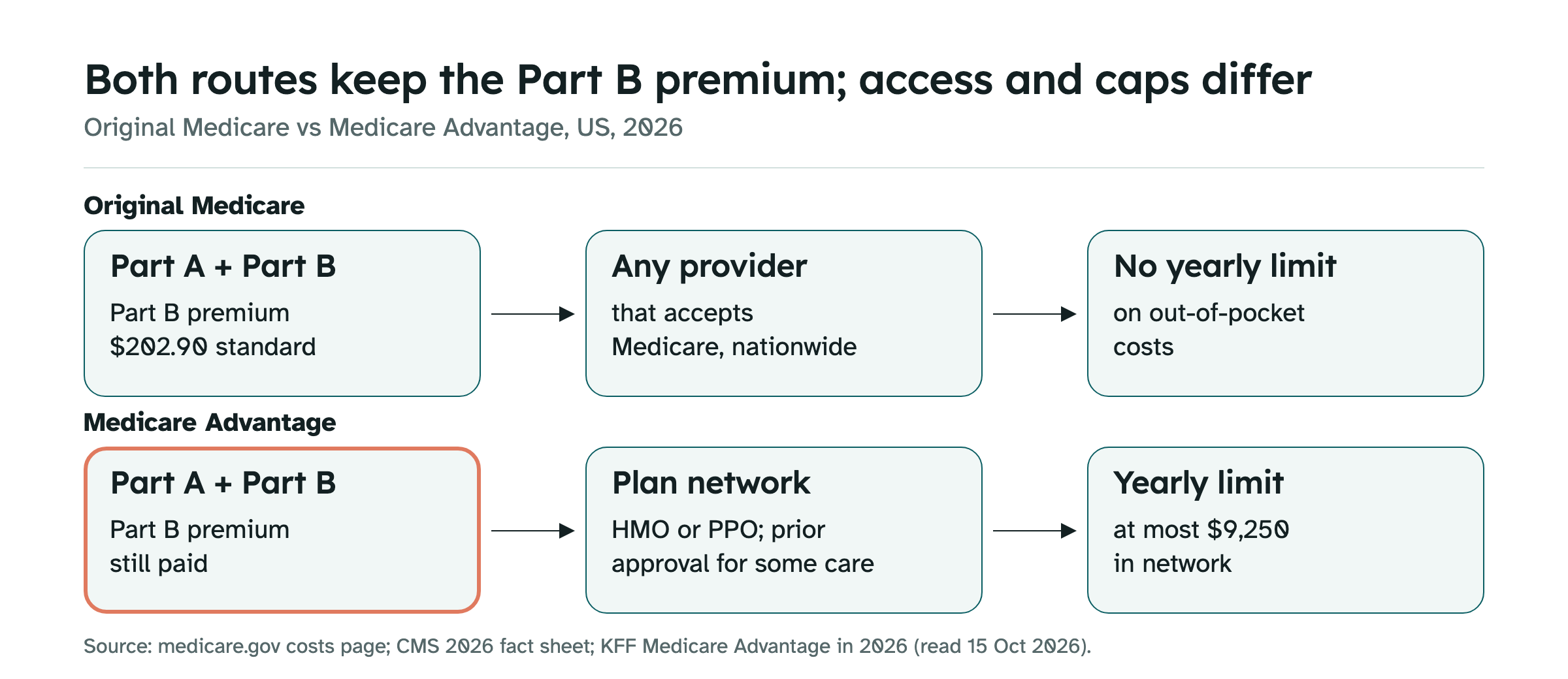
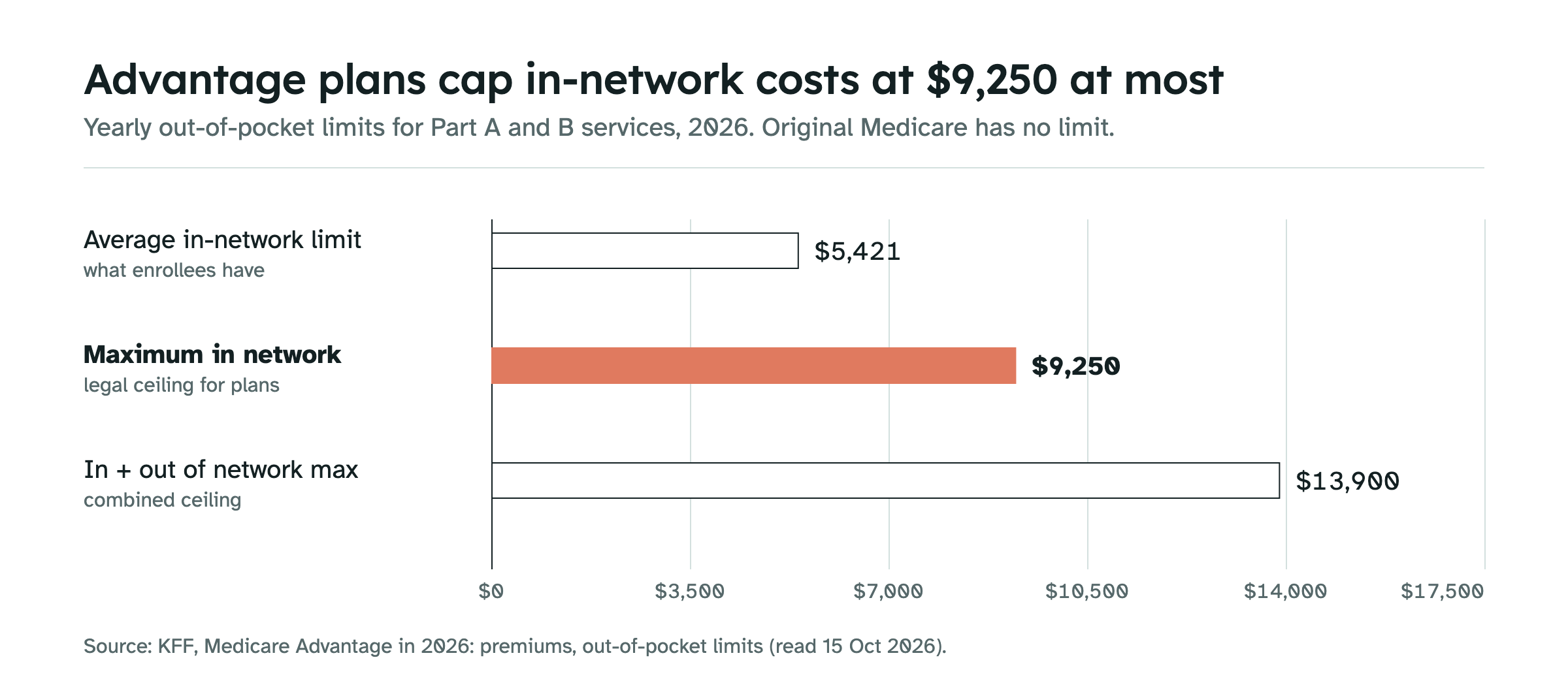
Costs work differently too. With either route you must have Part B and keep paying its premium; Advantage plans set their own premiums, deductibles and copayments on top.[2] In 2026, 75% of enrollees in individual Advantage plans with drug coverage pay no premium beyond the Part B premium, and the average supplemental premium is $15 a month.[6] Original Medicare has no out-of-pocket limit, while Advantage plans must cap in-network costs at no more than $9,250 ($13,900 in and out of network combined); the average in-network limit across enrollees is $5,421.[6]
- Administration: Original Medicare is run by a federal agency; Medicare Advantage is run by private insurers, with UnitedHealth Group and Humana together accounting for 46% of enrollment nationwide in 2026.[8]
- Provider access: Original Medicare allows any Medicare-accepting provider nationwide; Medicare Advantage plans use specific networks, so check that your doctors are in the network before you enroll.[8]
- Prior authorization: only a limited set of services triggers it in traditional Medicare, while virtually all Medicare Advantage plans require it for some services.[5]
- Extras: Medicare Advantage plans frequently bundle prescription drug coverage (MA-PD plans) and offer extra benefits such as vision, hearing, and dental coverage, which virtually all plans provided in 2026.[9]
Medicare Advantage plans 2026
Medicare Advantage plans cover the majority in 2026: 55% of eligible Medicare beneficiaries, 35.2 million of the 64.2 million people with both Parts A and B, are enrolled.[8] Enrollment grew by about 1.1 million people, or 3%, from 2025 to 2026, and the Congressional Budget Office projects the share will reach 63% by 2034.[8]
The clearest trend inside that growth is the rise of Special Needs Plans (SNPs), which restrict enrollment to people with significant or specialized care needs, including people eligible for both Medicare and Medicaid. Nearly 8.2 million beneficiaries are in SNPs in 2026, which is 23% of all Medicare Advantage enrollment, and SNPs accounted for 85% of the net enrollment increase over the past year.[8] Most SNP enrollment (78%) is in plans for people dually eligible for Medicare and Medicaid, while enrollment in plans for people with severe chronic conditions, mostly diabetes or cardiovascular conditions, grew 45% in a single year.[8]
- 55% of eligible beneficiaries, 35.2 million people, are in Medicare Advantage in 2026.[8]
- Special Needs Plans hold 23% of enrollment and drove 85% of the year's net growth.[8]
- Virtually all 2026 plans offer extra benefits such as vision, hearing, and dental coverage, and many bundle prescription drug coverage as MA-PD plans.[9]
- The market is concentrated: UnitedHealth Group holds 26% of enrollment and Humana 20%, together 46% nationwide.[8]
Differences between Original Medicare and Medicare Advantage
The differences between Original Medicare and Medicare Advantage that change the decision are provider access, prior authorization and the out-of-pocket cap; the Part B premium is the same in both. Which trade-off fits depends on your health needs, budget and the doctors you want to keep. The table summarizes the figures above, from CMS, medicare.gov and KFF.[1]
| Decision factor | Original Medicare | Medicare Advantage |
|---|---|---|
| Who runs it | Federal government (CMS) | Private insurers approved by Medicare |
| Provider access | Any doctor or hospital nationwide that accepts Medicare | Plan networks, commonly HMOs and PPOs |
| Prior authorization | Limited set of services, about 0.02 requests per enrollee in 2024 | Required for some services by virtually all plans; 7.7% of 2024 requests denied |
| Part B premium 2026 | $202.90 standard, more with IRMAA | Same: you keep paying it |
| Plan premium 2026 | None beyond Part B (Part D and Medigap are separate) | Set by each plan; 75% of MA-PD enrollees pay none beyond Part B |
| Yearly out-of-pocket limit | None | At most $9,250 in network |
| Extras | No bundled vision, hearing or dental | Virtually all plans offer vision, hearing and dental |
Whichever route you choose, some costs may be tax-deductible: US filers can deduct qualifying medical and dental expenses, including Medicare Part B premiums, above 7.5% of adjusted gross income, as IRS Publication 502 explains.[10]
This article explains how the two routes work; it cannot tell you which plan fits you and is not personal advice. Take the decision table, your current medications, your preferred doctors and your expected care for the year to a licensed clinician, pharmacist or benefits counselor. For every 2026 Part B figure in one place, see how much Medicare Part B costs.
Frequently asked questions
How much is the Medicare Part B deductible in 2026?
The annual deductible for Medicare Part B is $283 in 2026. Beneficiaries must pay this amount out of pocket before Medicare begins to cover its share of approved medical services.
Does Medicare Part B cover telehealth appointments?
Yes, Medicare Part B covers certain telehealth services, such as office visits, psychotherapy and consultations. After meeting the annual deductible, patients typically pay a 20% coinsurance for these virtual visits.
Are Medicare premiums tax deductible?
Yes, they can be. US filers who itemize can deduct qualifying medical and dental expenses, including Medicare Part B premiums, to the extent they exceed 7.5% of adjusted gross income, as IRS Publication 502 explains.
Can international residents enroll in Medicare?
Medicare is US federal health insurance for people 65 or older who meet US citizenship or residency requirements, with earlier eligibility for some people with disabilities, End-Stage Renal Disease or ALS. Readers helping US-based relatives should check those requirements on medicare.gov before applying.
What is the out-of-pocket maximum for Medicare Advantage?
Unlike Original Medicare, Medicare Advantage plans cap what you pay each year for covered Part A and Part B services. In 2026 the in-network limit may not exceed $9,250, and plans can set lower limits.