Best at-home blood test kits in 2026: accuracy and price
The best at home blood test is a finger-prick kit read by a CLIA-certified lab. Five US services compared on price and accuracy, 26 October 2026.
In this article7
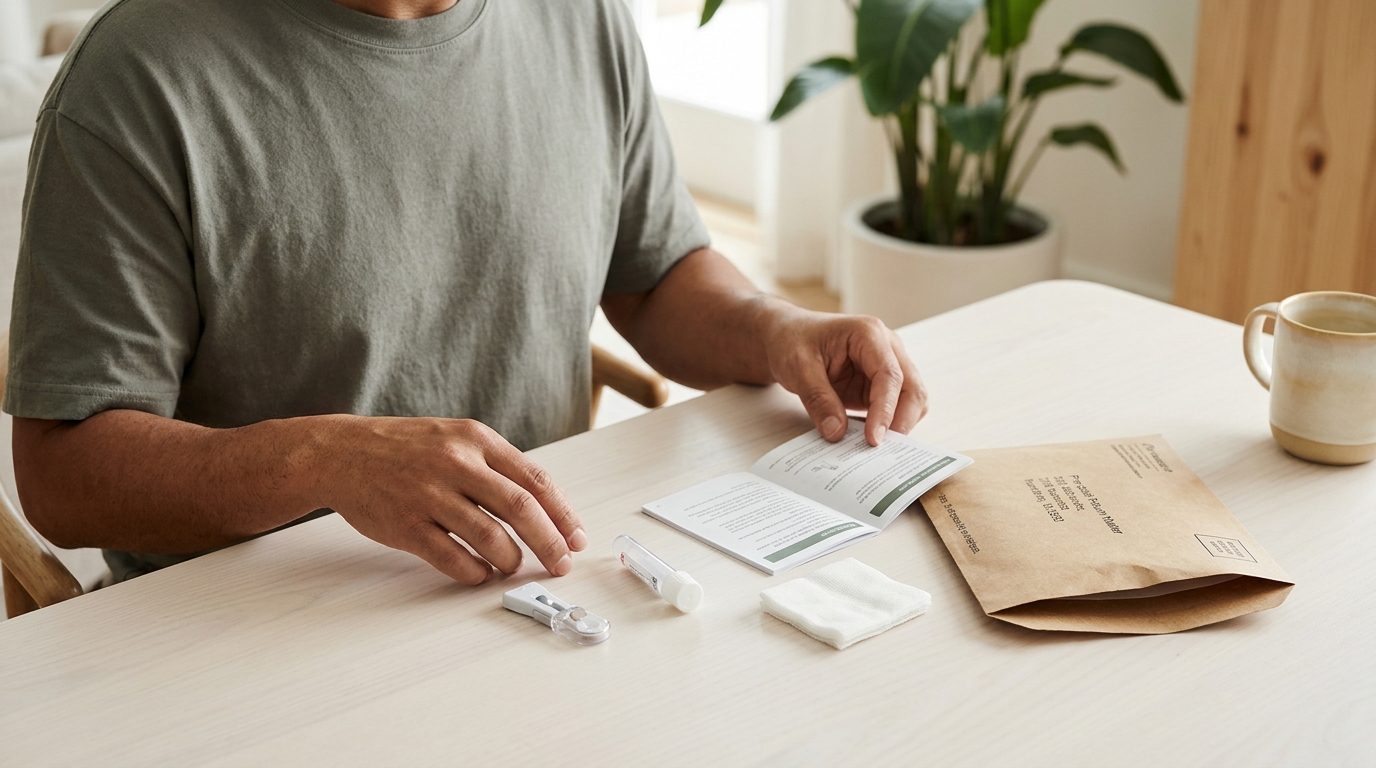
The best at home blood test depends less on the brand than on two questions. Which marker do you want to measure, and does a drop of fingertip blood measure it reliably? Mailed kits from companies such as Everlywell, LetsGetChecked and myLAB Box send that drop to a laboratory. Labcorp OnDemand and Quest sell the same kind of test online, but take the blood from a vein at one of their own sites. This guide compares five US services on price, sample type and laboratory, using the prices each company showed on its own website on 26 October 2026. The comparison is a selection of well-known services, not a ranking of the whole market. Prices and availability outside the United States differ.
What are the best home blood tests available?
The best home blood tests available are lab-analyzed kits for markers that work from a finger-prick sample, such as a cholesterol panel or HbA1c, the long-term blood sugar marker. MedlinePlus, the consumer health service of the US National Library of Medicine, separates two kinds of home test. Self-tests give an immediate result at home. Self-collection tests let you take the sample at home, which you then package and mail to a laboratory.[1] Almost all broader blood panels sold online fall into the second group.
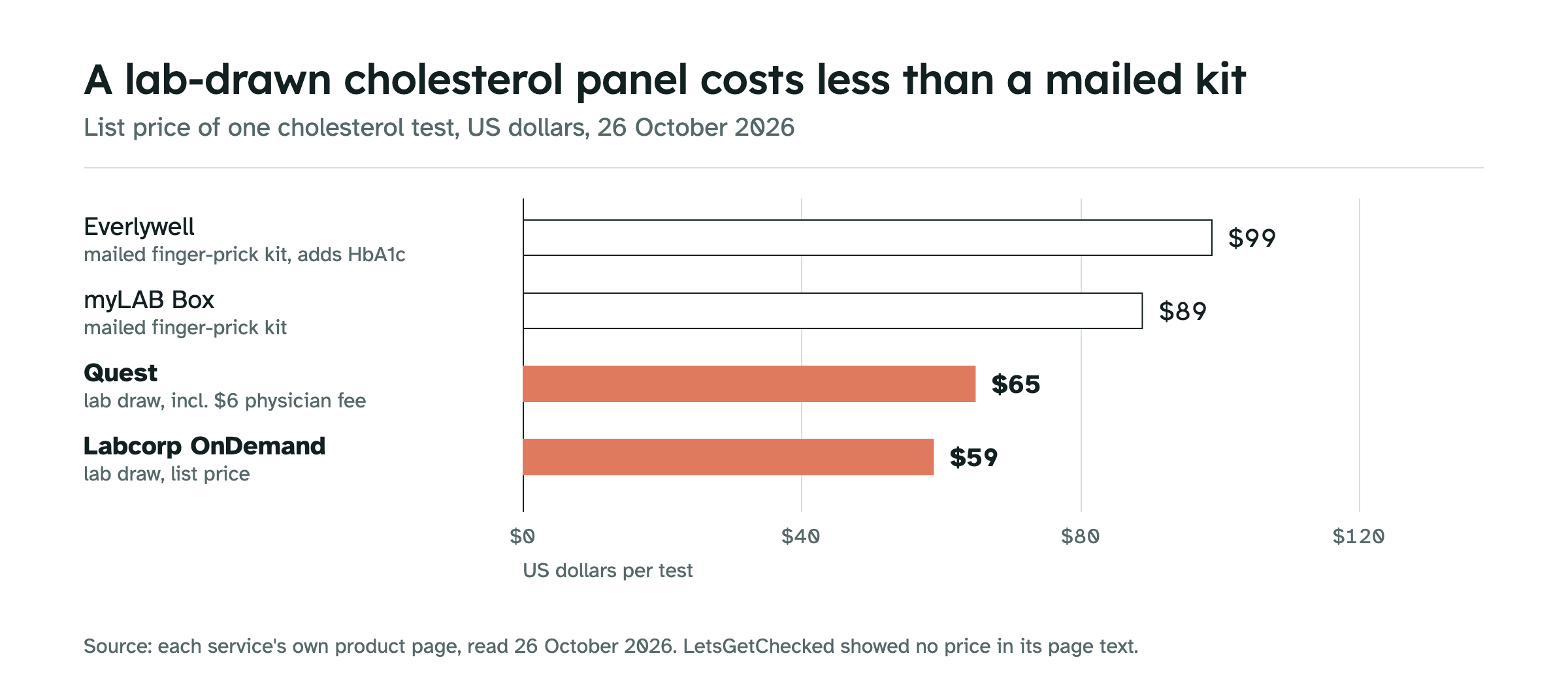
To compare like with like, the table uses one common test, the cholesterol (lipid) panel, at each service.
| Service | Cholesterol test and price (26 Oct 2026) | How the blood is taken | Laboratory stated by the service |
|---|---|---|---|
| Everlywell | Heart Health Test, 99 dollars, also measures HbA1c | Finger prick at home, mailed | CLIA-certified laboratories |
| LetsGetChecked | Cholesterol Test, – | Finger prick at home, mailed | Own CLIA-certified laboratory |
| myLAB Box | At Home Cholesterol Test, 89 dollars | Finger prick at home, mailed | CAP- and CLIA-certified laboratories |
| Labcorp OnDemand | Cholesterol and Lipid Panel Test, 59 dollars (44.25 dollars with a 25 percent discount on that day) | Venous draw at a Labcorp patient service center | Labcorp laboratory |
| Quest | Cholesterol (Lipid) Panel, 59 dollars plus a 6 dollar physician service fee | Venous draw at a Quest patient service center | CLIA-certified Quest laboratories |
A dash means the page showed no price in its text on that day. The values come from the services' own pages: Everlywell,[2] LetsGetChecked,[3] myLAB Box,[4] Labcorp OnDemand[5] and Quest.[6] LetsGetChecked describes its laboratory as its own and CLIA-certified on its homepage.[7] Labcorp OnDemand and Quest each name more than 2,000 patient service centers in the US. myLAB Box lists its cholesterol test as temporarily unavailable in New York State.
The table shows something the price tags alone hide. A lab draw is not more expensive than a mailed kit for a standard cholesterol panel. What a mailed kit buys is convenience: no appointment and no trip. What a lab draw buys is a full venous sample, which avoids the collection problems described further down. If you also want HbA1c, Everlywell's 99-dollar kit includes it, while the two lab panels above cover lipids only.
How do I check my blood type at home?
You can check your blood type at home with a blood typing card, which shows your ABO group and your RhD factor from a drop of blood from your fingertip. The best-known card is the EldonCard, made by the Danish company Eldon Biologicals. The company describes plastic cards with dried antibodies, a result after about two minutes and clearance by the US Food and Drug Administration (FDA).[8] You place the blood on the marked fields and read which ones clump.
Blood typing sorts blood by proteins, called antigens, on the surface of red blood cells. MedlinePlus lists four major ABO types, A, B, AB and O, and the Rh factor as a second test.[9] A home card answers those two questions and nothing more.
It does not replace hospital testing. MedlinePlus explains that minor antigens are not routinely detected during blood typing. A process called cross-matching is done before transfusions, except in emergencies, to catch them.[9] A result from a home card is therefore useful for curiosity or a donor card, but no hospital will rely on it. In pregnancy, your Rh status should come from your prenatal care team.
At home blood test
An at home blood test is worth taking when you know which value you need and what you will do with the result. The US Centers for Disease Control and Prevention (CDC) says most healthy adults should have their cholesterol checked every 4 to 6 years. People with heart disease, diabetes or a family history of high cholesterol need checks more often. The CDC adds that you may need to fast for 8 to 12 hours before a cholesterol test.[10] Check the kit's own instructions, because some kits ask for fasting and others do not.
A mailed kit follows the same steps at every service:
- Register the kit online, so the lab can link the sample to you.
- Warm your hands, clean a fingertip and prick it with the supplied lancet.
- Fill the tube or the card up to the mark, without squeezing the finger hard.
- Mail the sample on the day you take it, in the prepaid envelope.
- Read the result in the online account and check how the service flags values outside the reference range.
LetsGetChecked names about 2 to 5 days from the sample's arrival at the lab to the result.[3] The same page warns that collecting a sample may be more difficult with hard or callused fingertips. Several services offer a follow-up consultation for an abnormal result; LetsGetChecked lists 39 dollars for a virtual consultation after a high LDL value, with any medication as an extra cost.
A home result works best as a starting point. MedlinePlus advises asking your provider which kit to use, even when no prescription is needed.[1] For hormone tests, the time of day matters as well; the guide to the testosterone blood test[11] explains why a morning draw counts.
Top rated at home blood tests
The top rated at home blood tests, judged on accuracy, are those for markers that stay stable in a fingertip sample. Two studies show where that holds.
In a 2026 study in Clinical Chemistry and Laboratory Medicine, 480 adults gave paired capillary and venous samples. Results were clinically comparable for 16 of 18 routine analytes, which covered lipid, kidney, thyroid and cardiac panels. Potassium and chloride showed limited interchangeability. Fingertip collection gave larger sample volumes than an upper-arm device but more hemolysis, the breaking of red blood cells.[12] Two of the authors work for Roche Diagnostics, whose analyzers the study used, and the samples were taken in a clinic rather than mailed from home.
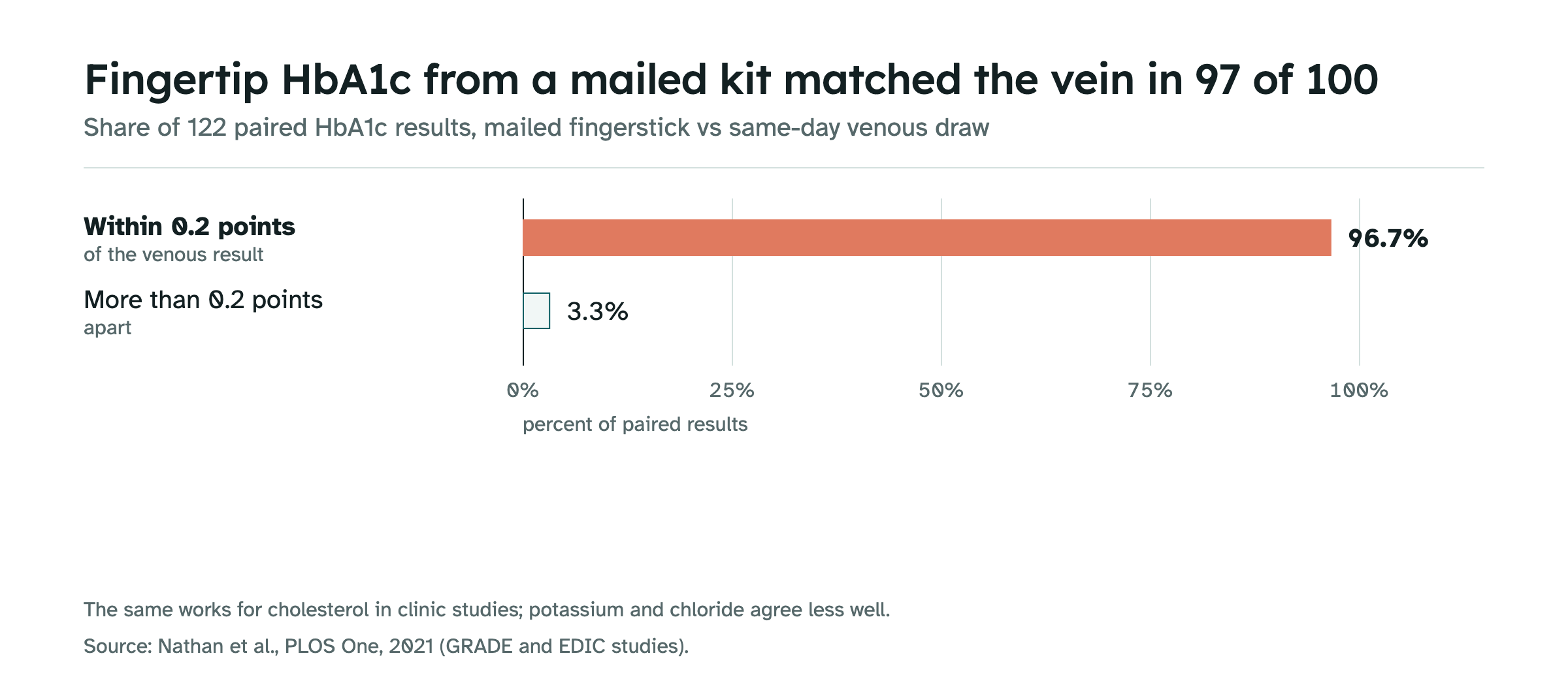
For HbA1c, a 2021 study in PLOS One compared mailed fingerstick kits with venous samples in 122 adults with diabetes. The two methods were highly correlated, and 96.7 percent of results differed by 0.2 percentage points or less.[13] Participants filled the capillary tubes themselves on the same day as the venous draw.
| Marker | Fingertip sample works well? | Basis |
|---|---|---|
| Cholesterol panel (lipids) | Yes, comparable to venous | 480-adult paired study, 2026 |
| HbA1c | Yes, 96.7 percent within 0.2 points | 122-adult mailed-kit study, 2021 |
| Potassium, chloride | Limited agreement | 480-adult paired study, 2026 |
The practical rule follows from the table. For lipids and HbA1c, a mailed finger-prick kit from a certified lab is a reasonable choice. For tests where hemolysis distorts the value, such as potassium, a venous draw at a lab is the safer route. If a kit result surprises you, repeat it with a venous sample before acting on it.
At home health testing reviews
At home health testing reviews on a vendor's website measure customer satisfaction, not accuracy. Everlywell showed an average of 4.78 from 269 reviews for its Heart Health Test on 26 October 2026,[2] and myLAB Box showed one rating for its cholesterol kit.[4] Neither figure says how often a result was right.
Laboratory physicians urge caution about the whole category. A 2025 review in Clinical Chemistry notes that direct-to-consumer testing happens outside traditional healthcare. The protections patients have there are not necessarily present. The authors see a substantial risk of medicalizing healthy people when tests are marketed aggressively.[14] They also stress that a test is only useful when the sample is collected and stored properly and the result is interpreted correctly.
Before you buy, check five points that no star rating covers:
- Laboratory: does the service name a CLIA-certified laboratory, and is it the one that analyzes your sample?
- Sample type: finger prick, dried blood spot or venous draw, and does the marker work from that sample?
- Price in full: kit price, physician or service fees, shipping and any follow-up consultation.
- Follow-up: who contacts you about a value far outside the range, and how fast?
- Your state or country: some kits are not sold everywhere, such as myLAB Box's cholesterol test in New York.
Take this list and your results to a licensed clinician or pharmacist, who can tell whether a value needs a repeat test or a visit. If you plan to pay from a health account, the guide to HSA vs FSA[15] explains what each covers. How Elenra builds comparisons is described on its methodology page[16]. This article is general information and does not replace a diagnosis.
Frequently asked questions
Are at-home blood tests as accurate as a lab draw?
For cholesterol and HbA1c, studies found fingertip results close to venous results. For potassium and chloride, agreement was limited, so a venous draw is the safer choice for those.
How much does an at-home cholesterol test cost?
On 26 October 2026, mailed kits cost 89 to 99 US dollars and lab-drawn panels ordered online cost 59 dollars before fees and discounts.
Can I find out my blood type without a doctor?
Yes, a home typing card shows your ABO group and RhD factor in a few minutes. Hospitals still type and cross-match blood again before any transfusion.
Sources
Medical disclaimer. The content on Elenra is general information. It is not medical advice, diagnosis or treatment and does not replace a consultation with a doctor or another qualified health professional. Talk to your doctor before you start, change or stop any medication or treatment. In an emergency, call your local emergency number. Medical disclaimer
Related reading
All Lab Tests →How to read blood test results: ranges and abbreviations
How to read blood test results line by line: what the columns, flags and abbreviations mean, and typical adult ranges from US health sources.

CBC vs CMP: what each blood test checks
CBC vs CMP: a CBC counts your blood cells, a CMP measures 14 chemicals. What each shows, which needs fasting and which tube is drawn first.