HSA vs FSA: what you can use them for in health care
HSA vs FSA explained: eligible expenses, gym memberships, health tests, limits, grace periods and rules, with current IRS, Medicare and Marketplace figures.
Contents

HSA vs FSA: what each account actually is
A Health Savings Account (HSA) and a health Flexible Spending Account (FSA) are both US arrangements that let you set aside money before tax and spend it on health care. Both can lower your tax bill, and both draw on the same federal definition of a qualified medical expense. Beyond that, they work quite differently, and those differences matter more than the name suggests. Below: what each account can pay for, and where the rules overlap and diverge. It is general information, not individual tax or medical advice, and the rules described here are specific to the United States.
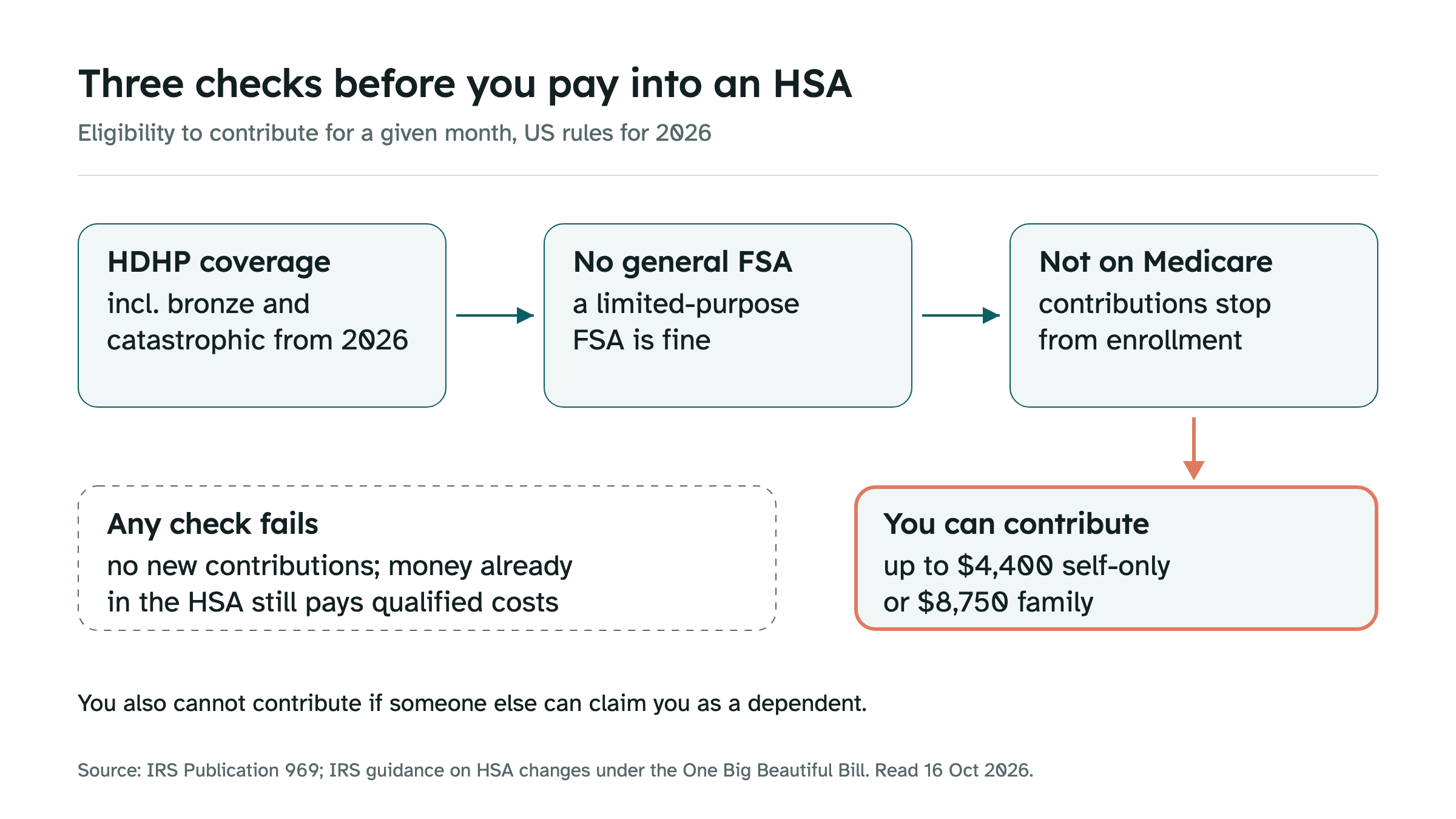
An HSA is a tax-exempt account that you own yourself. To contribute, you must be covered by a high deductible health plan (HDHP), a plan with a higher annual deductible than typical plans, and you generally cannot have other health coverage, be enrolled in Medicare, or be claimed as someone else's dependent. The account is portable: it stays with you if you change employers or leave the workforce, unused money rolls over year to year, and earnings on the balance are tax free.[1] An FSA, by contrast, is arranged through an employer. You do not pay tax on the money you put in, but you generally must use it within the plan year, and the account is tied to your job rather than following you to a new employer.[2]
| Feature | HSA | FSA |
|---|---|---|
| Who sets it up | You open it yourself, with a qualified trustee | Offered through an employer |
| Plan required | A high deductible health plan (HDHP) | None specific, but offered with job-based coverage |
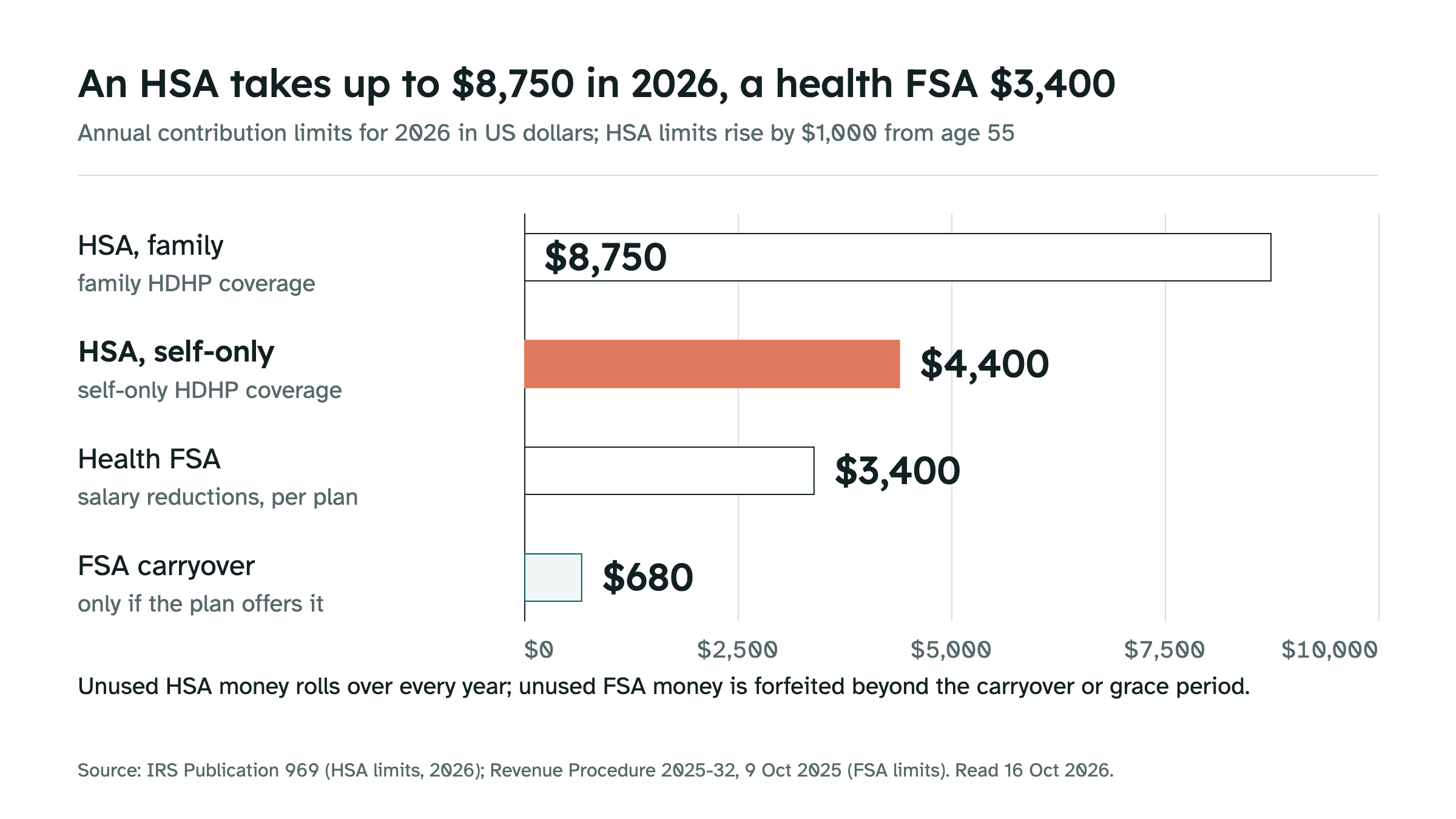
| 2026 contribution limit | $4,400 self-only, $8,750 family[1] | $3,400 per employer[3] |
| Extra from age 55 | $1,000 more per year[1] | No catch-up amount |
| Unused money | Rolls over year to year[1] | Forfeited at year end unless the employer offers a grace period or carryover[2] |
| Portability | Stays with you between jobs[1] | Tied to the employer |
What can you use an HSA or FSA for?
Both accounts pay for qualified medical expenses: costs for the diagnosis, cure, mitigation, treatment or prevention of disease, as IRS Publication 502 defines them[4]. In practice that means the share of care your insurance leaves to you, plus a range of supplies and devices. Over-the-counter medicines count whether or not they are prescribed, and so do menstrual care products[1].
- Deductibles and copayments under your health plan[2]
- Prescription drugs and insulin[2]
- Medical equipment and supplies, such as crutches and bandages[2]
- Diagnostic devices, such as blood sugar test kits[2]
- Dental treatment, eye exams, eyeglasses and contact lenses[4]
- Hearing aids, laboratory fees and hospital services[4]
What the accounts do not cover matters just as much. Publication 502 lists health club dues, cosmetic surgery, teeth whitening, nutritional supplements and weight-loss programs aimed only at general health among the expenses you cannot include[4]. Insurance premiums are generally excluded too; the HSA exceptions are in the FAQ below.
Can I use my HSA card on FSA items?
Yes, in the sense that both accounts draw on the same IRS definition of a qualified medical expense, so an item that is FSA-eligible, such as a deductible payment, a copayment, a prescription drug or a blood sugar test kit, is generally HSA-eligible too[2]. What differs is the account around it. If you are covered by a general-purpose health FSA, you usually cannot contribute to an HSA at the same time; limited-purpose FSAs covering only dental and vision care are the main exception[1]. And since January 1, 2026, bronze and catastrophic plans, including those bought through the Marketplace, count as HSA-compatible[5].
Can an HSA or FSA pay for a gym membership?
Usually not. IRS rules count only expenses for the diagnosis, cure, mitigation, treatment or prevention of disease, and Publication 502 explicitly excludes weight-loss costs aimed at improving appearance, general health or well-being.[4] A membership or program may qualify if it is prescribed to treat a specific diagnosed condition, such as a physical therapy or cardiac rehabilitation program, and obesity treatment programs can count as preventive care under high-deductible plan rules. For everyday activity that is not tied to a diagnosis, our fitness guides cover the options that do not need pre-tax dollars.
Check a specific expense before you pay
Before you spend pre-tax money on a specific test, treatment or product, ask a licensed clinician or pharmacist whether it counts as medically necessary for you, and check with your plan administrator that the account will reimburse it, much as you would when checking whether your insurance covers a treatment. To compare specific tests before you buy, our lab test guides explain what each one measures and what it costs.
Frequently asked questions
Can I use HSA or FSA money for a gym membership?
Usually not. A membership or program can qualify only when a clinician prescribes it to treat a specific diagnosed condition; the gym membership section above explains the IRS rule.
Can I have both an HSA and an FSA at the same time?
Generally not. If you are covered by a general-purpose health FSA that reimburses qualified medical expenses, you usually cannot contribute to an HSA. Exceptions exist for limited-purpose FSAs that cover only dental and vision care or preventive care, for post-deductible FSAs, and for suspended HRAs. Check your plan documents or ask your employer before contributing to both.
What happens to unused FSA money at the end of the year?
Under the use-it-or-lose-it rule, money left in an FSA at the end of the plan year is forfeited. Employers may offer one of two options: a grace period of up to 2.5 extra months to spend the balance, or a carryover of up to $680 into the following year. An employer can offer one of these options, never both, and does not have to offer either.
Can I contribute to an HSA if I am enrolled in Medicare?
No. Beginning with the first month you are enrolled in Medicare, your HSA contribution limit is zero, and this also applies to periods of retroactive Medicare coverage. You can still spend money already in the HSA on qualified medical expenses, including costs like the coinsurance for Medicare-covered telehealth services after the Part B deductible. Most people become eligible for Medicare at age 65, or earlier through disability.
Can I use HSA or FSA money to pay health insurance premiums?
Generally no. FSA funds cannot be used for insurance premiums, and HSA funds generally cannot pay premiums either, with a few exceptions listed in IRS Publication 969: COBRA continuation coverage, health coverage while you receive unemployment compensation, qualified long-term care insurance, and Medicare and other health coverage once you are 65 or older, though not a Medicare supplemental policy such as Medigap. Both accounts are designed for out-of-pocket costs such as deductibles, copayments, coinsurance, prescription drugs, and eligible equipment and supplies.
Are over-the-counter medicines eligible for FSA or HSA reimbursement?
Yes. Under IRS rules, over-the-counter medicines count as qualified medical expenses whether or not a doctor prescribed them, and so do menstrual care products. Insulin, medical equipment like crutches, supplies like bandages, and diagnostic devices such as blood sugar test kits are eligible as well. Keep receipts, since you submit claims with proof of the medical expense.
Can I use an FSA with a Marketplace health plan?
No. FSAs are tied to job-based coverage and cannot be combined with a Marketplace plan. The alternative is an HSA, which works with a high-deductible Marketplace plan, and as of January 1, 2026 bronze and catastrophic plans are also treated as HSA-compatible. Marketplace Open Enrollment starts November 1 each year.