CBC vs CMP: what each blood test checks
CBC vs CMP: a CBC counts your blood cells, a CMP measures 14 chemicals. What each shows, which needs fasting and which tube is drawn first.
In this article9

CBC vs CMP is a comparison of two different questions about the same blood sample. A CBC looks at the blood cells. A CMP looks at the chemistry dissolved around them. Both are common parts of a routine checkup in the United States, and a provider often orders them together. This guide uses US public health sources read on 28 October 2026. The main ones are MedlinePlus, the consumer health service of the US National Library of Medicine, and the National Heart, Lung, and Blood Institute (NHLBI). Reference ranges and units can differ between laboratories and countries, so the ranges printed on your own report are the ones that apply to it.
Does CBC or CMP show cholesterol?
Neither a CBC nor a CMP shows cholesterol. Cholesterol is measured with a separate blood test that MedlinePlus lists under the names lipid panel and lipid profile.[1] It reports cholesterol and triglycerides, and it is used to estimate the risk of heart disease.
The confusion is understandable, because the CMP is often called a metabolic or chemistry panel. Its 14 tests cover blood sugar, minerals, proteins, liver enzymes and kidney markers, but no blood fats.[2] If your result sheet shows LDL or HDL values, a lipid panel was ordered as well.
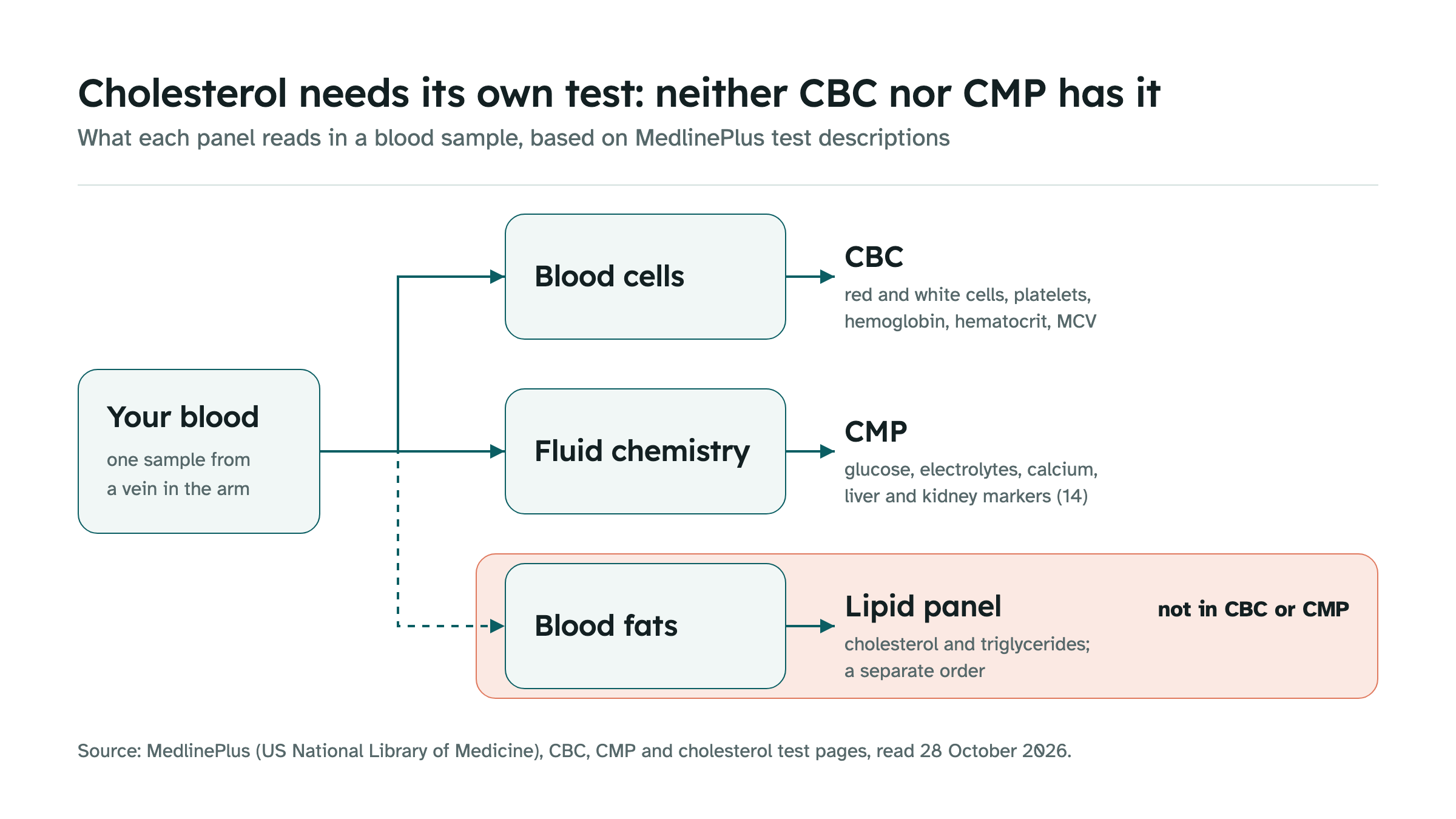
The difference matters for preparation. MedlinePlus states that you may need to fast for 9 to 12 hours before a cholesterol test, and that your provider will tell you whether you need to.[1] A CBC on its own needs no fasting at all.
Does CBC or CMP show anemia?
A CBC is the test that shows anemia, a condition in which the blood carries less oxygen than the body needs. The NHLBI names four CBC values that can point to anemia: the red blood cell count, hemoglobin, hematocrit and the mean corpuscular volume (MCV).[3]
- Hemoglobin is the iron-rich protein in red blood cells that carries oxygen.
- Hematocrit is the share of your blood volume made up of red blood cells.
- MCV is the average size of your red blood cells.
The NHLBI publishes these normal ranges for adults on its anemia diagnosis page, last updated on 18 December 2025:
| CBC value | Adult men | Adult women |
|---|---|---|
| Red blood cells | 5 to 6 million cells/mcL | 4 to 5 million cells/mcL |
| Hemoglobin | 14 to 17 g/dL | 12 to 15 g/dL |
| Hematocrit | 41% to 50% | 36% to 44% |
| Mean corpuscular volume | 80 to 95 fL | 80 to 95 fL |
The NHLBI adds that age, high altitude and race can also shift normal ranges, and that your doctor will judge your result against your own situation.[3] Each lab prints its own reference range next to your result.
A CMP does not measure hemoglobin or count red blood cells, so it cannot show anemia on its own. It does include bilirubin, a waste product the body makes when it breaks down old red blood cells.[2] That is one reason a provider may read the two panels side by side. A low CBC value is a starting point, not an answer: MedlinePlus lists dehydration, heart disease and too little iron among the possible reasons for abnormal red cell values.[4]
Do you draw CBC or CMP first?
When a CBC and a CMP come from the same draw, the CMP tube is usually filled first. The order follows the tubes, not the test names. The Clinical and Laboratory Standards Institute (CLSI) sets this order of draw in its venous collection standard GP41:[5]
- Blood culture tube or bottle
- Sodium citrate tube (for example, blue closure)
- Serum tubes, including those with clot activator and gel (for example, red or gold closure)
- Heparin tube (for example, green closure)
- EDTA tube (for example, lavender or pink closure)
- Sodium fluoride/potassium oxalate tube (for example, gray closure)
A CBC needs whole blood that has not clotted, so it goes into an EDTA tube. The test guide of the Mount Sinai clinical laboratories in New York lists "Lavender Top Tube (EDTA)" for the CBC and a gold top tube for the CMP.[6] Some laboratories use a green heparin tube for the CMP instead. Either way, it comes before the lavender tube in the CLSI order.
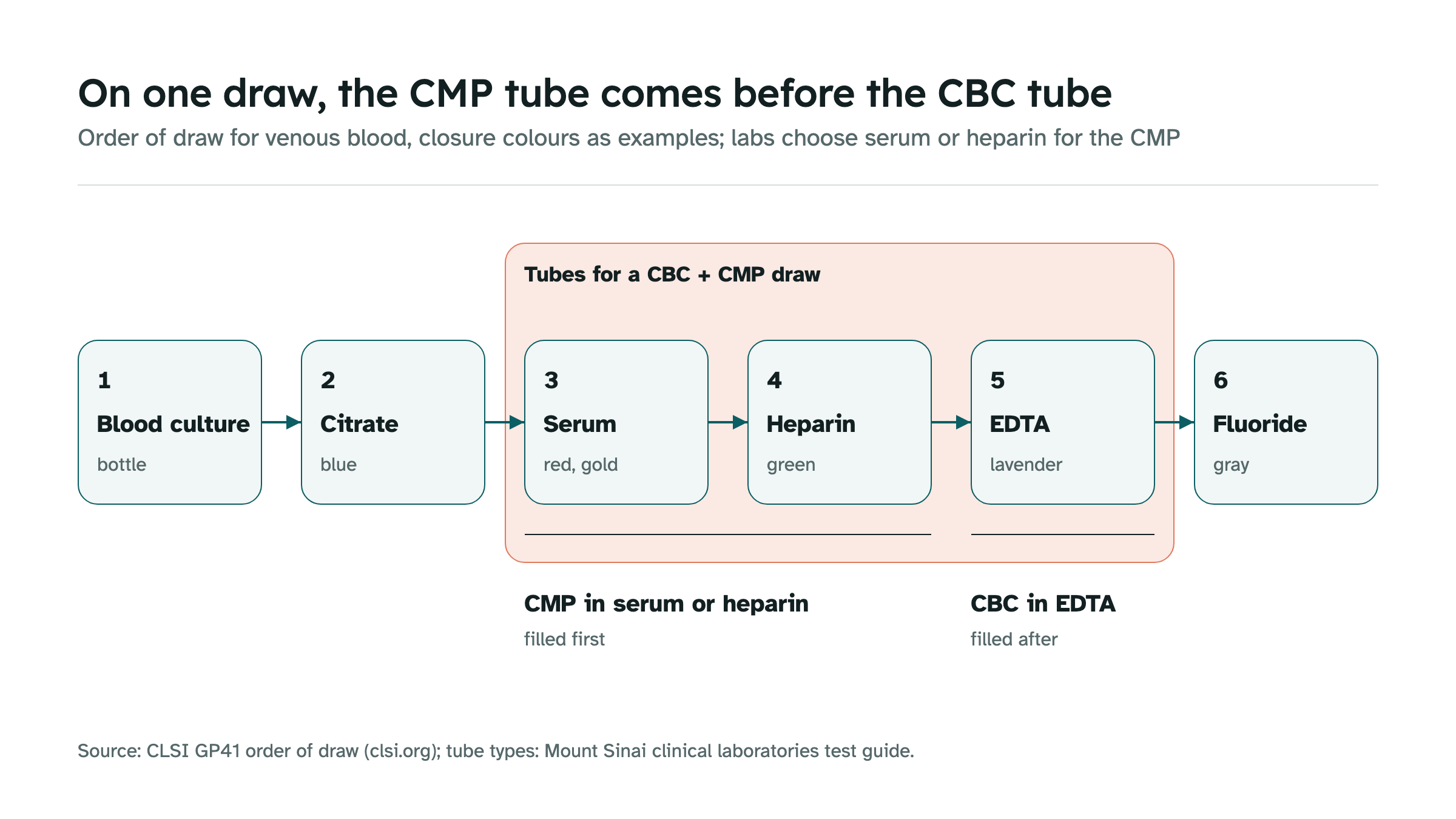
The reason is carryover. CLSI explains that the order is designed so that the additive of one tube cannot alter the results of the next one.[5] For you, the order changes nothing: the staff fill several tubes through one needle, and MedlinePlus states that a blood draw usually takes less than five minutes.[4]
Are CMP and CBC the same?
No, a CMP and a CBC are not the same test. A CBC measures the number and size of your blood cells. A CMP measures chemicals in the liquid part of your blood. The table sets them side by side, based on the MedlinePlus pages for each test.[2]
| CBC (complete blood count) | CMP (comprehensive metabolic panel) | |
|---|---|---|
| What it looks at | Blood cells | Chemicals dissolved in the blood |
| What it measures | Red blood cells, white blood cells, platelets, hemoglobin, hematocrit, MCV | Glucose, calcium, sodium, potassium, bicarbonate, chloride, albumin, total protein, ALP, ALT, AST, bilirubin, BUN, creatinine |
| Number of values | Six core values; a CBC with differential adds each white cell type | 14 |
| Typical questions | Anemia, infection, clotting cells, blood disorders | Blood sugar, kidney and liver health, fluid and electrolyte balance |
| Other names | Full blood count, blood cell count | Chem 14, chemistry panel, metabolic panel |
| Fasting | Usually not needed | May be needed for several hours |
CMP blood test explained
The 14 CMP values fall into five groups. MedlinePlus describes them like this:[2]
- Glucose: blood sugar, the body's main source of energy.
- Calcium: a mineral needed for nerves, muscles and the heart.
- Electrolytes: sodium, potassium, bicarbonate and chloride, which help control the amount of fluid in your body and its acid-base balance.
- Proteins and liver markers: albumin and total protein, plus the enzymes ALP, ALT and AST and the waste product bilirubin.
- Kidney markers: BUN (blood urea nitrogen) and creatinine, waste products that your kidneys filter out of your blood.
A smaller version, the basic metabolic panel (BMP), includes 8 of these 14 tests. It leaves out total protein, albumin, bilirubin and the three liver enzymes.[2] If your order says BMP, the liver values will not be on your report.
Do I need to fast before CBC and CMP?
You do not need to fast for a CBC, but you may need to fast for a CMP. MedlinePlus states that a CBC usually needs no special preparation, unless your provider ordered other tests on the same sample.[4] Cleveland Clinic gives the same advice: you can eat, drink and take your medications as usual before a CBC.[7]
For a CMP, the answer depends on the order. Cleveland Clinic says providers sometimes ask patients not to eat or drink for 10 to 12 hours before the test.[8] MedlinePlus lists blood glucose tests and the basic metabolic panel among the tests that usually require fasting. It adds that some liver tests need fasting only when they are part of a CMP.[9]
If you are asked to fast, MedlinePlus defines it this way:[9]
- Do not eat or drink anything except plain water, usually for 8 to 12 hours.
- Coffee, juice and soda count as drinks, so skip them.
- Flavored or sparkling water with sweeteners also counts; plain water is fine.
Because a CBC and a CMP are often ordered together, the stricter rule decides the morning. Ask your provider before the appointment whether the order includes a test that needs fasting, and whether you should take your usual medicines. An early morning appointment keeps the fasting time short.
Difference between cbc and cmp blood test
The difference between a CBC and a CMP blood test is the part of the blood each one reads. That decides what each test can and cannot tell you. This list puts the practical points in one place:
- What is measured: CBC: cells. CMP: chemistry.
- What a result can point to: CBC: anemia, infection, blood disorders. CMP: blood sugar, kidney and liver health, electrolyte balance.
- What neither shows: cholesterol, which needs a lipid panel.
- Preparation: CBC: none. CMP: possibly 10 to 12 hours of fasting, if your provider asks for it.
- Collection: CMP in a serum or heparin tube, CBC in a lavender EDTA tube, filled in that order.
- Reading the result: both list each value with the laboratory's own reference range.
Providers order a CMP for reasons beyond a checkup. MedlinePlus names signs of liver or kidney disease, a general symptom such as fatigue, an abnormal earlier result, and checking whether a treatment works or affects the liver or kidneys.[2] A CBC is also used to monitor conditions and treatments that can affect blood cell counts, such as infections, anemia and immune system disorders.[4]
Both tests are screening and monitoring tools, not diagnoses. MedlinePlus notes that an abnormal CMP value can point to a health condition; high blood glucose, for example, can be a sign of diabetes. More tests are usually needed to confirm or rule it out.[2] You can find more guides on panels and home tests in the Elenra lab tests section[10].
Cbc blood test explained
A CBC blood test counts the cells in a sample from a vein in your arm and measures their size. MedlinePlus lists six core values:[4]
- Red blood cells, which carry oxygen from your lungs to the rest of your body.
- White blood cells, which fight infections and other diseases.
- Platelets, which help your blood clot and stop bleeding.
- Hemoglobin, the oxygen-carrying protein inside red blood cells.
- Hematocrit, the share of whole blood made up of red blood cells.
- Mean corpuscular volume (MCV), the average size of your red blood cells.
There are five major types of white blood cells. A standard CBC reports their total number. A separate test, the CBC with differential, counts each type.[4] Your order or report shows which version was run.
MedlinePlus gives examples of what values outside the range can mean. A low white cell count may point to an autoimmune disorder, a bone marrow disorder or cancer. A high white cell count may signal an infection or a reaction to a medicine. Possible reasons for abnormal red cell values are covered in the anemia section above.[4]
Those are possibilities, not conclusions. MedlinePlus states that an abnormal level does not always mean a condition that needs treatment. Diet, activity level, medicines, a menstrual period and not drinking enough water can all affect the results.[4] Your provider reads the CBC together with your history, your symptoms and any other tests, such as the CMP. Some values also depend on timing; the guide to the testosterone blood test[11] explains why a morning draw matters for hormones.
The next step is a short list for your appointment. Write down which panels were ordered, whether you were asked to fast, and which values your report flags. Take that list to a licensed clinician or pharmacist, who can explain your results in the context of your health. If you are weighing a test you order yourself, the comparison of at-home blood test kits[12] shows which markers work from a finger-prick sample and what they cost. How this guide was researched is described in the Elenra methodology[13].
Frequently asked questions
Is a CMP the same as a chem 14?
Yes. MedlinePlus lists chem 14, chemistry panel and chemistry screen as other names for the comprehensive metabolic panel, because it measures 14 substances.
Can a CBC detect infection?
A high white blood cell count on a CBC can signal an infection, or a reaction to a medicine. It does not show which infection, so a provider uses it together with symptoms and other tests.
Does a CMP check thyroid function?
No. The 14 CMP values cover glucose, calcium, electrolytes, proteins, liver enzymes, bilirubin and kidney markers. Thyroid hormones need a separate test order.
Can a CBC and a CMP come from one blood draw?
Yes. Both are taken from a vein in the arm, so one needle can fill the tubes for both tests. If the CMP needs fasting, the fasting rule applies to the whole appointment.
Is a BMP the same as a CMP?
No. A basic metabolic panel contains 8 of the 14 CMP tests. It leaves out total protein, albumin, bilirubin and the liver enzymes ALP, ALT and AST.
Sources
Medical disclaimer. The content on Elenra is general information. It is not medical advice, diagnosis or treatment and does not replace a consultation with a doctor or another qualified health professional. Talk to your doctor before you start, change or stop any medication or treatment. In an emergency, call your local emergency number. Medical disclaimer
Related reading
All Lab Tests →How to read blood test results: ranges and abbreviations
How to read blood test results line by line: what the columns, flags and abbreviations mean, and typical adult ranges from US health sources.

Best at-home blood test kits in 2026: accuracy and price
The best at home blood test is a finger-prick kit read by a CLIA-certified lab. Five US services compared on price and accuracy, 26 October 2026.