How to read blood test results: ranges and abbreviations
How to read blood test results line by line: what the columns, flags and abbreviations mean, and typical adult ranges from US health sources.
In this article8

How to read blood test results comes down to four columns: the test name, your result, the unit and the reference range. A value outside the range is usually marked H for high or L for low. That mark tells you where to look, not what is wrong. MedlinePlus is the consumer health service of the US National Library of Medicine. It states that results outside the range "may or may not be a sign of a health problem" and that healthy people sometimes have them.[1] This guide uses MedlinePlus and the National Heart, Lung, and Blood Institute (NHLBI), read on 29 October 2026. It explains the report, not your health. That part belongs to the clinician who ordered the test.
When to worry about blood test results?
A blood test result needs quick attention when the lab marks it as a critical value, not when it simply carries an H or L. Labs must immediately alert the person or organization that ordered the test when a result points to an immediately life-threatening condition. Reports often mark these results with an asterisk and note when the clinician was told.[2] So if a result is critical, the call usually comes to you through your clinician before you have read the report yourself.
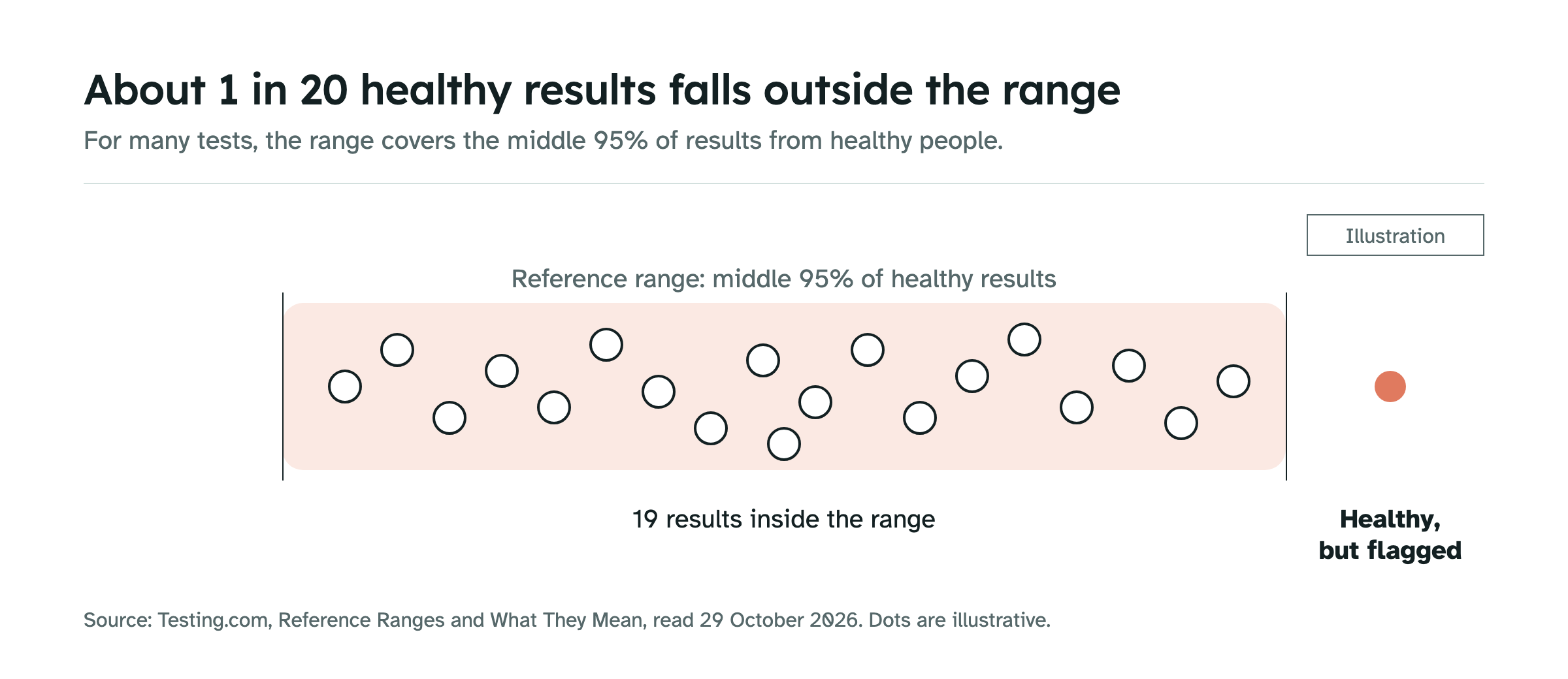
An ordinary flag is different. Reference ranges are commonly set to cover 95% of results in a healthy population, which means 5% of healthy people fall outside the limits of any one test.[3] Order 20 tests, and one value outside its range is not unusual. MedlinePlus adds the other side: a result inside the range is not a guarantee of good health, and symptoms can still call for more testing.[1]
Three things make a flag worth a closer conversation with your clinician:
- the value is far outside the range, not just over the line
- the same value has moved in one direction over several tests
- you have symptoms that fit the test, such as tiredness with a low hemoglobin
What not to do: start, stop or change a medicine or a supplement because of a single result. If you feel unwell, that is a reason to contact a clinician whatever the report says.
What does a normal blood test test for?
A routine blood test usually means a few standard panels rather than one test. MedlinePlus describes the common ones as part of a routine checkup:
- Complete blood count (CBC): counts and measures your red blood cells, white blood cells and platelets, plus hemoglobin, hematocrit and the average red cell size.[4]
- Comprehensive metabolic panel (CMP): measures 14 substances, including glucose, calcium, the electrolytes sodium, potassium, bicarbonate and chloride, the proteins albumin and total protein, the liver enzymes ALP, ALT and AST, bilirubin, and the kidney markers BUN and creatinine.[5]
- Basic metabolic panel (BMP): measures eight of these substances: glucose, calcium, the electrolytes and the kidney markers BUN and creatinine, without the liver tests and proteins.[6]
- Lipid panel (cholesterol test): total cholesterol, LDL, HDL and triglycerides.[7]
- Hemoglobin A1C: the share of hemoglobin coated with glucose, which reflects blood sugar over time.[8]
Not every checkup includes all five. If a panel is missing from your report, it was most likely not ordered. A separate guide to what a CBC and a CMP each check explains the two most common panels side by side.
How do you read your blood test results?
You read a blood test report row by row, from left to right. Most reports use the same columns, even when the layout differs:
- Test name, often abbreviated (for example "Hgb" for hemoglobin).
- Result, a number, or a word such as positive or negative.
- Unit, such as mg/dL (milligrams per deciliter).
- Reference range, the low and high limits the lab considers normal for your group.
- Flag, usually H or L when the result falls outside the range.
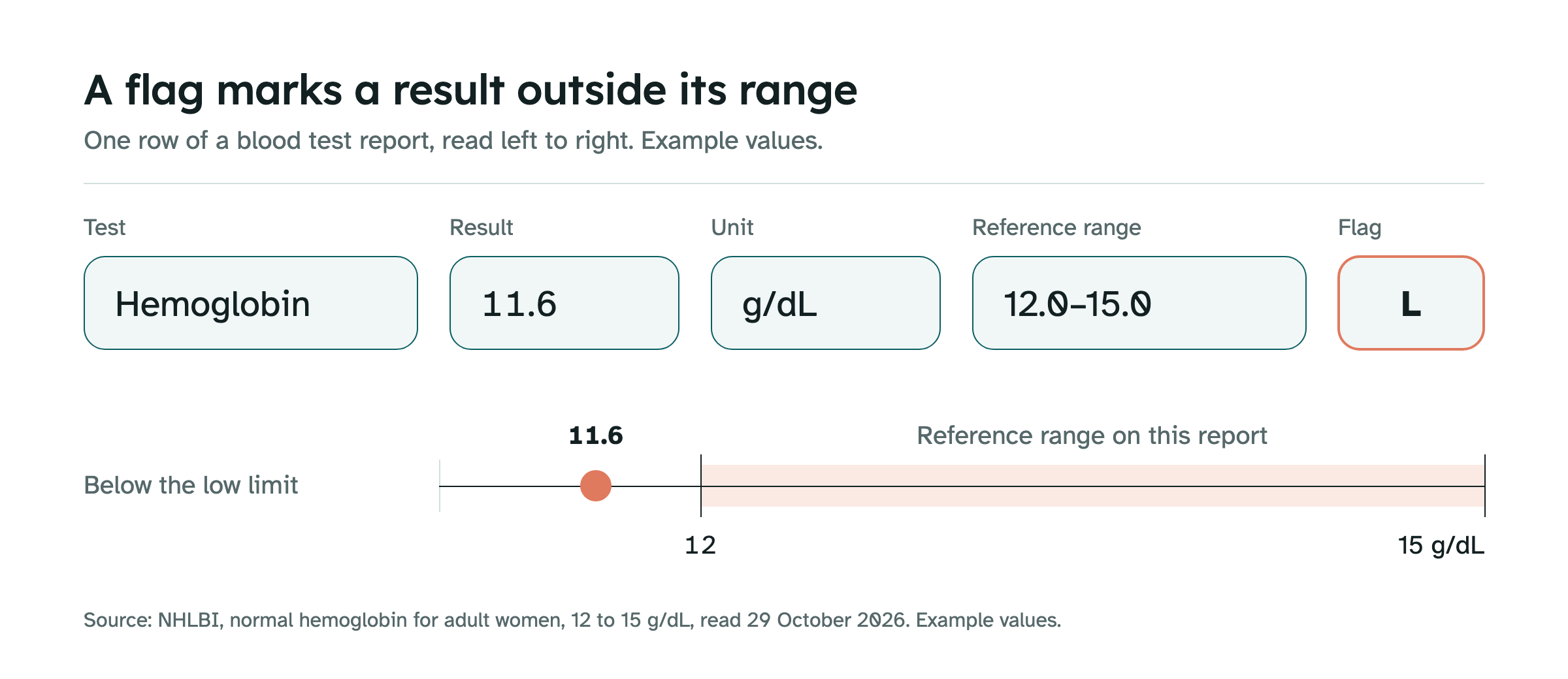
The reference range comes from testing large groups of healthy people, and a test can have separate ranges for children and adults.[1] Labs often use different methods, so MedlinePlus advises against comparing your result with ranges found elsewhere and against comparing results from different labs.
Common blood test abbreviations
Common blood test abbreviations stand for the cells, enzymes and fats a panel measures; the table gives their meaning from the MedlinePlus test pages.[4][5][9][7][8]
| Abbreviation | Stands for | What it tells you |
|---|---|---|
| WBC | White blood cells | Cells that fight infection |
| RBC | Red blood cells | Cells that carry oxygen |
| Hgb or Hb | Hemoglobin | Iron-rich protein that carries oxygen |
| Hct | Hematocrit | Share of blood volume made up of red cells |
| MCV | Mean corpuscular volume | Average size of red blood cells |
| PLT | Platelets | Cells that help blood clot |
| BUN | Blood urea nitrogen | Waste product filtered by the kidneys |
| eGFR | Estimated glomerular filtration rate | How well the kidneys filter, calculated from creatinine, age and other factors |
| ALT, AST | Alanine transaminase, aspartate aminotransferase | Enzymes made mainly in the liver |
| ALP | Alkaline phosphatase | Enzyme made mainly in the liver |
| LDL | Low-density lipoprotein | "Bad" cholesterol |
| HDL | High-density lipoprotein | "Good" cholesterol |
| A1C | Hemoglobin A1C | Share of hemoglobin coated with glucose |
What are normal results for a blood test?
Normal results for a blood test are the values inside the reference range printed on your report. MedlinePlus does not publish general ranges for most tests for exactly this reason: they differ between labs.[1] For a few tests, US public health bodies do publish typical adult values.
For the CBC, the NHLBI lists these normal ranges for adults on its anemia diagnosis page, last updated on 18 December 2025. Red blood cells, hemoglobin and hematocrit vary with altitude.[10]
| CBC value | Adult men | Adult women |
|---|---|---|
| Red blood cells | 5 to 6 million cells/mcL | 4 to 5 million cells/mcL |
| Hemoglobin | 14 to 17 g/dL | 12 to 15 g/dL |
| Hematocrit | 41% to 50% | 36% to 44% |
| Mean corpuscular volume | 80 to 95 fL | 80 to 95 fL |
For cholesterol, MedlinePlus gives healthy levels for adults aged 20 or older: total cholesterol below 200 mg/dL, LDL below 100 mg/dL and non-HDL below 130 mg/dL. HDL of 60 mg/dL or more is best, and HDL below 40 mg/dL in men or below 50 mg/dL in women is considered low.[7] The NHLBI gives the same non-HDL goal, below 130 mg/dL, together with HDL of at least 40 mg/dL for men and 50 mg/dL for women.[11]
For A1C, the cut-offs commonly used to diagnose diabetes are below 5.7% for normal, 5.7% to 6.4% for prediabetes and 6.5% or higher for diabetes.[8] MedlinePlus adds that providers often use more than one test before making that diagnosis.[8]
How can I interpret my blood test results?
You can interpret your blood test results best by looking at four things around the number, not the number alone.
The trend. One result is a snapshot. A value that rises or falls over several tests can matter even while it stays inside the range.[3] Trends only compare well when the tests come from the same lab, because ranges and methods differ.[1]
The unit. The same substance can be reported in different units, such as micrograms per deciliter or micromoles per liter. A number only means something next to its unit, so check the unit before you compare a result with an older report or with another country's lab.
Preparation. MedlinePlus lists food and drink, medicines or supplements, hard exercise, a menstrual period and skipped fasting as common factors that can change a result.[1] Fasting for a blood test usually means 8 to 12 hours with nothing but plain water.[12] A CBC alone needs no special preparation, and not drinking enough water is one of the things that can shift its values.[4]
The whole picture. Your provider reads lab results together with a physical exam, your health history, your family history and any imaging. MedlinePlus states that this combination usually leads to a more accurate diagnosis than any one lab test.[1]
A short list to take to the appointment:
- Which flagged results matter, and which are expected for me?
- Has any value changed since my last test?
- Did fasting, medicines or supplements affect a result?
- Do I need a repeat test, and when?
Blood test results chart
A blood test results chart can only show the typical adult values that US health sources publish for common blood tests, read on 29 October 2026. Your lab's own range wins wherever the two differ. The MedlinePlus pages for the CMP and the CBC give no general ranges for the chemistry values or white blood cells, so only your report can answer what is normal for them.[5][4][10][7][8][9]
| Test | What it measures | Typical adult value | Source |
|---|---|---|---|
| Hemoglobin | Oxygen-carrying protein | Men 14 to 17 g/dL; women 12 to 15 g/dL | NHLBI |
| Hematocrit | Red cell share of blood | Men 41% to 50%; women 36% to 44% | NHLBI |
| MCV | Red cell size | 80 to 95 fL | NHLBI |
| Total cholesterol | All cholesterol in blood | Below 200 mg/dL | MedlinePlus |
| LDL | "Bad" cholesterol | Below 100 mg/dL | MedlinePlus |
| HDL | "Good" cholesterol | 60 mg/dL or more is best | MedlinePlus |
| A1C | Long-term blood sugar | Below 5.7% | MedlinePlus |
| eGFR | Kidney filtering | 90 to 100: probably no kidney disease | MedlinePlus |
| CMP values, WBC, platelets | Chemistry and other blood cells | Range on your own report | MedlinePlus |
The next step is simple: bring this list and your report to the clinician or pharmacist who can see your history. If cost or access is the question, the guide to checking whether your insurance covers a treatment walks through it. More guides on blood panels sit in the Lab Tests section.
Frequently asked questions
What does H or L mean on a blood test?
H means your result is above the lab's reference range and L means it is below. It marks a value to discuss with your clinician; on its own it is not a diagnosis.
Can I compare my results with a chart online?
Only roughly. Labs use different methods and reference ranges, so the range printed on your own report is the one to compare against.
Why is my result outside the range when I feel fine?
Reference ranges usually cover 95% of healthy people, so about 1 in 20 healthy people falls outside any single range. Food, exercise, medicines and fasting can also shift a result.
Do I need to fast before a blood test?
Only if your provider says so. A CBC alone needs no preparation, while some chemistry and cholesterol tests may need 8 to 12 hours with nothing but plain water.
Does a normal result mean I am healthy?
Not always. A result inside the range does not rule out every problem, and symptoms can still be a reason for more tests.
Sources
Medical disclaimer. The content on Elenra is general information. It is not medical advice, diagnosis or treatment and does not replace a consultation with a doctor or another qualified health professional. Talk to your doctor before you start, change or stop any medication or treatment. In an emergency, call your local emergency number. Medical disclaimer
Related reading
All Lab Tests →CBC vs CMP: what each blood test checks
CBC vs CMP: a CBC counts your blood cells, a CMP measures 14 chemicals. What each shows, which needs fasting and which tube is drawn first.

Best at-home blood test kits in 2026: accuracy and price
The best at home blood test is a finger-prick kit read by a CLIA-certified lab. Five US services compared on price and accuracy, 26 October 2026.