Best sleep trackers in 2026: rings, watches and bedside devices
The best sleep tracker for you depends on form and running cost. Compare rings, watches, an arm band and bedside devices with prices and subscriptions.
In this article9
What is the best sleep tracker without a subscription?
The best sleep tracker without a subscription is one whose maker sells the sleep analysis with the device. Among the products compared here, RingConn says outright that its Gen 2 ring tracks sleep with "No Subscription Required".[1] Apple and Garmin sell sleep scoring as part of the hardware and its app, and neither product page lists a subscription for it.
Other makers split the product into hardware and a membership. Oura charges €5.99 a month or €69.99 a year for EU members, and $5.99 a month or $69.99 a year before tax in the US.[2] Without the membership, Oura says the ring and app still work, but the insights you get are "much more limited".[2]
Google's Pixel Watch 4 tracks sleep with the Google Health app, but some features and the personal coaching need a Google Health Premium subscription. After a free trial, Google lists it at €8.99 a month in Germany.[3] Eight Sleep goes furthest: its Pod requires an Autopilot plan for the first 12 months, starting at €199 a year.[4]
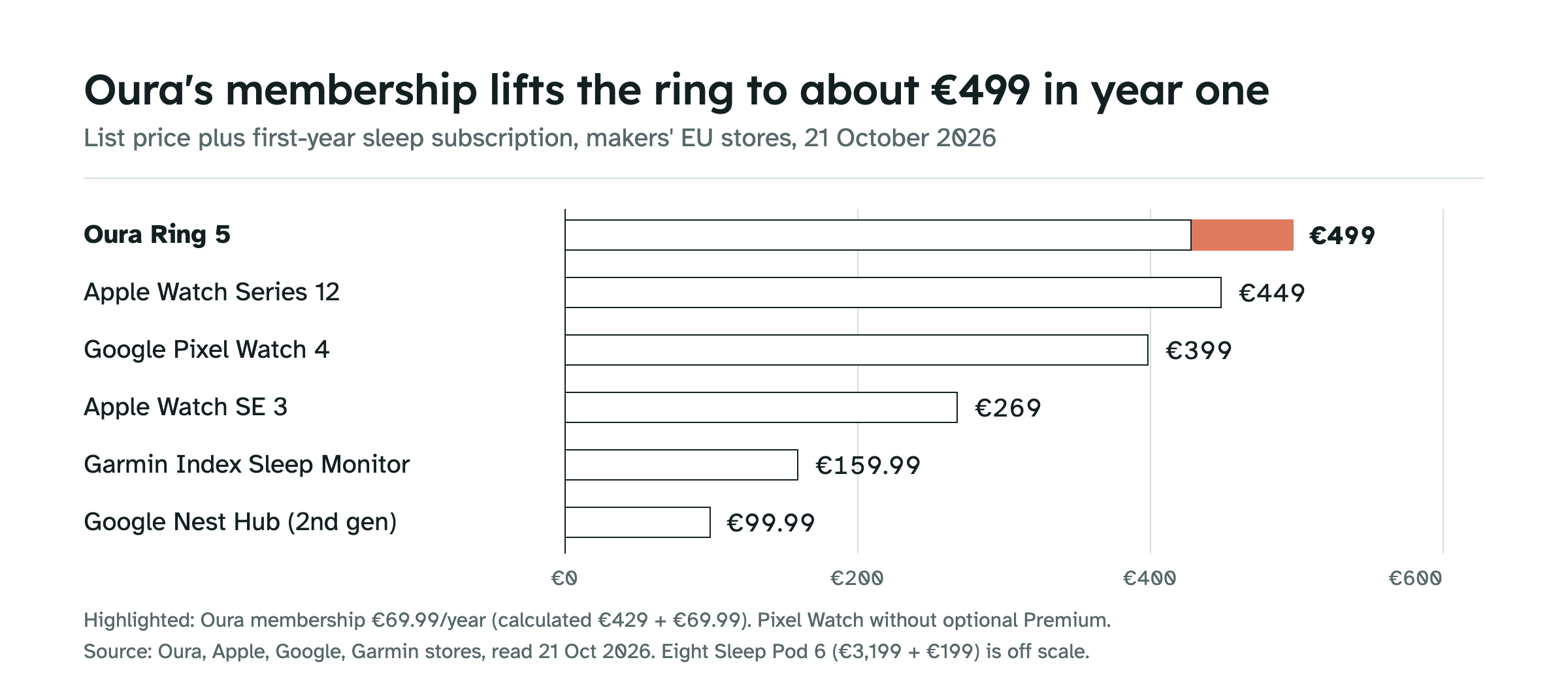
A subscription is not automatically a bad deal, but it changes the price. Over the first year, an Oura Ring 5 at €429 plus the annual membership costs about €499. In the US, Oura lists its membership as eligible for health savings and flexible spending accounts, which are explained in the guide to HSA and FSA rules in health care[5].[2]
Which tracker is best for sleep tracking?
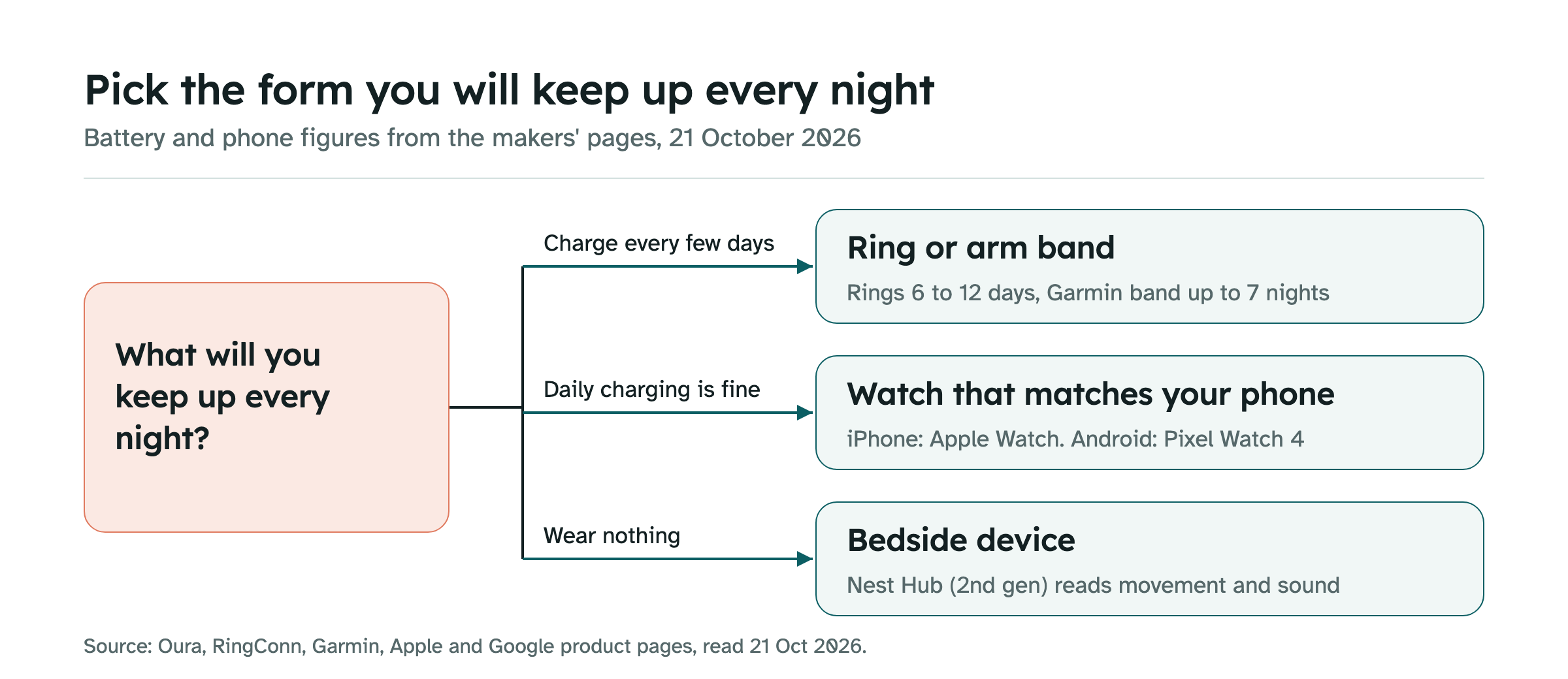
The best tracker for sleep tracking is the form you will not take off at night. A device that sits in a drawer or runs flat at 2 am records nothing, so comfort, battery life and your phone matter more than a long feature list.
- Ring: small and light on the finger, with several days per charge. Oura gives 6 to 9 days for the Ring 5, and RingConn gives 10 to 12 days for the Gen 2.[6][1]
- Watch: tracks sleep and daytime activity in one device, but needs charging more often. Apple lists up to 24 hours for the Series 12 and up to 18 hours for the SE 3.[7]
- Arm band: Garmin's Index Sleep Monitor is worn on the upper arm only at night and lasts up to 7 nights.[8]
- Bedside device: Google's Nest Hub (2nd gen) uses movement and sound to analyse sleep, so you wear nothing.[9]
- Bed cover: Eight Sleep's Pod sits on the mattress and combines sleep tracking with heating and cooling, at a far higher price.[4]
Check your phone before anything else. Apple shows sleep data in the Health app on iPhone, and Google requires the Google Health app, a Google account and a compatible Android device for the Pixel Watch 4.[10][3]
Do sleep trackers actually work?
Sleep trackers work as estimates, not as medical tests. They infer sleep from movement, heart rate, temperature or sound, while a sleep lab study (polysomnography) records brain activity, breathing and more through the night.
The American Academy of Sleep Medicine (AASM),[11] the US professional society for sleep medicine, addressed this in its 2018 position statement on consumer sleep technology. It said these devices lacked validation against polysomnography and clearance by the US Food and Drug Administration, so they cannot be used to diagnose or treat sleep disorders.[12] The same statement says they may help the conversation between patient and clinician when used within a proper clinical evaluation.
The makers say much the same. Google states that the Pixel Watch 4's sleep analysis is not meant for diagnosing or treating disease. It says the same of Sleep Sensing on the Nest Hub.[3][9] Garmin notes that its sleep monitor is not a medical device.[8] How accurate individual devices are, and whether a wearable can detect sleep apnea, are separate questions this guide does not cover.
Where a tracker is useful is in showing patterns against a clear benchmark. The US Centers for Disease Control and Prevention (CDC) recommends 7 or more hours of sleep for adults aged 18 to 60. For ages 61 to 64 it gives 7 to 9 hours, and 7 to 8 hours from 65 on.[13] Those are US recommendations; other countries publish their own.
Many people fall short of that. According to the CDC, about 1 in 3 US adults reported not getting enough rest or sleep every day. An estimated 50 to 70 million Americans have chronic sleep disorders, as the National Heart, Lung, and Blood Institute (NHLBI) notes on a page last updated on 24 March 2022.[14] A tracker can show whether your own nights fit the guideline, but it cannot tell you why they do not.
Best sleep tracker ring
The best sleep tracker ring depends on whether you accept a subscription. Oura and RingConn both track sleep from the finger, but they price the analysis differently.
Oura Ring 5. Oura sells the Ring 5 from €429 on its EU store and gives 6 to 9 days of battery life, depending on ring size and use.[6] The full Oura experience needs the membership described above, with the first month free for new members.[2] Oura also offers a free sizing kit, which matters because a ring that fits badly is easy to stop wearing.
RingConn Gen 2. RingConn lists the Gen 2 at $299 on its store, which shows US dollars to readers in Europe. On 21 October 2026 it was marked out of stock.[1] RingConn gives 10 to 12 days of battery life and up to 150 days with its charging case, and it states that no subscription is required.
A ring suits you if a watch feels heavy at night or you dislike charging every day. It suits you less if you also want a screen on your wrist for notifications and workouts.
Best sleep tracker watch
The best sleep tracker watch is usually the one that matches your phone. Apple Watch works with iPhone, and the Pixel Watch 4 needs a compatible Android device.
Apple Watch Series 12 and SE 3. Apple lists the Series 12 from €449 and the SE 3 from €269 in Germany, and both show a sleep score.[7] Apple's support page explains the score: it runs from 0 to 100 and is built from sleep duration (50 points), bedtime consistency (30 points) and interruptions (20 points).[10] Apple advises charging the watch to at least 30% before bed and wearing it for at least one hour to record sleep.[10]
That points to the main drawback of a watch. With up to 24 hours on the Series 12 and up to 18 hours on the SE 3, you need a charging routine, for example during a shower or breakfast.[7]
Google Pixel Watch 4. Google sells the Pixel Watch 4 from €399 in Germany.[3] It uses sleep, resting heart rate and heart rate variability to show whether you are ready for a demanding workout or need rest. Some features and the coaching require Google Health Premium, which comes with a three-month free trial and then costs €8.99 a month.
Garmin Index Sleep Monitor. If you want night data without wearing a watch in bed, Garmin sells an arm band for €159.99.[8] It reports a sleep score, sleep stages and heart rate variability status in the Garmin Connect app, and it has a smart alarm that vibrates within a 30-minute window.
Best sleep tracker app
The best sleep tracker app is usually the one that comes with your device. Apple's Health app, the Oura app, Google Health and Garmin Connect each read data from their own hardware, so the app choice follows the device choice.
A phone-only app is the cheapest place to start. Sleep Cycle is a free download with in-app purchases and a Premium subscription, and it analyses sleep with sound picked up by the phone's microphone.[15] It also offers a wake-up alarm timed to a light sleep phase and shares data with Apple Health. On its own, a phone app relies on sound rather than signals from your body, so it has less to work with than a wearable.
For people who do not want to wear anything, a bedside device sits between the two. Google's Nest Hub (2nd gen) costs €99.99 in Germany, and Google says Sleep Sensing can currently be tried at no extra charge.[9] It is a smart display first, so it also puts a screen in the bedroom.
Best sleep trackers 2026
The best sleep trackers of 2026 are compared below on four criteria: form, list price, battery life and whether the sleep analysis needs a subscription. Elenra did not test these devices; the figures come from the makers' own pages, read on 21 October 2026, and the Elenra methodology[16] explains how comparisons are built.
| Device | Form | List price | Battery | Subscription for sleep analysis |
|---|---|---|---|---|
| Oura Ring 5 | Ring | from €429[6] | 6 to 9 days | Membership €5.99/month or €69.99/year (EU)[2] |
| RingConn Gen 2 | Ring | $299 (out of stock)[1] | 10 to 12 days | Not required, per RingConn |
| Apple Watch Series 12 | Watch | from €449[7] | up to 24 hours | None listed |
| Apple Watch SE 3 | Watch | from €269 | up to 18 hours | None listed |
| Google Pixel Watch 4 | Watch | from €399[3] | not compared | Some features: Google Health Premium €8.99/month |
| Garmin Index Sleep Monitor | Arm band | €159.99[8] | up to 7 nights | None listed |
| Google Nest Hub (2nd gen) | Bedside | €99.99[9] | mains power | Sleep Sensing currently at no extra charge |
| Eight Sleep Pod 6 | Bed cover | from €3,199[4] | mains power | Autopilot required for 12 months, from €199/year |
Euro prices are those the makers show on their German or EU stores; RingConn shows US dollars. A few rules help narrow the list:
- If you will not charge every day, start with a ring or the Garmin arm band.
- If you want one device for day and night, choose the watch that matches your phone.
- If you do not want to wear anything, a bedside device is the simplest option.
- Add the first year of any subscription to the price before you compare.
If your sleep stays poor for weeks, take the numbers and this decision list to a licensed clinician or pharmacist rather than to another app. The guide on waking up at 3am every night explains when night waking needs a clinician, and the sleep trackers section[17] lists related guides.
Frequently asked questions
Do I need a subscription to track sleep?
Not always. RingConn says its Gen 2 ring needs none, while Oura's full analysis needs a membership of €5.99 a month in the EU.
Can a sleep tracker diagnose insomnia or other sleep disorders?
No. A tracker can show a pattern worth discussing, but a diagnosis needs a clinician and, where needed, a sleep study.
Is a ring or a watch better for sleep?
A ring is smaller and lasts several days per charge, which makes it easy to wear every night. A watch adds a screen and daytime features but needs charging more often.
How much sleep should a tracker show?
The CDC recommends 7 or more hours for adults aged 18 to 60. Other countries publish their own guidance.
Can I track sleep without wearing anything?
Yes. A phone app such as Sleep Cycle or a bedside device such as Google's Nest Hub estimates sleep from sound or movement, with less data than a wearable.
Sources
Medical disclaimer. The content on Elenra is general information. It is not medical advice, diagnosis or treatment and does not replace a consultation with a doctor or another qualified health professional. Talk to your doctor before you start, change or stop any medication or treatment. In an emergency, call your local emergency number. Medical disclaimer
Related reading
All Sleep →Waking up at 3am every night: causes and what helps
Waking up at 3am every night has common causes, from stress to alcohol to sleep apnea. See what US health bodies say helps and when to see a clinician.
How much sleep do adults need by age?
Adults need 7 or more hours of sleep per night, with needs shifting slightly by age. Learn what the evidence says about 6, 3 or 2 hours and when to seek help.