Waking up at 3am every night: causes and what helps
Waking up at 3am every night has common causes, from stress to alcohol to sleep apnea. See what US health bodies say helps and when to see a clinician.
In this article5

How to go back to sleep after waking up?
Start by not treating the wake-up as an emergency. The American Academy of Sleep Medicine (AASM) says that an occasional poor night is not insomnia; in many cases it means you stayed up late, got up early or woke in the night, and stress is a common reason.[1] Worrying about whether you will get enough sleep and watching the clock can make sleep problems worse, according to the National Heart, Lung, and Blood Institute (NHLBI).[2]
What the NHLBI lists under stimulus control is practical. Go to bed only when you are sleepy, get out of bed if you cannot sleep, and use the bed only for sleep and sexual activity.[3] The same page suggests winding down with a routine such as reading, soothing music or a hot bath, and keeping the bedroom cool, quiet and dark. It also advises avoiding TV and electronic devices, because their light can disrupt your sleep-wake cycle.[3]
A few habits during the day and evening make a repeat wake-up less likely:
- Keep a regular sleep and wake time, including weekends.
- Avoid caffeine, nicotine and alcohol close to bedtime.
- Be active during the day, finishing at least 5 to 6 hours before bed.
- Limit what you drink close to bedtime, so you are less likely to need the bathroom.
Each of these comes from the NHLBI's insomnia treatment page, last updated on 24 March 2022.[3] They are general habits, not a treatment plan for your situation. If you want a longer view of how much sleep adults need, see our guide on how much sleep adults need by age.
Why do I wake up at 3am
The medical sources behind this guide describe waking in the night in general. None of them singles out 3 am as a special hour. The time on the clock is what you notice; the guidance looks at how often it happens, for how long and what else is going on.
The NHLBI says waking often during the night is the most common insomnia symptom and mostly affects older adults. Waking too early and not getting back to sleep is also common.[4] The causes the sources name fall into a few groups:
- Stress and mood. The NHLBI lists worry about school or work, relationships, money or the death of a loved one.[2] The AASM adds that depression is a frequent cause of insomnia.[1]
- Alcohol, caffeine and nicotine. The NHLBI notes that alcohol can make it easier to fall asleep but leads to lighter sleep than normal, which makes waking during the night more likely.[3]
- Your room and routine. Noise, light during the night, uncomfortably high or low temperatures and a changing schedule can disturb your sleep-wake cycle.[2] The AASM also names a bed partner who snores.[1]
- Hormone changes. Insomnia is more common in women than in men, and hormone changes in pregnancy and menopause can cause sleep problems.[2]
- Medicines. Pseudoephedrine in some cold and allergy medicines, and some antidepressants and medicines for ADHD, high blood pressure or Parkinson's disease, can cause insomnia, according to the AASM.[1] Do not stop or change a medicine on your own; ask the prescriber or a pharmacist.
- Other medical conditions. Pain, discomfort and limited mobility can make it hard to stay asleep.[1]
Sleep apnea deserves a separate mention. The NHLBI lists breathing that starts and stops, frequent loud snoring and gasping for air as symptoms during sleep, and waking often during the night to urinate among the symptoms you may notice yourself.[5] Frequent night-time urination can have other causes too, so it is a prompt to ask, not a diagnosis. The NHLBI says a sleep study may be needed to diagnose apnea.[5]
Middle of the night insomnia
Insomnia means trouble falling asleep, staying asleep or getting good-quality sleep even when you have the time and the right environment. The NHLBI describes chronic insomnia as occurring three or more nights a week for more than three months and not fully explained by another health problem.[6] Short-term insomnia can last a few days or weeks.[6]
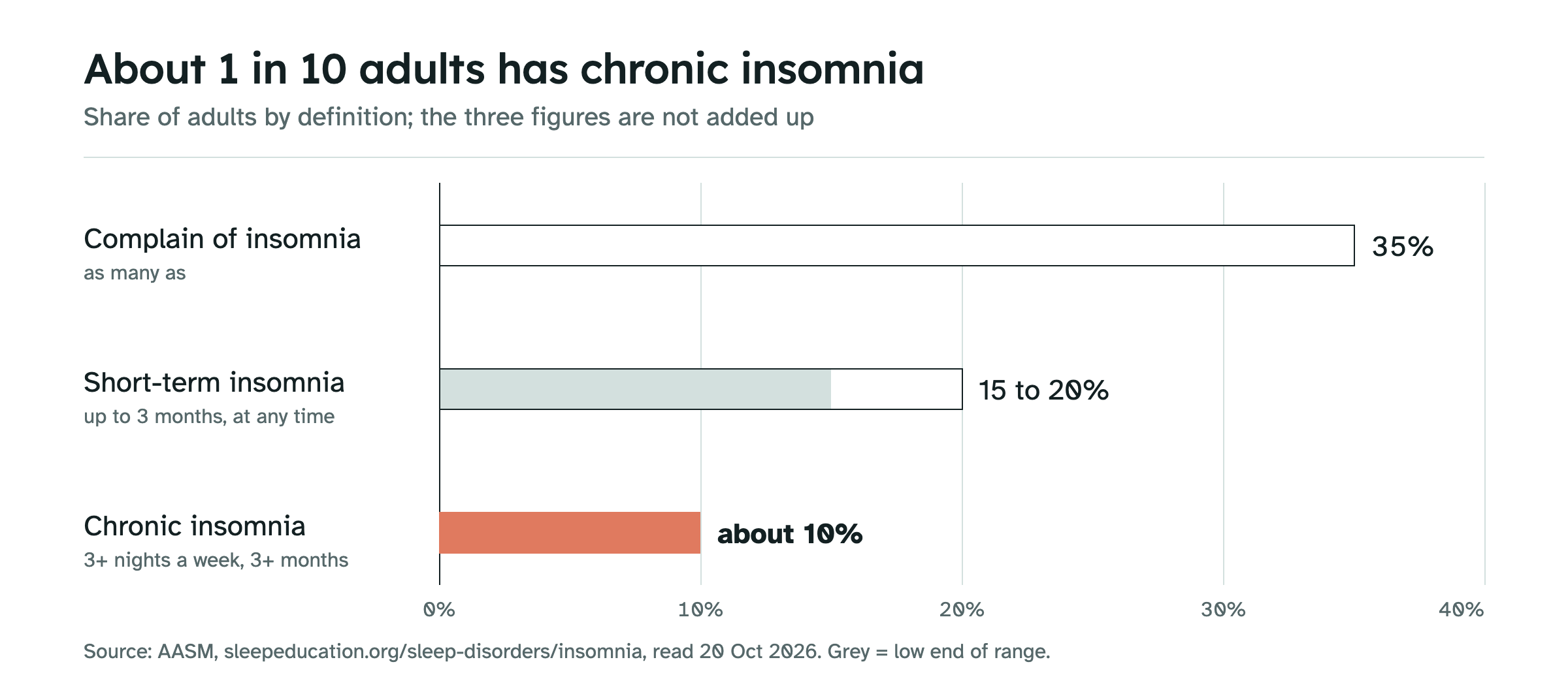
How common it is depends on how it is counted. The AASM's patient site says as many as 35 percent of adults complain of insomnia. It puts short-term insomnia, which lasts up to three months, at 15 to 20 percent of people at any given time, and chronic insomnia at about 10 percent of people.[1] Those figures are from the AASM page as read on 20 October 2026, and they describe groups, not your own risk.
MedlinePlus adds that most cases of chronic insomnia are secondary, meaning they are a symptom or side effect of another problem such as a medical condition, a medicine or another sleep disorder.[7] That is why a clinician usually starts with your history: the cause shapes the treatment.
Chronic insomnia is not only a nuisance. The NHLBI says it can affect memory and concentration and is associated with a higher risk of high blood pressure, coronary heart disease, diabetes and cancer.[6] These are associations, and they do not mean that your own broken nights will lead to any of them.
When to see a clinician
The AASM suggests booking an appointment with a sleep doctor if you have had insomnia for at least three months. For less than three months, it suggests following good sleep hygiene and talking to a medical provider if the problem does not go away.[1] A two-week sleep diary, noting when you go to sleep, when you wake and how long you were awake in between, gives the clinician something concrete to work with.[1]
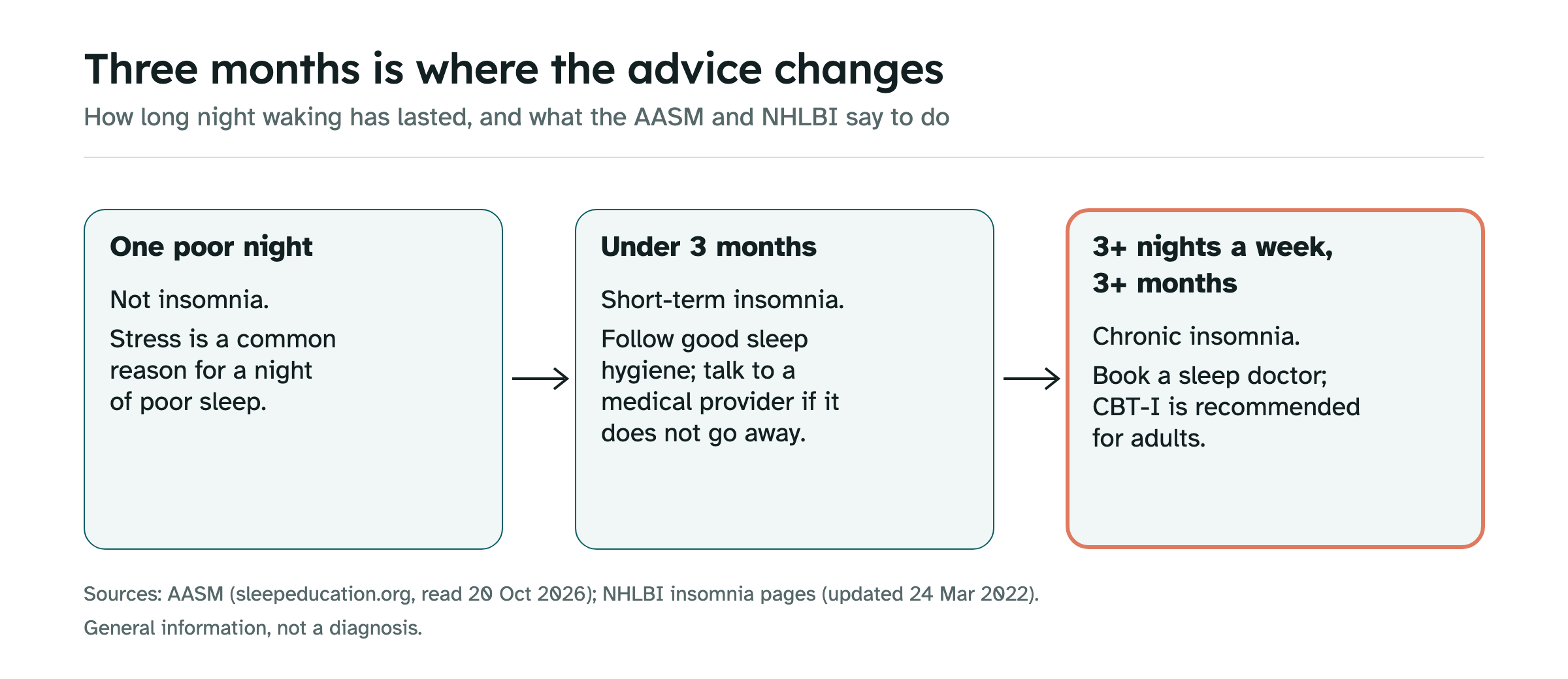
For chronic insomnia, the AASM states that cognitive behavioral therapy for insomnia (CBT-I) is recommended for adults. It addresses the thoughts and behaviors that keep you from sleeping well, and it can be delivered in person, by video or online.[1] The NHLBI describes CBT-I as a 6- to 8-week plan that is usually the first treatment option for long-term insomnia.[3] How CBT-I compares with sleep medicines and supplements is a separate question; this guide does not rank treatments, and only a clinician who knows your history can advise on them.
Questions to take to a clinician or pharmacist:
- How many nights a week do I wake, and for how long? (Bring the sleep diary.)
- Could any of my medicines, alcohol or caffeine be part of it?
- Do snoring, gasping or waking to urinate mean I should be checked for sleep apnea?
- Could menopause, pain, low mood or anxiety be involved?
- Is CBT-I available to me in person or online, and what would it cost? Our guide on how to check whether your insurance covers a treatment[8] can help with that last question.
This is general information and not a diagnosis; see our medical disclaimer[9]. If sleepiness is making driving or work unsafe, or low mood is growing, do not wait for the three months to pass.
Frequently asked questions
Is waking up at 3am every night a sign of something serious?
Not necessarily. Occasional waking is common and often linked to stress or habits. Waking up several nights a week for more than three months meets the NHLBI definition of chronic insomnia, and then a clinician should look for causes, including sleep apnea, medicines and mood.
What should I do if I cannot fall back asleep?
The NHLBI advises getting out of bed if you cannot sleep and going back only when you are sleepy, keeping the room cool, quiet and dark, and staying away from screens.
Does alcohol make night waking worse?
It can. The causes section above sets out what the NHLBI says about alcohol and sleep.
When is middle of the night insomnia chronic?
When it happens three or more nights a week, lasts more than three months and cannot be fully explained by another health problem, according to the NHLBI.
Which treatment do guidelines favor for chronic insomnia?
The AASM states that cognitive behavioral therapy for insomnia (CBT-I) is recommended for chronic insomnia disorder in adults. Whether it fits you is a question for a clinician.
Sources
Medical disclaimer. The content on Elenra is general information. It is not medical advice, diagnosis or treatment and does not replace a consultation with a doctor or another qualified health professional. Talk to your doctor before you start, change or stop any medication or treatment. In an emergency, call your local emergency number. Medical disclaimer
Related reading
All Sleep →Best sleep trackers in 2026: rings, watches and bedside devices
The best sleep tracker for you depends on form and running cost. Compare rings, watches, an arm band and bedside devices with prices and subscriptions.

How much sleep do adults need by age?
Adults need 7 or more hours of sleep per night, with needs shifting slightly by age. Learn what the evidence says about 6, 3 or 2 hours and when to seek help.