How much sleep do adults need by age?
Adults need 7 or more hours of sleep per night, with needs shifting slightly by age. Learn what the evidence says about 6, 3 or 2 hours and when to seek help.
Contents
Can you function on 6 hours of sleep?
Many people who sleep six hours a night describe themselves as functioning fine, and for the first day or two that can genuinely feel true. The problem is that the feeling is not a reliable measure. In a well-known lab study published in the journal Sleep in 2003, healthy adults were restricted to six hours in bed per night for 14 consecutive days. Their performance on attention and reaction-time tasks declined steadily, accumulating into cognitive deficits equivalent to up to two full nights without any sleep at all.[1]
What makes this study so widely cited is what happened to the participants' own ratings. Their subjective sleepiness rose sharply at first, then levelled off, and barely distinguished the six-hour group from people sleeping even less.[1] In other words, the participants stopped feeling sleepier even as their measured performance kept getting worse. The US National Heart, Lung, and Blood Institute (NHLBI) describes the underlying belief as a common myth: the idea that people can learn to get by on little sleep with no negative effects. Research points the other way.[2]
Like any single study, this one has limits.
- The participants were a small group of healthy adults studied in a controlled laboratory, not people managing real work, family and screen time.
- The restriction lasted two weeks, so it cannot say what years of six-hour nights do over a lifetime.
- The outcomes were lab performance tasks, which are sensitive measures but not the same as everyday errors, mood or long-term health.
- The study shows what happens on average, not who can safely run on less sleep as an individual.
In short: you may feel functional on six hours, and you may even perform close to normally for a short while, but the evidence suggests the feeling of adaptation arrives well before the actual adaptation does. Whether six hours is also unhealthy over the long run is the next question.
Is it healthy to sleep for 6 hours?
One short night is a recovery question; a habit of short nights is a health question. Here the evidence comes mostly from large observational studies that follow people for years and compare health outcomes with reported sleep duration. The NHLBI summarises that sleep deficiency is linked to a range of chronic health problems, including heart disease, kidney disease, high blood pressure, diabetes, stroke, obesity and depression.[2] The joint consensus statement of the American Academy of Sleep Medicine and the Sleep Research Society reaches a similar list, adding impaired immune function, increased pain, more errors and a higher accident risk for people regularly sleeping under seven hours.[3]
For the conditions most often studied, the pattern is consistent enough that it is worth taking seriously, particularly for the heart and metabolism.
- Heart disease and high blood pressure
- Type 2 diabetes
- Obesity and weight gain
- Depression and low mood
- Stroke
Two caveats keep this honest. First, these are associations, not proof that short sleep causes these conditions. People who sleep little also tend to differ in other ways, such as shift work, stress, illness or lifestyle factors, and no observational study can fully separate those threads. Second, sleep duration is only one factor among many, and no guideline suggests that sleep hours alone determine health outcomes. The scale of the issue is nonetheless large: according to the CDC, about 1 in 3 adults in the United States reports not getting enough rest or sleep every day.[2] So six hours is not a clearly harmless shortcut, but it is also not a verdict on any one person's future health.
Do adults need 7 or 8 hours of sleep?
The clearest guideline answer comes from a joint consensus statement of the American Academy of Sleep Medicine (AASM) and the Sleep Research Society, published in the journal Sleep in June 2015. A panel of 15 sleep medicine and research experts, having reviewed thousands of studies, concluded: adults should sleep 7 or more hours per night on a regular basis to promote optimal health.[3] The AASM, a professional medical society for sleep medicine, continues to anchor its public guidance on this recommendation.[4]
It helps to read the number correctly. Seven hours is a floor, not a target. The same statement notes that regularly sleeping more than nine hours may be appropriate for some people, such as young adults, those recovering from sleep debt and people with illnesses, while for others the health effects of very long sleep are uncertain.[3] In practice, most adults do well somewhere between 7 and 9 hours, and the right amount for you is the amount within that range after which you feel alert during the day without needing caffeine to function.
What about the people who say they have always been fine on five or six hours? Genuine short sleepers, people who are truly rested on very little sleep, do exist and appear to run in families, but research suggests they are rare. Much more common is someone who has adapted to feeling tired, which the first section above showed is exactly what subjective ratings fail to detect. The claim "I am fine on less" is usually untested against anything more objective than a habit. For most readers asking whether they need 7 or 8 hours, the useful answer is: start from 7 as the minimum, and treat consistently needing much more or much less as something worth mentioning to a clinician.
Is having 2 hours of sleep enough?
No. Two hours is not enough sleep for an adult, and it is worth being plain about that. Sleep runs in cycles of roughly 90 minutes each, moving through light sleep, deep sleep and REM sleep, so two hours in bed allows at most one full cycle and misses most of the deep and REM sleep that a normal night provides. A night like that is closer to total sleep deprivation than to a short night, and the effects are the ones the NHLBI describes: trouble learning, focusing and reacting, and difficulty reading other people's emotions and reactions.[2]
The comparison from the 2003 lab study puts the scale in context: two weeks of six-hour nights produced deficits equivalent to up to two nights of total deprivation.[1] Two hours sits at the extreme end of that spectrum. Safety is the most immediate concern. According to the NHLBI, sleepiness while driving, not related to alcohol, is responsible for serious car crash injuries and deaths, and very short sleep makes brief, involuntary lapses of attention far more likely.[2] If you have slept two hours, driving and operating machinery are the activities to avoid first.
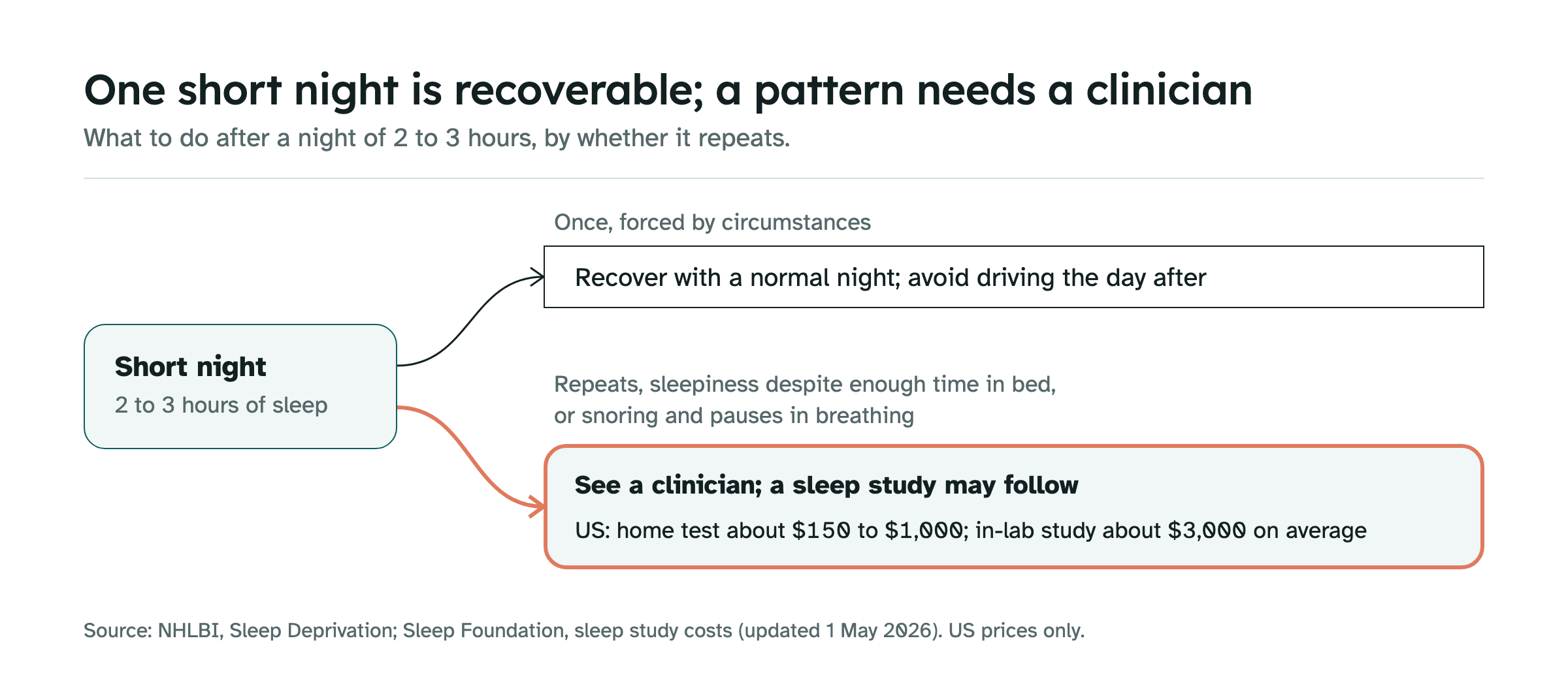
- A single two-hour night: unpleasant and genuinely impairing, but recoverable, usually within a night or two of normal sleep.
- A repeated pattern of two-hour nights: not sustainable, and a sign that something, from a schedule to an untreated sleep disorder, needs to change.
- The reassuring part: one bad night does not damage your health in any lasting way that research has shown.
- The less reassuring part: the brain does not fully compensate for lost sleep by napping briefly or pushing through, despite how normal a routine it can start to feel.
Will I be ok on 3 hours of sleep?
Three hours now and then is a different situation from either a six-hour habit or a two-hour emergency, because the practical question is usually how to get through one specific day: a flight, a sick child, a deadline. You will not be at your best, since attention, reaction time and mood all suffer after a night that short, but one three-hour night is something most healthy adults recover from once they sleep normally again.
- Treat driving as the main hazard. Sleepiness behind the wheel is linked to serious crash injuries and deaths, so if possible delay driving, use public transport or let someone else drive.[2]
- A short nap, ideally brief and early in the day, can take the edge off drowsiness without making the next night harder to sleep through.
- Caffeine can help alertness for a few hours if it is a tool you already use, but timed late in the day it tends to trade tonight's sleep for today's, which extends the problem.
- Plan an early night. Recovery sleep the following night is the actual fix; the other measures only make the day safer.
The line to watch is repetition. A three-hour night forced by circumstances is a scheduling problem. Three-hour nights that keep happening, whether from insomnia, a noisy environment, shift patterns or an inability to sleep longer despite the opportunity, stop being an occasional issue and become something to describe to a clinician, especially if daytime sleepiness persists. That distinction, one hard night versus a pattern you cannot change, is the most useful way to judge whether a short night is simply an inconvenience or the start of a conversation about your health.
How much sleep is ideal
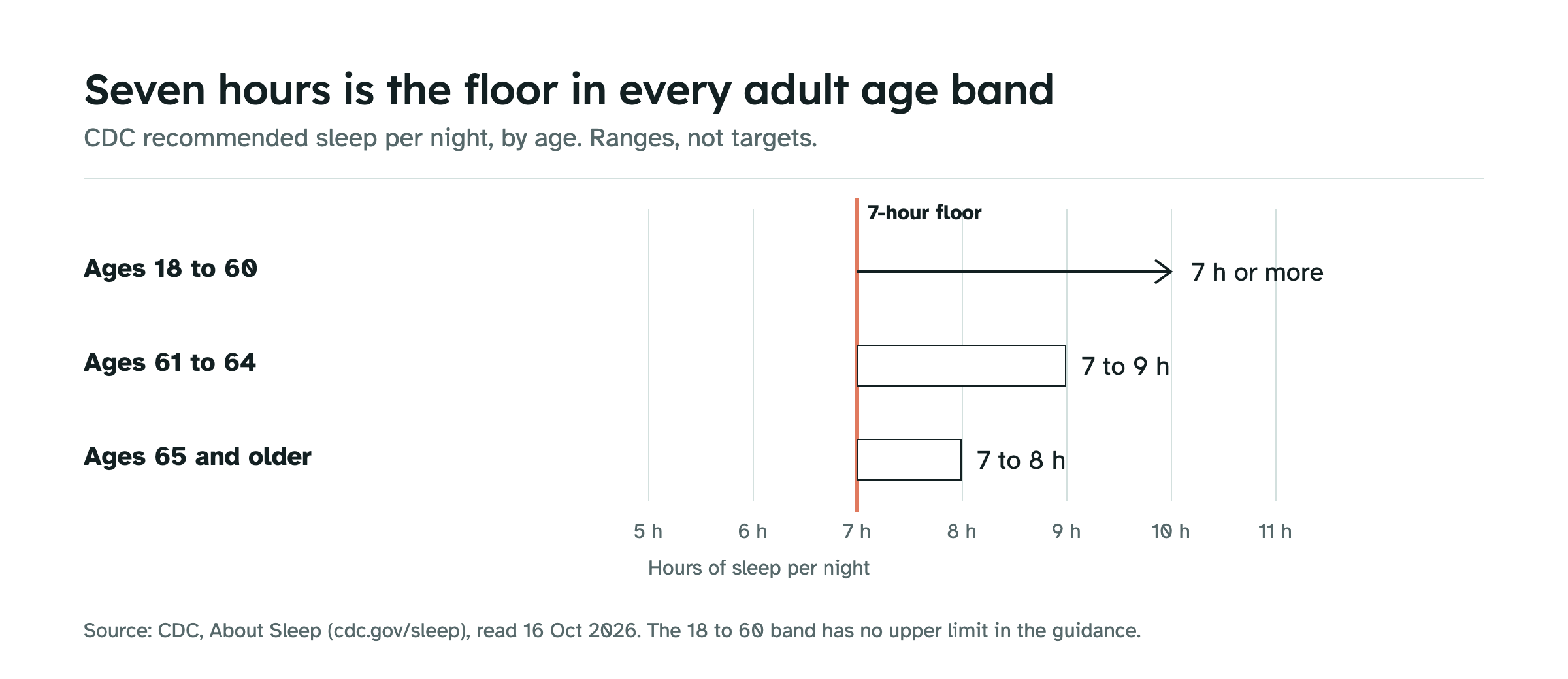
The by-age answer most health authorities converge on is summarised in the CDC's sleep recommendations, which draw on the AASM and Sleep Research Society consensus and the National Sleep Foundation's duration recommendations.[5] For adults, the numbers look like this:
| Age group | Recommended daily sleep |
|---|---|
| Adults, 18 to 60 years | 7 or more hours[5] |
| Adults, 61 to 64 years | 7 to 9 hours[5] |
| Adults, 65 years and older | 7 to 8 hours[5] |
For the common specific version of the question, how many hours a 40-year-old needs: at 40 you are in the 18-to-60 band, so the guideline minimum is 7 hours per night, with 7 to 9 being the range where most adults land. Older adults do not need dramatically less sleep, as is often assumed; the US National Institute on Aging notes that older people generally still need about the same amount as other adults, though their sleep tends to come earlier and be lighter and more fragmented.[6] Elenra's Healthy Aging section looks at related changes with age.
Hours are only half the answer. The CDC emphasises that sleep quality and consistency matter alongside duration: going to bed and getting up at similar times, sleeping mostly uninterrupted, and waking without feeling tired despite enough hours in bed.[5] The most practical test of whether your personal amount is right is not a formula but a pattern: you fall asleep within a reasonable time, wake reasonably refreshed, and stay alert through the day without leaning on stimulants. If that describes you at 7.5 hours, that is a better signal than any table. If it does not describe you even with 8 or 9 hours in bed, the next section is the relevant one.
When to seek help
Guideline numbers answer how much sleep adults need in general; they cannot tell you why you are not getting it. Some situations are worth moving from self-experiment to a professional conversation, because they can point to a treatable sleep disorder rather than a habit problem.
- You regularly sleep poorly despite spending enough time in bed.
- A partner has noticed loud snoring, gasping or pauses in breathing during the night.
- Daytime sleepiness persists even after nights that look long enough.
- You fall asleep unintentionally during the day, or feel very drowsy while driving.[2]
If a clinician suspects a sleep disorder such as sleep apnea, the usual next step is a sleep study. In the United States, costs vary widely and depend heavily on insurance. According to the Sleep Foundation (updated May 2026), an in-lab sleep study, called polysomnography, averages about 3,000 US dollars, with a range from about 1,000 to over 10,000 dollars depending on coverage and facility.[7] Home sleep apnea tests, which use less equipment and no overnight lab stay, typically run from about 150 to 1,000 dollars. For those eligible, US Medicare covers 80 percent of the cost of medically necessary sleep studies after the deductible is met.[7]
| Type of test | Typical US cost |
|---|---|
| In-lab sleep study (polysomnography) | About 3,000 USD on average; roughly 1,000 to over 10,000 USD[7] |
| Home sleep apnea test | About 150 to 1,000 USD[7] |
| Medicare coverage | 80 percent of medically necessary studies after the deductible[7] |
These figures and pathways are specific to the US system. If you read this from another country, the tests and coverage will differ, sometimes substantially, so check how sleep studies are arranged and reimbursed in your local health system rather than planning around American prices. What does not differ is the sensible next step: take the decision list above, along with a note of your typical sleep hours and daytime symptoms, to a licensed clinician or pharmacist, and ask what testing would involve for you. More background on sleep quality, sleep disorders and how guides like this one are researched is collected in Elenra's sleep health section.
Frequently asked questions
How many hours of sleep does a 40-year-old need?
A 40-year-old falls in the adult 18-60 band, for which the CDC and the AASM recommend 7 or more hours per night. Most adults in this range do best between 7 and 9 hours, and individual needs vary within that band.
Do adults need 7 or 8 hours of sleep?
The American Academy of Sleep Medicine and the Sleep Research Society recommend 7 or more hours per night on a regular basis, so 7 is the minimum rather than the ideal. Most healthy adults land between 7 and 9 hours; if you wake refreshed and stay alert without stimulants, your amount is likely right for you.
Can I train my body to need less sleep?
Research suggests not. In a well-known lab study, people restricted to 6 hours per night for 14 days showed steadily declining cognitive performance, equivalent to up to 2 nights of total sleep deprivation, while their own sleepiness ratings barely rose. Feeling adapted is not the same as being unimpaired.
Is 6 hours of sleep enough for an adult?
For most adults, no. Six hours sits below the 7-hour floor recommended by the AASM, and habitually short sleep is linked in observational research to higher risks of heart disease, high blood pressure, diabetes, obesity and depression. These are associations rather than proven causes, but the guideline is clear.
What happens if I only sleep 2 or 3 hours in a night?
One very short night measurably impairs attention, reaction time, mood and the ability to read other people's emotions, and it raises the risk of microsleeps, which makes driving dangerous. A single night like this is recoverable with normal sleep afterwards; the concern is when it keeps happening.
How much does a sleep study cost without insurance?
US figures: an in-lab sleep study (polysomnography) averages about 3,000 dollars, with prices ranging from about 1,000 to over 10,000, while home sleep apnea tests typically cost 150 to 1,000 dollars. US Medicare covers 80 percent of a medically necessary study after the deductible. Costs and pathways differ outside the US, so check your local system.
Does sleep need change with age after 18?
Only slightly. The CDC recommends 7 or more hours for adults 18-60, 7-9 hours for 61-64, and 7-8 hours for 65 and older. Older adults often shift to earlier bed and wake times and sleep more lightly, but the total need stays close to 7 to 8 hours.
How can I tell if I am getting enough sleep?
Practical signs include falling asleep within roughly 15-30 minutes, waking without an alarm feeling reasonably rested, and staying alert through the day without needing caffeine to function. If you regularly give yourself enough time in bed and still sleep poorly or feel sleepy, that is worth discussing with a clinician.