Strength training for beginners: a 3-day full-body plan
A strength training plan for beginners: five exercises per day, a set ladder by week and when to add weight, based on HHS and ACSM 2026 guidance.
In this article8
- How often should a beginner do strength training?
- Is strength training and weight training the same?
- Beginner workout plan: three full-body days
- What belongs in a basic workout plan?
- How do you progress a strength training program?
- Who should check with a clinician first?
- Frequently asked questions
- Sources
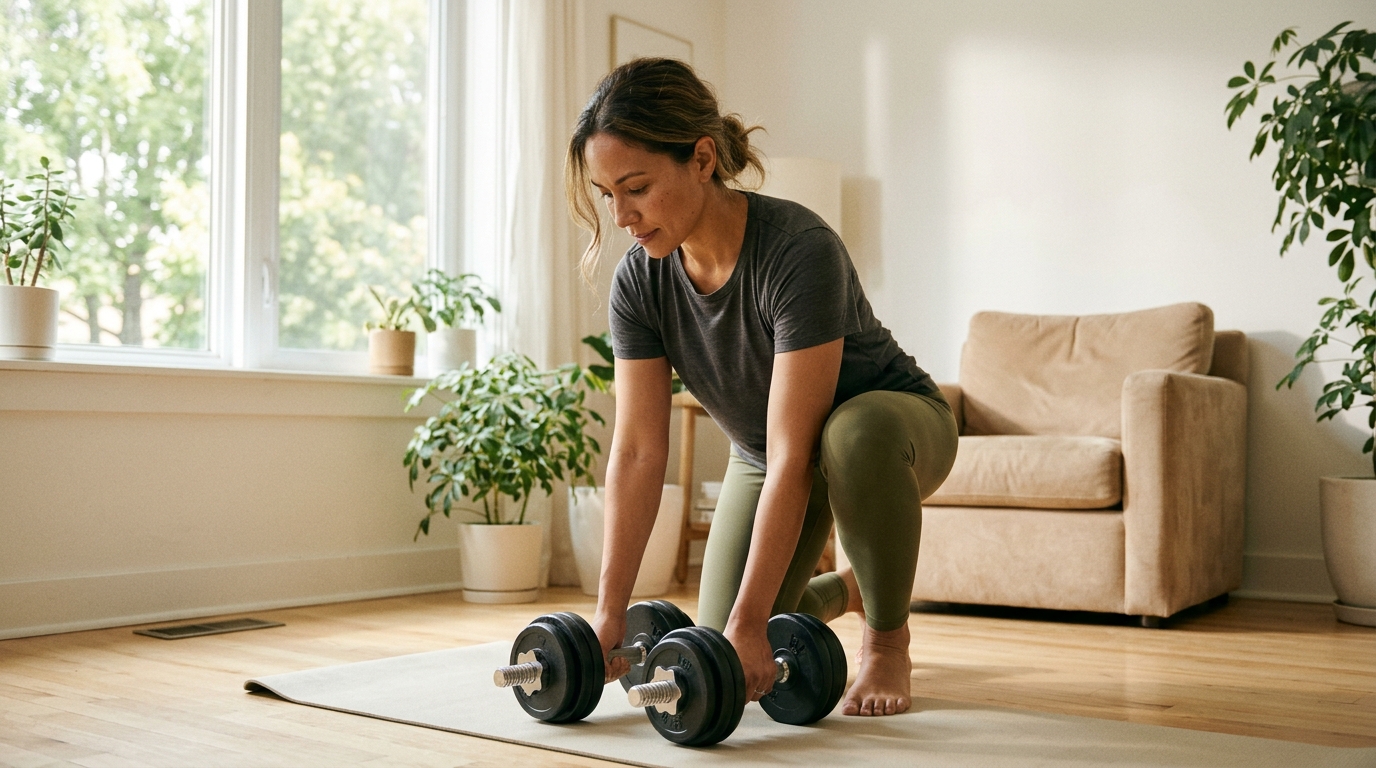
Strength training for beginners works best as a short, full-body routine repeated on three non-consecutive days a week. That is one day more than the minimum in the Physical Activity Guidelines for Americans. They ask for muscle-strengthening activities of moderate or greater intensity that involve all major muscle groups on 2 or more days a week.[1] The third day is a buffer: miss one session and you still meet the guideline. The plan below follows that guideline and the American College of Sports Medicine (ACSM) Position Stand published in March 2026. Both were read on 2 November 2026. It is general information for healthy adults, not a program for a specific condition.
How often should a beginner do strength training?
A beginner should do strength training at least twice a week, and three days is a practical target. The US Department of Health and Human Services (HHS) sets that minimum in the second edition of its Physical Activity Guidelines. It asks adults to work all the major muscle groups of the body: the legs, hips, back, chest, abdomen, shoulders and arms.[1] The guidelines recommend no specific session length. What counts is effort: each exercise is done until another repetition would be difficult.
Strength work comes on top of aerobic activity, not instead of it. HHS states that adults need at least 150 to 300 minutes of moderate-intensity aerobic activity, like brisk walking, each week.[2] This article covers the strength part only.
If you are starting from zero, you are in the majority. Healthy People 2030, the US national health objectives, reports that 32.9 percent of adults did muscle-strengthening activities on 2 or more days a week in 2024. The baseline was 31.9 percent in 2020, and the national target is 36.6 percent.[3] The figures come from the National Health Interview Survey and cover leisure time.
Is strength training and weight training the same?
Strength training and weight training are the same kind of activity under different names. The HHS guidelines define muscle-strengthening activity as strength training, resistance training, or muscular strength and endurance exercises. They list lifting weights, resistance bands, body-weight exercises such as push-ups, pull-ups and planks, and carrying heavy loads as examples.[1] Weight training is one way to do it, with dumbbells, barbells or machines providing the load.
The equipment matters less than many beginners expect. In its 2026 Position Stand, the ACSM reports that elastic bands, body-weight exercises and home-based routines yield marked benefits in strength, muscle size and physical function. It adds that traditional gym settings are not needed to see results.[4] So the plan below works in a gym, and every row lists a version you can do with bands or your own body weight. A full home routine is a separate topic.
Beginner workout plan: three full-body days
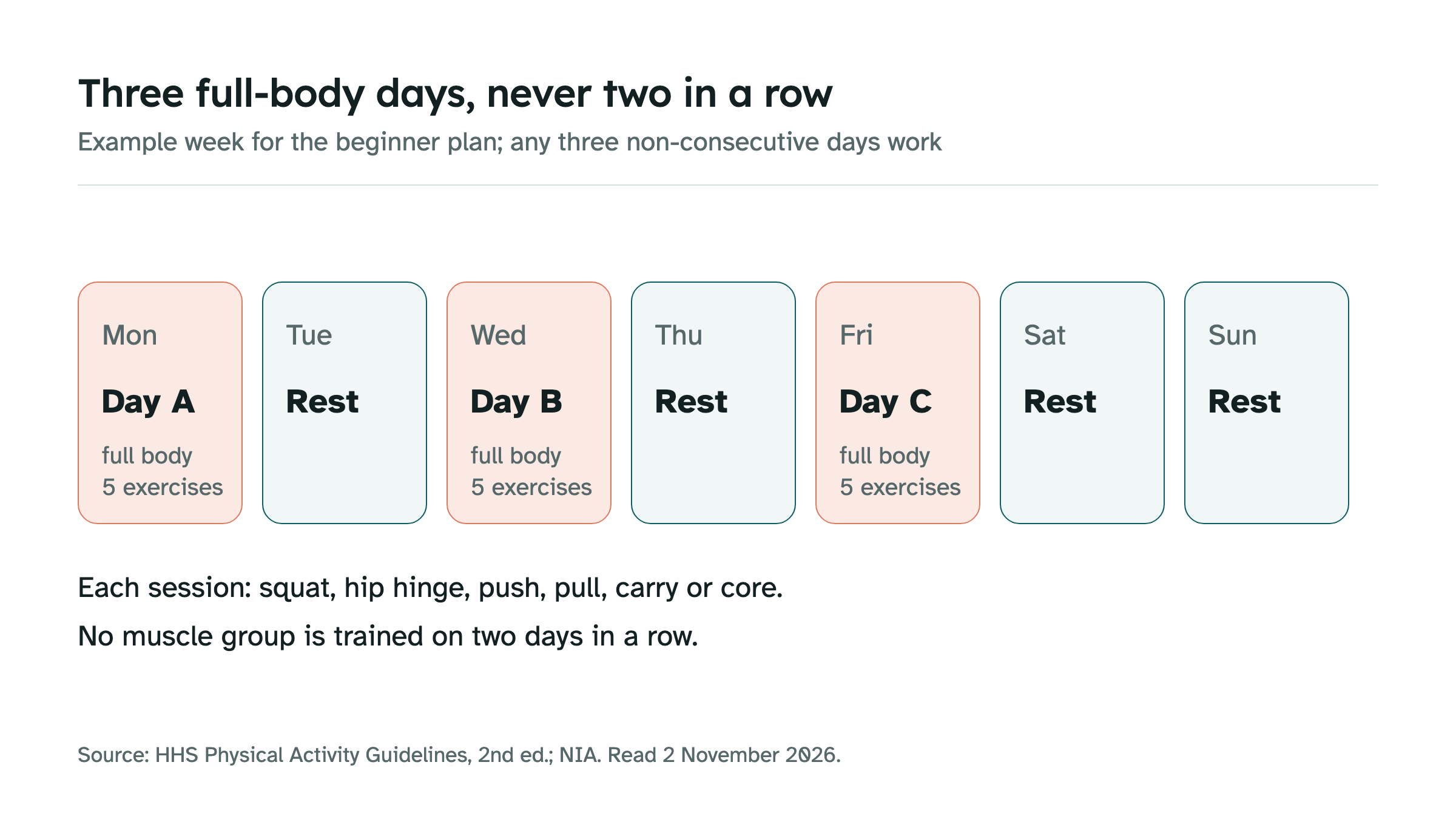
A beginner workout plan of three full-body days fits a Monday, Wednesday and Friday week, with at least one rest day after each. The National Institute on Aging (NIA) advises against working the same muscle group on two days in a row, to allow for recovery between sessions.[5] Each day covers five movement patterns: a squat, a hip hinge, a push, a pull and a carry or core exercise. Together they reach every major muscle group the guidelines name.
The plan is an example built from the guidelines, not a prescription. Swap any exercise that hurts or that you cannot do with control.
| Pattern | Day A (Mon) | Day B (Wed) | Day C (Fri) | Without a gym |
|---|---|---|---|---|
| Squat (legs, hips) | Goblet squat | Split squat | Box squat | Sit-to-stand from a chair |
| Hinge (hips, back) | Dumbbell Romanian deadlift | Glute bridge | Kettlebell or dumbbell deadlift | Glute bridge |
| Push (chest, shoulders, arms) | Push-up, hands raised if needed | Dumbbell overhead press | Dumbbell bench press | Incline push-up against a table |
| Pull (back, arms) | One-arm dumbbell row | Lat pulldown | Seated cable row | Band row |
| Carry or core (abdomen) | Plank | Farmer's carry | Dead bug | Plank or dead bug |
Sets and repetitions by week
A repetition (rep) is one complete movement, and a set is a group of repetitions done without a break. The HHS guidelines state that one set of 8 to 12 repetitions of each exercise is effective, although 2 or 3 sets may be more effective.[1] The plan uses that range as a ladder:
| Weeks | Sets per exercise | Repetitions | Sets per day |
|---|---|---|---|
| 1–2 | 1 | 8–12 | 5 |
| 3–6 | 2 | 8–12 | 10 |
| 7 onwards | 3 | 8–12 | 15 |
Choose a load that makes the last repetitions of each set hard while your form stays the same. If you are new to a movement, the NIA suggests starting without weights, or with resistance bands, until you are comfortable with it. Rest between sets until your breathing settles.
What belongs in a basic workout plan?
A basic workout plan needs one exercise for each major muscle group and nothing more. The HHS guidelines point out that the effects of muscle-strengthening activity are limited to the muscles doing the work. That is why a plan made only of arm exercises, or only of leg exercises, falls short. The five patterns in the table cover the legs, hips, back, abdomen, chest, shoulders and arms.
Machines and free weights both work. The ACSM Position Stand is the first major update to its resistance training guidance since 2009. It synthesized 137 systematic reviews with more than 30,000 participants and found that the choice between machines and free weights did not consistently affect outcomes for the average healthy adult.[4] The same review found no consistent benefit from complex periodization, the planned rotation of training variables. For a beginner, that means a basic plan is not a compromise.
What a basic plan does need:
- a short warm-up, which the NIA describes as doing the exercises first with less weight
- one exercise per pattern, done with control through the full movement
- a record of the weight and repetitions, so you know when to add load
- the same plan for at least several weeks, because changing it every session makes progress hard to see
The ACSM puts the main message plainly: the most meaningful gains come from moving from no resistance training to any resistance training, so regular participation is the primary goal for most adults.[4]
How do you progress a strength training program?
You progress a strength training program by adding a little weight, one more set or one more day, one change at a time. The NIA states that gradual increases in the amount of weight, number of sets or repetitions, or the number of days a week of exercise will result in stronger muscles.[5] A simple rule fits the 8 to 12 range: when you can do 12 good repetitions in every set of an exercise, raise the weight slightly, so that you are back at around 8.
You do not need to train to failure, the point where you cannot complete another repetition. The ACSM review found that training to fatigue or momentary muscle failure did not consistently affect outcomes for the average healthy adult.[4] Stopping when one more good repetition would be hard, as the HHS guidelines describe, is enough.
After the first months, the plan can follow the goal. The ACSM gives these targets for adults:
| Goal | ACSM 2026 guidance |
|---|---|
| Strength | Heavier loads, around 80% of one-repetition maximum (1RM), for 2–3 sets per exercise |
| Muscle size | Higher weekly volume, around 10 sets per muscle group |
| Power | Moderate loads of 30–70% of 1RM, lifted as fast as possible |
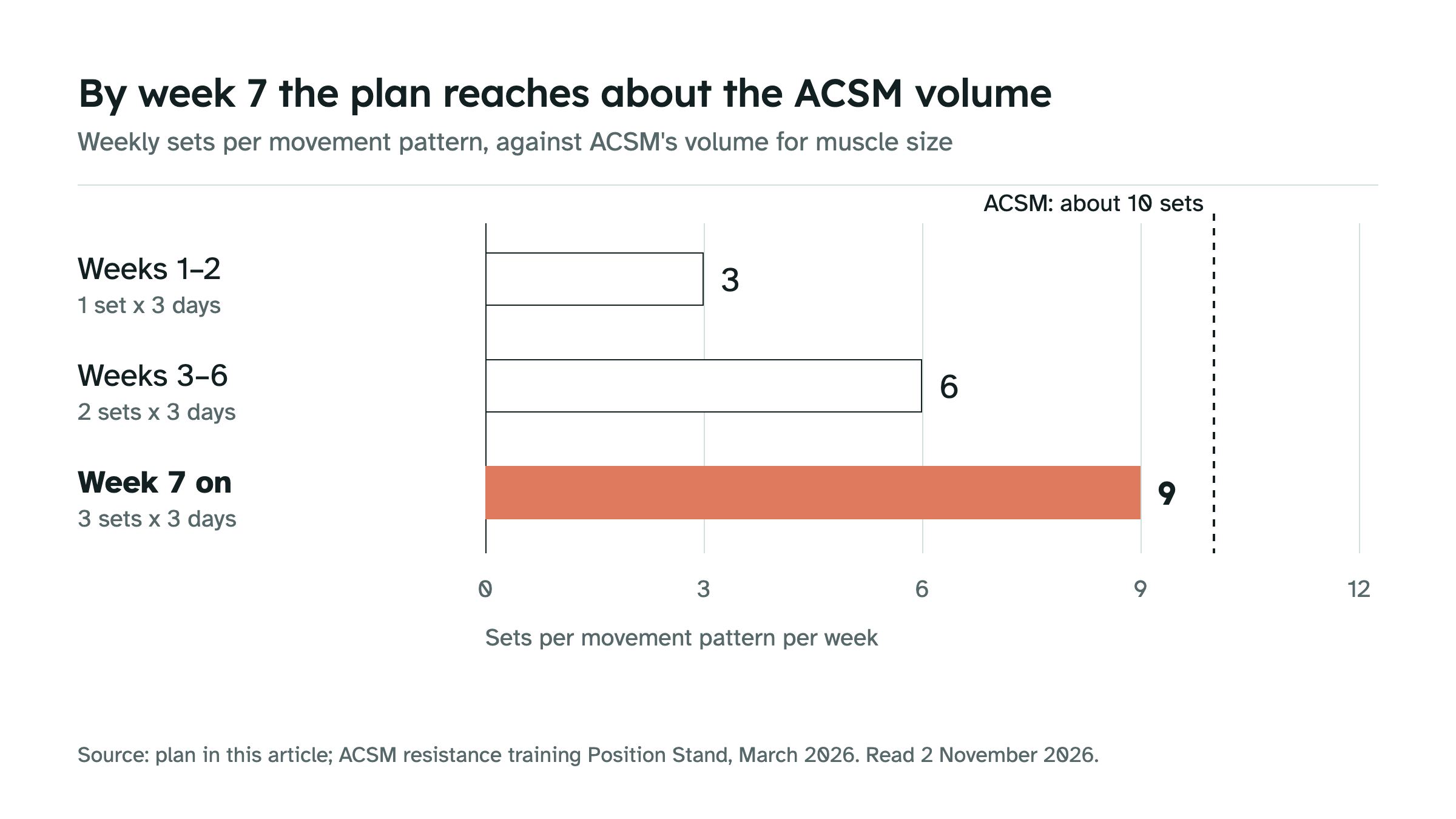
One-repetition maximum is the heaviest weight you can lift once with good form. A beginner does not need to test it. At three sets per exercise, this plan already gives each movement pattern 9 sets a week across the three days, close to the volume the ACSM names for muscle size.
Who should check with a clinician first?
People with a chronic condition, people with symptoms and people who are pregnant should check with a clinician before they start. The HHS guidelines state that adults with chronic conditions or symptoms should be under the care of a health care provider. Pregnant women should be under the care of a provider who monitors the pregnancy.[1] The guidelines name conditions such as diabetes, heart disease and osteoarthritis, and symptoms such as chest pain or pressure, dizziness and joint pain.
For everyone else, HHS is clear: healthy adults who plan gradual increases in activity generally do not need to consult a health care provider first. That changes if something new appears. People who develop new symptoms when they increase their activity should consult a provider.
The NIA's safety tips are written for older adults, and they are a sensible checklist for any beginner:
- Warm up with lighter weights before the working sets.
- Do not hold your breath: breathe out during the effort and in as you relax.
- Avoid locking your arm and leg joints in a straight position.
- Overdoing it can cause exhaustion, sore joints, and muscle pain or injury, so listen to your body.
If you have high blood pressure, the blood pressure chart by age explains the categories to discuss with your clinician. Older readers can pair this plan with balance exercises for fall prevention, and recovery days fit within the sleep adults need by age. If any of the conditions above apply to you, take this plan to your clinician and adapt it together before your first session.
Frequently asked questions
How many days a week should a beginner lift weights?
Two days a week is the US minimum for working all major muscle groups. Three full-body sessions on non-consecutive days meet that target and leave room to miss one.
How many sets and reps should a beginner do?
HHS rates a single set of 8–12 repetitions per exercise as effective, with 2 or 3 sets possibly more effective. In this plan you do one set in weeks 1–2, two sets in weeks 3–6 and three sets from week 7.
Can I build strength without a gym?
Yes. The 2026 ACSM Position Stand reports marked benefits from elastic bands, body-weight exercises and home-based routines. Each exercise in a gym plan has a version that uses a chair, a table or a band.
Do I need to train until I cannot do another rep?
No. The ACSM review found that training to momentary muscle failure did not consistently change outcomes for the average healthy adult. Ending a set when one more good repetition would be hard is enough.
What is the best beginner workout plan in 2026?
There is no single best plan. The ACSM's 2026 guidance puts regular training of all major muscle groups at least twice a week ahead of any complex program, so the best plan is a simple full-body one you can keep doing.
Sources
Medical disclaimer. The content on Elenra is general information. It is not medical advice, diagnosis or treatment and does not replace a consultation with a doctor or another qualified health professional. Talk to your doctor before you start, change or stop any medication or treatment. In an emergency, call your local emergency number. Medical disclaimer