Balance exercises for seniors: a weekly fall-prevention routine
Five NHS balance exercises for seniors, how often to do them and what the US guidelines and research say about preventing falls after 65.
In this article7
What are 5 balance exercises?
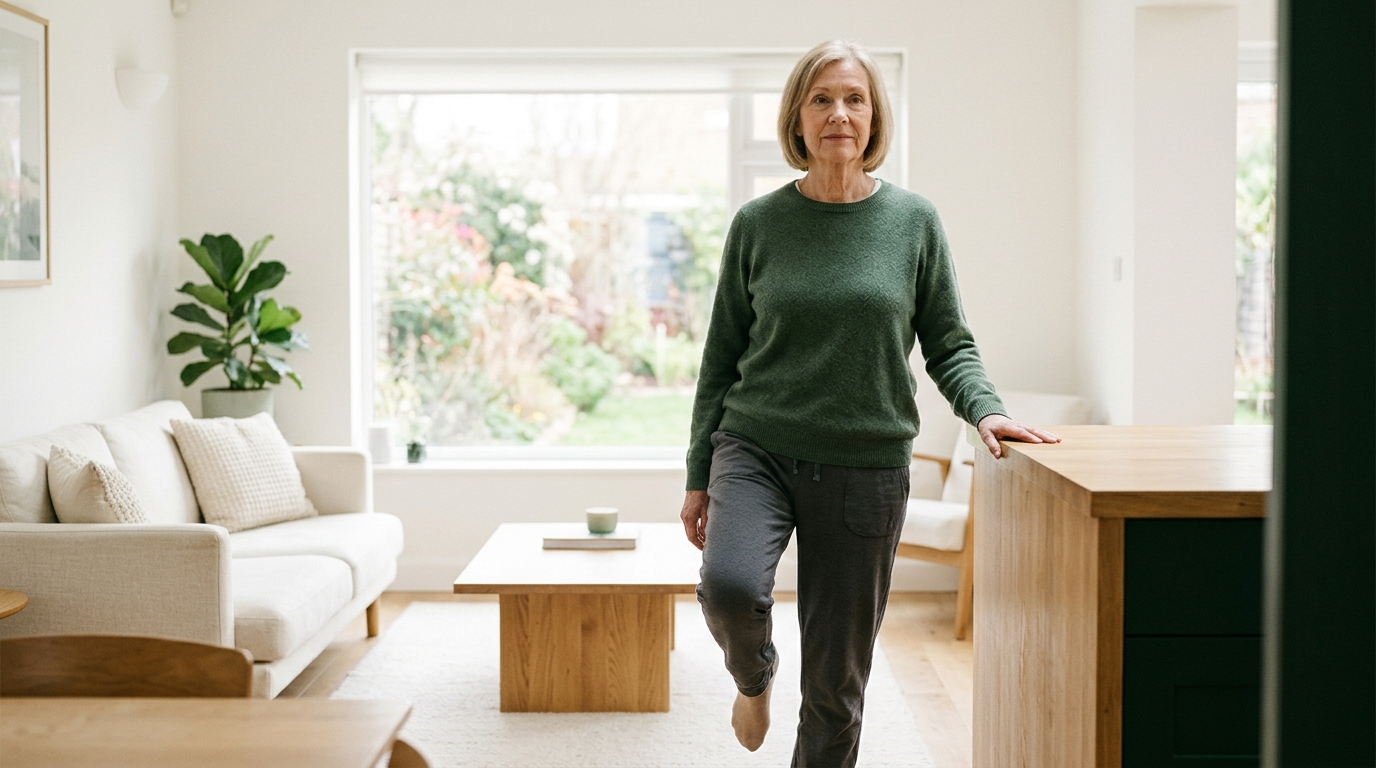
Five balance exercises that most older adults can start at home are sideways walking, the simple grapevine, the heel-to-toe walk, the one-leg stand and the step-up. They make up the balance routine the NHS publishes for people who have not exercised for a while. It suggests doing them at least twice a week, next to a wall or a stable chair.[1]
| Exercise | How it is done | NHS starting amount |
|---|---|---|
| Sideways walking | Feet together, knees slightly bent, step to the side slowly and bring the other foot to join it | 10 steps each way |
| Simple grapevine | Walk sideways by crossing one foot over the other, fingers on a wall if needed | 5 cross-steps each side |
| Heel-to-toe walk | Place one heel directly in front of the other foot's toes, looking forward | At least 5 steps |
| One-leg stand | Face a wall with fingertips touching it, lift one leg and keep the hips level | Hold 5 to 10 seconds, 3 times each side |
| Step-up | Step up onto a step with a railing or wall nearby, then step down slowly | Up to 5 steps with each leg |
The NHS page, last reviewed in November 2023, gives two rules for progress. Build up slowly and increase the repetitions over time, and move away from the wall as you progress.[1] For the step-up, the slow and controlled movement is what trains balance, not the speed.
Wear comfortable clothing and supportive shoes, and keep a chair or counter within reach. If a move makes you dizzy or you cannot keep your footing even with support, stop and ask a clinician or physical therapist which version is safe for you.
What are the 5 P's of fall prevention?
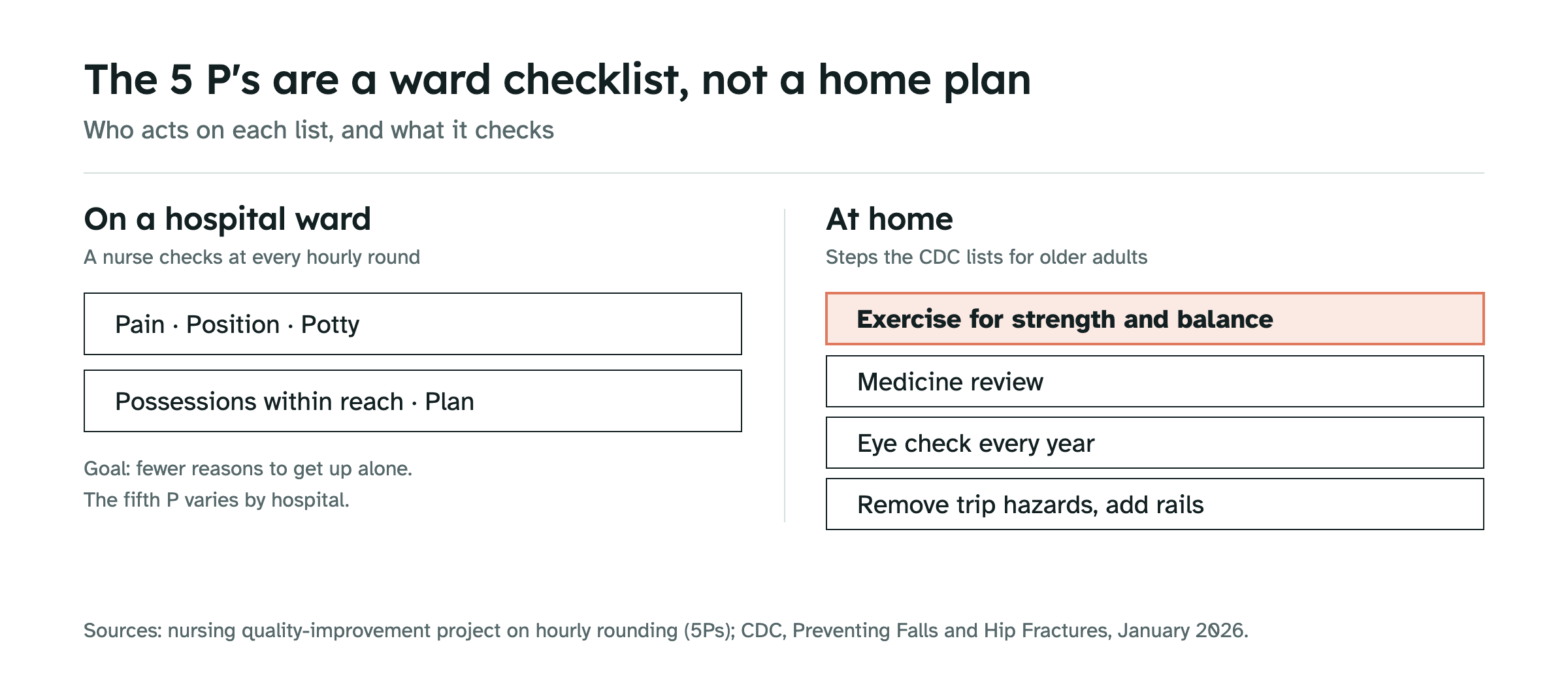
The 5 P's of fall prevention are a checklist nurses use during regular rounds in hospitals and care homes, and there is no single official list. One version, used in a quality-improvement project on a 28-bed neurological hospital unit, checks pain, position, potty, possessions and plan at every hourly visit.[2] Other hospitals swap the last P for "pumps" or "protection", or use only four.
The idea behind the list is simple: many patients fall when they get up alone to reach the toilet, a phone or a glass of water. A nurse who asks about pain, helps with toileting and repositioning, and puts personal items within reach removes the reason to get up unassisted. A 2014 systematic review in the Journal of Nursing Administration found moderate-strength evidence that hourly rounding programmes reduce patient falls.[3] In that project, falls went from 3.68 to 3.24 per 1,000 patient-days during the 12-week rollout.[2]
At home, the 5 P's are less useful as a plan. The steps public health bodies list for people living independently are different: exercise for strength and balance, a medicine review, eye checks and a safer home.[4] If a relative is in hospital or a care home, asking how the ward handles rounding and call bells is a reasonable question for the care team.
Exercises to improve balance after 65
Exercises that improve balance after 65 are any activities that make you control your body while standing still or moving, and they work best alongside leg and core strength. The Physical Activity Guidelines for Americans name walking backward, standing on one leg and using a wobble board as examples. They add that strengthening the muscles of the back, abdomen and legs also improves balance.[5]
The same guidelines ask older adults to do "multicomponent" activity each week: balance training together with aerobic activity and muscle-strengthening.[5] For adults overall, the weekly targets are at least 150 minutes of moderate-intensity aerobic activity and muscle-strengthening on 2 or more days. Older adults are asked to set the effort by their own fitness and conditions.
Beyond the five NHS moves, these options appear in US public health guidance:
- Tai chi. The CDC names tai chi as a good example of exercise that strengthens the legs and improves balance. The National Institute on Aging lists tai chi, yoga and Pilates for balance and strength.[4][6]
- Strength work. The National Institute on Aging suggests lifting weights or using resistance bands to build strength alongside balance training.[6]
- Walking with a twist. Walking backward or sideways, in a hallway with a rail, turns an ordinary walk into balance practice.
A sample week that follows these guidelines could look like this. The split is illustrative, not a prescription.
| Day | Balance | Strength | Aerobic |
|---|---|---|---|
| Monday | NHS five moves, about 10 minutes | Chair stands, resistance band | 20-minute brisk walk |
| Wednesday | Tai chi class or video | Rest day | 20-minute brisk walk |
| Friday | NHS five moves, more repetitions | Chair stands, step-ups | 20-minute brisk walk |
| Weekend | Walking backward along a rail | Rest day | Longer walk or cycling |
Balance training for older adults
Balance training for older adults is the part of fall prevention with the strongest evidence. The US Preventive Services Task Force (USPSTF) gives a grade B recommendation for exercise to prevent falls in adults 65 and older who live in the community and are at increased risk of falling.[7] Increased risk most often means a previous fall, or problems with walking, mobility or physical function.
The numbers behind that recommendation are consistent across reviews:
- USPSTF, June 2024. Across 29 pooled trials with 14,475 people, exercise reduced the rate of falls (incidence rate ratio 0.85) and the risk of injurious falls. The most common schedule was 2 to 3 sessions a week for 12 months.[7]
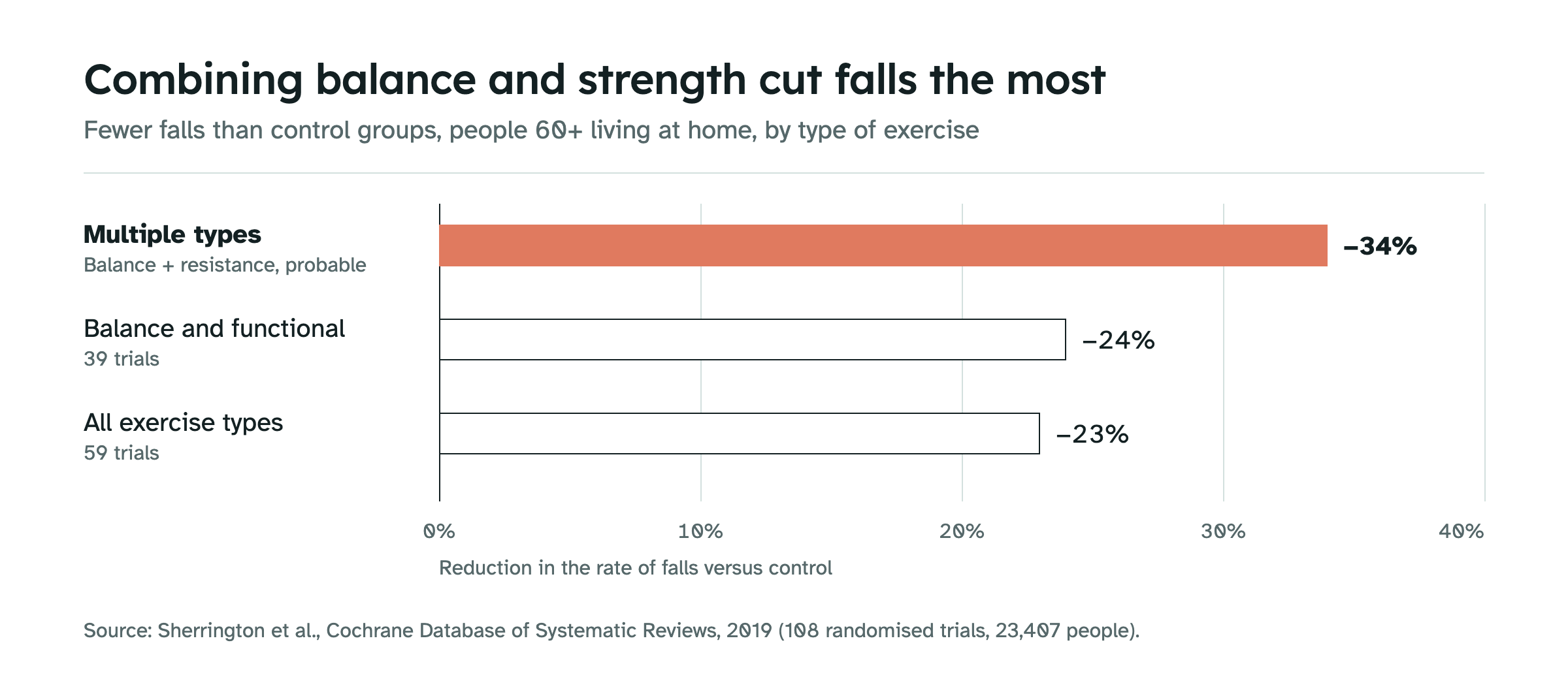
- Cochrane, 2019. In 108 randomised trials with 23,407 people living at home, exercise of all types reduced the rate of falls by 23 percent. Balance and functional exercises reduced it by 24 percent, and programmes combining several types, usually balance plus resistance training, probably by 34 percent.[8]
The USPSTF found no significant drop in fall-related fractures or in deaths from any cause. Exercise lowers how often people fall, but it does not remove the risk.
Two points from the evidence matter for planning. Most trial programmes were supervised group classes or physical therapy, so a class or a few sessions with a physical therapist is closer to what was tested than a printout.[7] And the US activity guidelines note that low-intensity walking on its own does not seem to reduce fall-related injuries and fractures.[5] The benefit came from programmes that challenge balance, not from staying active in general.
Fall prevention
Fall prevention for older adults combines exercise with a few medical and household checks, because most falls have more than one cause. The scale is large. The CDC says more than one in four older people fall each year, less than half tell their doctor, and falling once doubles the chance of falling again.[9] The National Council on Aging puts the US number at 14 million people aged 65 and older each year, with 38,000 deaths from falls in that age group in 2021.[10] Worldwide, the World Health Organization estimated about 842,000 deaths from falls in 2023, 71 percent of them in people aged 60 and older.[11]
The CDC lists these steps for older adults next to strength and balance exercise:[4]
- Ask a doctor or health care provider to evaluate your risk of falling.
- Ask a doctor or pharmacist to review medicines that might make you dizzy or sleepy.
- Have your eyes checked at least once a year and update your glasses.
- Ask about vitamin D, and get screened for osteoporosis.
- Remove trip hazards, add grab bars and stair rails, and improve lighting.
Hearing is worth adding to that list. The National Council on Aging reports that people with hearing loss are nearly three times as likely to fall.[10] In the US, adults with perceived mild to moderate hearing loss can now buy FDA-regulated hearing aids over the counter, without a visit to a hearing professional.[12] Blood pressure that drops when you stand up, called postural hypotension, is another risk factor the National Institute on Aging names.[6] Our blood pressure chart by age explains the readings.
These figures and services are from the United States. In other countries, fall clinics, physiotherapy access and coverage depend on the national health system. For more topics in this area, see Elenra's prevention guides, and how Elenra sources its articles.
The next step is practical: write down your falls or near-falls from the past year, the medicines you take and which of the five moves feel hard. Take that list to a licensed clinician, pharmacist or physical therapist and ask whether a supervised balance programme fits you. If you are in the US and cost is the question, our guide on checking whether your insurance covers a treatment walks through the calls to make before booking physical therapy or a class.
Frequently asked questions
How often should seniors do balance exercises?
The NHS suggests at least twice a week. Most trial programmes behind the USPSTF recommendation also ran two or three times a week, for about a year.
What is the best balance exercise for seniors?
No single exercise has been shown to be best. Programmes that combine balance and functional exercises with strength training reduced falls the most in the 2019 Cochrane review.
Can balance improve after 70?
Yes. The trials in the Cochrane review had an average participant age of 76, and exercise still reduced the rate of falls.
Is walking enough to prevent falls?
The US activity guidelines say low-intensity walking alone does not seem to reduce fall-related injuries. Add exercises that challenge balance and build leg strength.
Are balance exercises safe if I have already fallen?
A previous fall is the most common marker of increased risk. Ask a clinician or physical therapist to check which exercises are safe before starting alone.
Sources
Medical disclaimer. The content on Elenra is general information. It is not medical advice, diagnosis or treatment and does not replace a consultation with a doctor or another qualified health professional. Talk to your doctor before you start, change or stop any medication or treatment. In an emergency, call your local emergency number. Medical disclaimer