Blood pressure chart by age: what is normal and what is too high
Blood pressure chart by age with ACC/AHA, ESC and NICE thresholds: what counts as normal, where 140 over 70 falls, and how targets change after 80.
In this article9

Is 140 over 70 ok blood pressure?
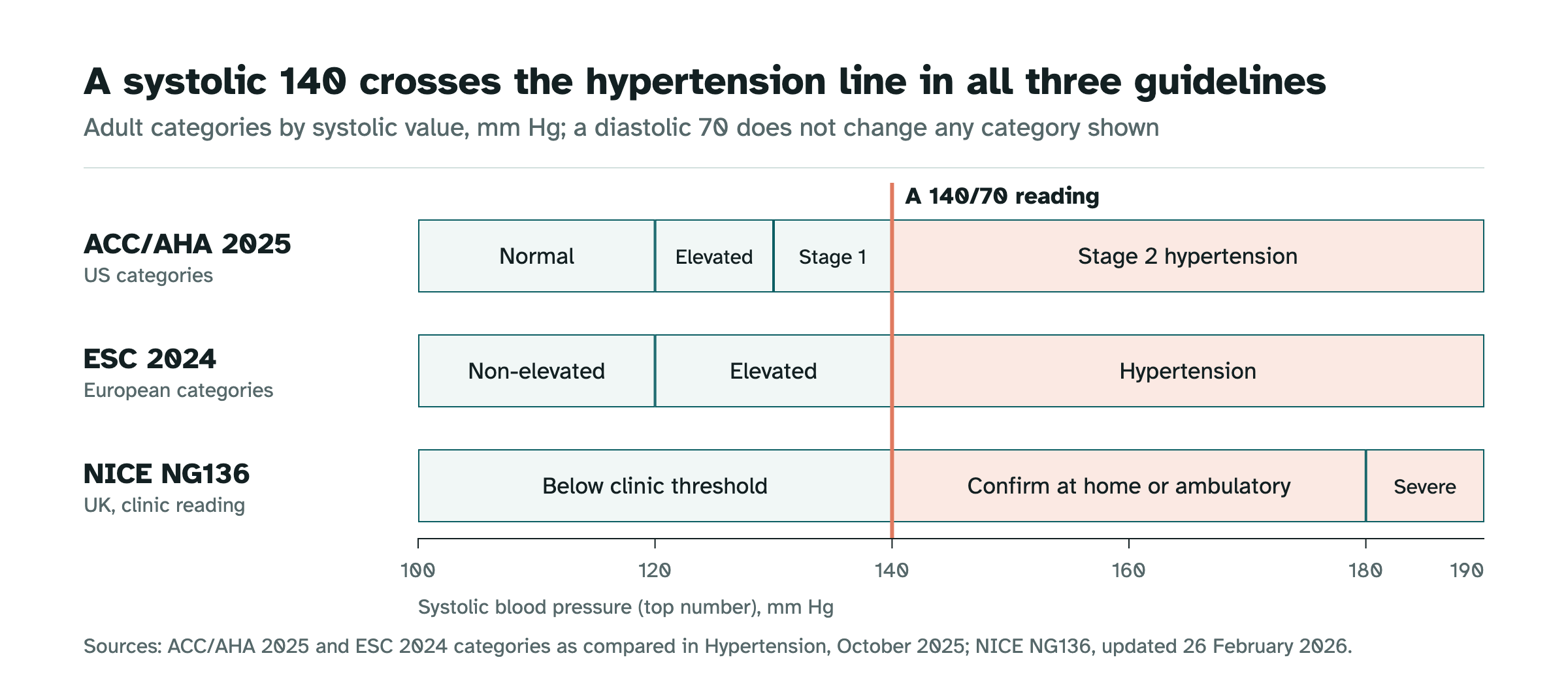
A blood pressure of 140 over 70 is above the normal range in every major guideline, because the top number has reached 140. The 2025 ACC/AHA guideline for high blood pressure in adults counts a systolic value of 140 mm Hg or higher as stage 2 hypertension, even when the bottom number is below 80.[1] The US National Heart, Lung, and Blood Institute (NHLBI) uses the same cut-off in its public chart: stage 2 starts at 140 systolic or 90 diastolic.[2]
The two numbers measure different moments. The systolic value, the top number, is the pressure when the heart pumps blood out. The diastolic value, the bottom number, is the pressure between beats, when the heart fills.[2] A reading of 140/70 therefore has a high top number and a normal bottom number. Because the stage 2 definition uses "or", one number at or above the cut-off is enough.
Still, one reading is not a diagnosis. Blood pressure changes throughout the day with activity, and the NHLBI describes high blood pressure as readings that are consistently at or above the threshold.[2] The UK guideline from the National Institute for Health and Care Excellence (NICE) asks for a second clinic measurement at 140/90 or higher. Ambulatory or home monitoring then confirms the result.[3] Whether a 140/70 reading needs treatment depends on repeated readings and on overall cardiovascular risk, which a clinician assesses.
What is ideal blood pressure by age?
Ideal blood pressure is the same for every adult age group: below 120 systolic and below 80 diastolic in the US categories.[2] The 2025 ACC/AHA guideline, published on 14 August 2025, kept these categories from its 2017 predecessor and did not add separate rows for older adults.[4] A chart by age therefore repeats the same limits in every row. What differs between age groups is how many people are above them.
The table combines both: the categories that apply to everyone and the share of US adults with high blood pressure in each age band. The prevalence comes from the National Health and Nutrition Examination Survey (NHANES), August 2021 to August 2023, published by the CDC's National Center for Health Statistics in October 2024.[5]
| Age group | Normal (ACC/AHA) | Stage 2 starts at | Adults with high blood pressure (US, 2021–2023) |
|---|---|---|---|
| 18 to 39 | below 120/80 | 140 or 90 | 23.4 percent |
| 40 to 59 | below 120/80 | 140 or 90 | 52.5 percent |
| 60 and older | below 120/80 | 140 or 90 | 71.6 percent |
The survey counts someone as having hypertension at 130/80 or higher, or when they take medication to lower blood pressure.[5] Across all ages, 47.7 percent of US adults met that definition, and only 20.7 percent of those with hypertension had their blood pressure controlled below 130/80. These are US figures; prevalence in other countries depends on the population and on the threshold a country uses.
What is the new normal blood pressure for seniors?
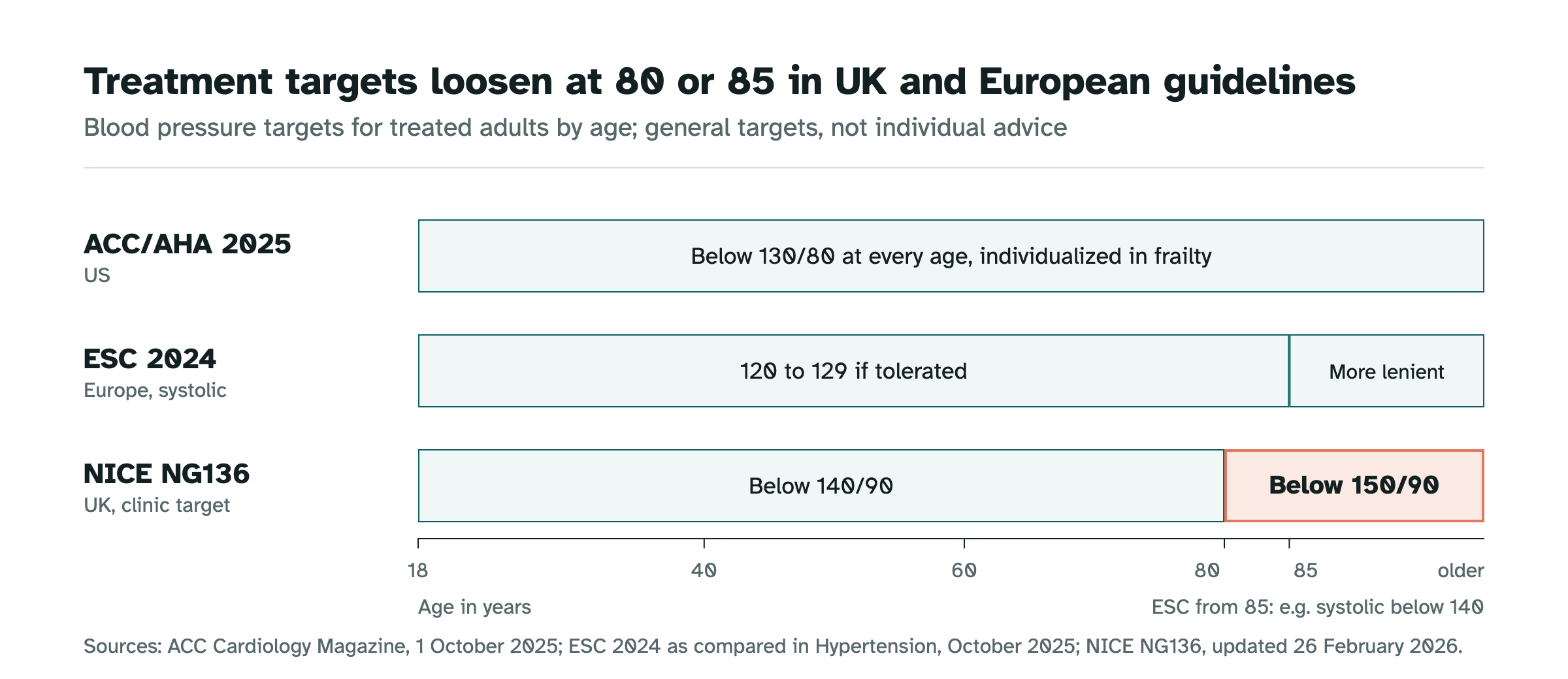
There is no separate normal range for seniors; the "new" element in recent guidelines is the treatment target. The 2025 ACC/AHA guideline reaffirmed a target below 130/80 for all adults, with additional considerations for some groups.[6] For people with frailty, the guideline individualizes the target rather than applying the general one.[4]
European and UK guidelines write the age conditions out more explicitly. The 2024 guideline of the European Society of Cardiology (ESC) aims for a systolic value of 120 to 129 in treated adults aged 18 to 84, if tolerated. It allows more lenient targets, for example below 140 systolic, from age 85 or with symptomatic dizziness on standing before treatment.[7] NICE sets a clinic target below 140/90 for people under 80 with hypertension and below 150/90 for people aged 80 and over.[3]
| Guideline | General target | Older adults |
|---|---|---|
| ACC/AHA 2025 (US) | below 130/80 | individualized in frailty |
| ESC 2024 (Europe) | systolic 120 to 129, ages 18 to 84, if tolerated | more lenient from 85, e.g. systolic below 140 |
| NICE NG136 (UK) | clinic below 140/90 under 80 | clinic below 150/90 from 80 |
The European Society of Hypertension (ESH) 2023 guideline adds one more age rule. For people aged 65 to 79 whose only raised value is the top number, it primarily targets a systolic value of 140 to 150, or 130 to 139 if tolerated.[4] NICE also asks clinicians to check people aged 80 and over for a drop in blood pressure on standing. Where that drop is significant, the target is based on the standing value.[3] These targets apply to people already diagnosed and treated; they are not a sign that a higher reading is healthy at an older age.
Is 140 over 70 a healthy blood pressure?
By the NHLBI's definition, 140/70 is not a healthy blood pressure: a healthy systolic value is below 120, and a healthy diastolic value is below 80.[2] The bottom number of 70 is in the healthy range, but the top number is 20 points above it.
A raised top number with a normal or low bottom number has its own name. Guidelines call this pattern isolated systolic hypertension, and the ESH 2023 guideline gives it its own target for people aged 65 to 79, as described in the section above.[4] Being common in later life does not make the reading harmless. The NHLBI lists heart attack, heart failure, stroke, chronic kidney disease and possibly vascular dementia among the problems that controlling blood pressure can help prevent or delay.[2]
High blood pressure usually causes no symptoms until it has caused serious health problems. According to the NHLBI, about 1 in 3 US adults with high blood pressure are not aware of it. For that reason, the institute recommends a blood pressure check at least once a year and regular home monitoring.[2] Measuring correctly at home is a separate topic and not covered here; see Elenra's blood pressure section.
What's normal blood pressure for age?
Normal blood pressure for any adult age is below 120/80 in the US categories, and the ESC uses a similar "non-elevated" range of below 120 systolic and below 70 diastolic.[4] Neither guideline publishes higher normal values for older age groups. The age-related numbers that circulate online describe what is common in a population, not what is healthy.
The CDC data show how quickly common and normal drift apart. Among US adults aged 60 and older, 71.6 percent have high blood pressure by the survey's definition, so a normal reading at 60 is the exception rather than the rule.[5] Hypertension was more common in men than in women aged 18 to 39 (30.0 compared with 16.4 percent) and aged 40 to 59 (55.9 compared with 49.0 percent); from 60, the survey found no significant difference between men and women.
For a 60-year-old, the answer to "what is too high" is therefore the same as for a 40-year-old. Under ACC/AHA, 130/80 or higher is high blood pressure; under ESC and NICE, 140/90 or higher is hypertension. What differs between countries is the threshold, not the age.
Is 140 over 70 a normal blood pressure?
No guideline classes 140 over 70 as normal; the three major guideline bodies differ only in the label they give it. Side by side, the same clinic reading of 140/70 sorts like this:
| Guideline | Hypertension threshold | Label for a clinic reading of 140/70 |
|---|---|---|
| ACC/AHA 2025 (US) | 130 systolic or 80 diastolic | stage 2 hypertension |
| ESC 2024 (Europe) | 140 systolic or 90 diastolic | hypertension |
| NICE NG136 (UK) | clinic 140/90, then home or ambulatory 135/85 | at the clinic threshold, confirmation needed |
The ACC/AHA labels follow its category table, and the ESC defines hypertension as 140 systolic or 90 diastolic and above.[4] NICE confirms hypertension when the clinic reading is 140/90 or higher and the average ambulatory or home reading is 135/85 or higher.[3] The home and ambulatory limit is lower than the clinic limit, so home readings are compared with 135/85, not with 140/90.
The guidelines also differ on when medication enters the conversation. The 2025 ACC/AHA guideline recommends medication at 130/80 or higher when the 10-year cardiovascular risk on the PREVENT calculator is 7.5 percent or more. For lower-risk adults, it does so when blood pressure stays at or above 130/80 after 3 to 6 months of lifestyle changes.[4] That decision depends on individual risk factors, which only a clinician can weigh.
Blood pressure normal range
The blood pressure normal range for adults is below 120 systolic and below 80 diastolic in the US categories, and the full chart runs from there to severe hypertension.[2] The chart below shows the 2025 ACC/AHA categories next to the ESC 2024 categories, in mm Hg.
| Category (ACC/AHA) | Systolic and/or diastolic | ESC 2024 equivalent |
|---|---|---|
| Normal | below 120 and below 80 | non-elevated: below 120 and below 70 |
| Elevated | 120 to 129 and below 80 | elevated: 120 to 139 or 70 to 89 |
| Stage 1 hypertension | 130 to 139 or 80 to 89 | elevated: 120 to 139 or 70 to 89 |
| Stage 2 hypertension | 140 or higher or 90 or higher | hypertension: 140 or higher or 90 or higher |
The category values in this chart come from the guideline comparison published in the journal Hypertension in October 2025.[4] At the top of the range, the NHLBI chart lists readings higher than 180 systolic or 120 diastolic as a hypertensive crisis and advises contacting a healthcare provider immediately; NICE classes a clinic reading of 180 systolic or 120 diastolic or higher as severe hypertension.[3]
A chart helps sort a number, but it cannot say what a number means for one person. Before an appointment, a short list makes the conversation with a licensed clinician or pharmacist more useful:
- Your readings with date and time, at the clinic and at home, and the arm used
- Whether the top number, the bottom number or both are above the range
- Your age, existing conditions such as diabetes or kidney disease, and any medicines you take
- Dizziness or falls when standing up, which matter for targets from age 80
- The guideline your health system follows, since US, European and UK thresholds differ
Take this list to a licensed clinician or pharmacist and go through the readings together. Elenra's heart health section covers blood pressure and cholesterol, and the Elenra methodology explains how its guides are sourced and checked.
Frequently asked questions
What blood pressure is too high for a 60 year old?
The same thresholds apply at 60 as at any adult age. Under the US ACC/AHA categories, 130/80 or higher is high blood pressure; under the European ESC and UK NICE guidelines, 140/90 or higher is hypertension.
Does normal blood pressure go up with age?
Blood pressure tends to rise with age, but the normal range does not. US categories set normal below 120/80 for every adult, while 71.6 percent of US adults aged 60 and older have high blood pressure.
Is 140 over 70 dangerous?
It is above the normal range, but one reading does not establish hypertension. Guidelines confirm a raised reading with repeated or home and ambulatory measurements. The NHLBI advises contacting a healthcare provider immediately at readings higher than 180 systolic or 120 diastolic.
What is the blood pressure target for people over 80?
NICE sets a clinic target below 150/90 for people aged 80 and over with hypertension. The ESC allows more lenient targets from 85, such as a systolic value below 140, and the ACC/AHA individualizes targets in frailty.
Which number matters more, the top or the bottom?
Both count. The US hypertension stages are defined by the top number or the bottom number, so a high top number alone, as in 140/70, is enough for stage 2.
Sources
Medical disclaimer. The content on Elenra is general information. It is not medical advice, diagnosis or treatment and does not replace a consultation with a doctor or another qualified health professional. Talk to your doctor before you start, change or stop any medication or treatment. In an emergency, call your local emergency number. Medical disclaimer
Related reading
All Heart Health →Best home blood pressure monitors in 2026: validated models only
The best home blood pressure monitor is a validated upper-arm cuff device that fits your arm. Eight models checked against STRIDE BP, 22 October 2026.