Best home blood pressure monitors in 2026: validated models only
The best home blood pressure monitor is a validated upper-arm cuff device that fits your arm. Eight models checked against STRIDE BP, 22 October 2026.
In this article8
Can stress affect blood pressure readings?
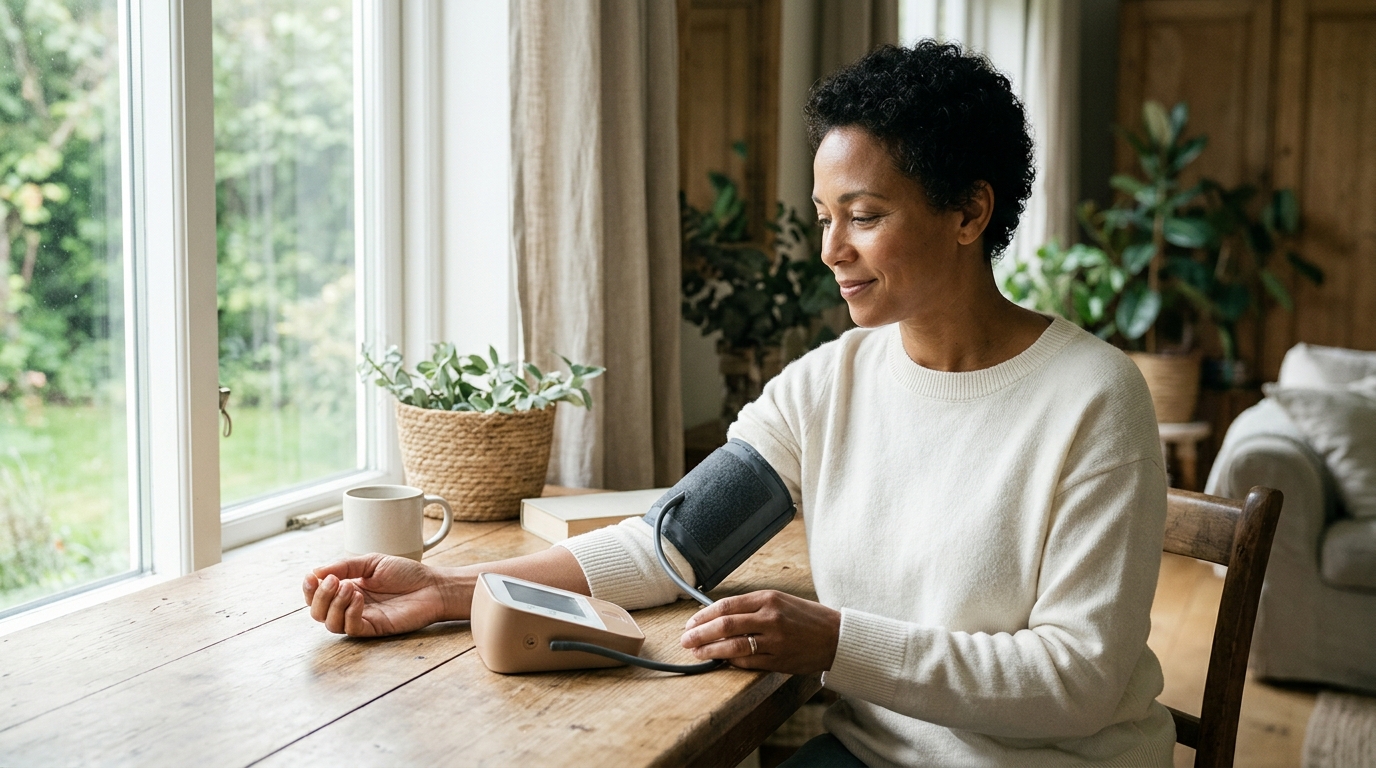
Stress can affect blood pressure readings, which is why a reading taken while you are upset or rushed is not a reliable one. The US National Heart, Lung, and Blood Institute (NHLBI) lists being excited or nervous among the situations in which a blood pressure reading may not be accurate, even when you have prepared for the measurement.[1] MedlinePlus, the consumer health service of the US National Library of Medicine, advises not to measure when you are under stress.[2]
The clinic itself can be the stressor. The NHLBI describes "white coat hypertension" as readings that are higher in a provider's office than at home or in a pharmacy. The opposite pattern, masked high blood pressure, means office readings come out lower.[1] Readings from home help a clinician tell the two apart, which is one reason home monitors matter.
Stress is not the only thing that moves a single number. The NHLBI asks you not to exercise, drink coffee or smoke cigarettes for 30 minutes before the test.[1] It also asks you to go to the bathroom before the test, to sit and relax for at least 5 minutes, and not to talk while relaxing or during the test.[1] Blood pressure also varies across the day: according to MedlinePlus it is usually higher at work, lower at home and lowest during sleep.[2]
One high reading is therefore not a diagnosis. The NHLBI says high blood pressure is diagnosed from two or more readings at separate medical appointments.[1] What the numbers mean by category is covered in the blood pressure chart by age.
How can I check my blood pressure by hand?
You can check your blood pressure by hand only with a manual cuff, a squeeze bulb and a stethoscope; counting your pulse with your fingers gives your heart rate, not your blood pressure. In the manual method described by MedlinePlus, the cuff is wrapped snugly around the bare upper arm, with its lower edge about 2.5 cm (1 inch) above the bend of the elbow. It is inflated with the bulb and then deflated slowly through the valve.[2]
While the pressure falls, you listen over the artery at the elbow. The point at which you first hear the sound of blood pulsing is the systolic pressure, the top number. The point at which the sounds disappear is the diastolic pressure, the bottom number.[2] MedlinePlus notes that inflating the cuff too slowly or not high enough can give a false reading.
For home use, the AHA recommends an automatic monitor with a cuff that goes on the upper arm instead.[3] MedlinePlus advises asking your provider to compare your home readings with those taken in the office.[2] A step-by-step guide to measuring correctly at home is a separate topic and is not covered here.
What drink reduces blood pressure?
No single drink reduces blood pressure enough to replace a treatment plan, but a few have been tested in trials. The best-studied is beetroot juice, which is rich in nitrate. A 2013 meta-analysis in the Journal of Nutrition pooled sixteen short crossover trials with 254 participants and found an average drop of 4.4 mm Hg in systolic pressure; the change in diastolic pressure was not significant.[4] A 2024 meta-analysis of 11 trials in 349 people with hypertension found a systolic reduction of 5.31 mm Hg compared with placebo, and no effect on diastolic or 24-hour readings. Its authors rated the certainty of the evidence as low.[5]
Hibiscus tea, also called sour tea, is the second drink with pooled trial data. A 2015 meta-analysis in the Journal of Hypertension combined five randomised trials with 390 participants. It reported weighted mean differences of -7.58 mmHg in systolic and -3.53 mmHg in diastolic blood pressure, and called for further well designed trials to validate these results.[6]
| Drink | Evidence | Average change | Certainty |
|---|---|---|---|
| Beetroot juice, adults | Sixteen crossover trials, 254 participants, 2013[4] | systolic −4.4 mm Hg | not graded; trials lasted 2 hours to 15 days |
| Beetroot juice, people with hypertension | 11 trials, 349 patients, 2024[5] | systolic −5.31 mm Hg, diastolic unchanged | low |
| Hibiscus tea | 5 randomised trials, 390 participants, 2015[6] | systolic −7.58, diastolic −3.53 mm Hg | further trials needed |
What you leave out of your glass has firmer backing. The NHLBI's DASH eating plan includes fat-free or low-fat dairy products and limits sugar-sweetened beverages.[7] For people with high blood pressure, the institute also advises to avoid or limit alcohol.[8] Ways to lower blood pressure without medication are a separate article; if you take blood pressure medicine, a drink is never a reason to change it without your clinician.
Validated home blood pressure monitors
A validated home blood pressure monitor is one whose accuracy has been tested against reference measurements in a published study that followed an established protocol. The current reference is the AAMI/ESH/ISO Universal Standard, ISO 81060-2:2018.[9]
Independent lists do that work. STRIDE BP, an international non-profit founded by hypertension experts, says it has approved 551 and recommends as preferred only 294 of the over 5,000 electronic blood pressure monitors on the market.[10] Its home list, generated on 22 October 2026, contains 350 validated upper-arm devices that are on the market.[9] For readers in the US, a patient guide from Nationwide Children's Hospital points to validatebp.org, the U.S. Blood Pressure Validated Device Listing.[3]
STRIDE BP sorts its list into three kinds of entries:
- Validated: the device passed a validation procedure that the STRIDE BP Scientific Advisory Board checked and approved.
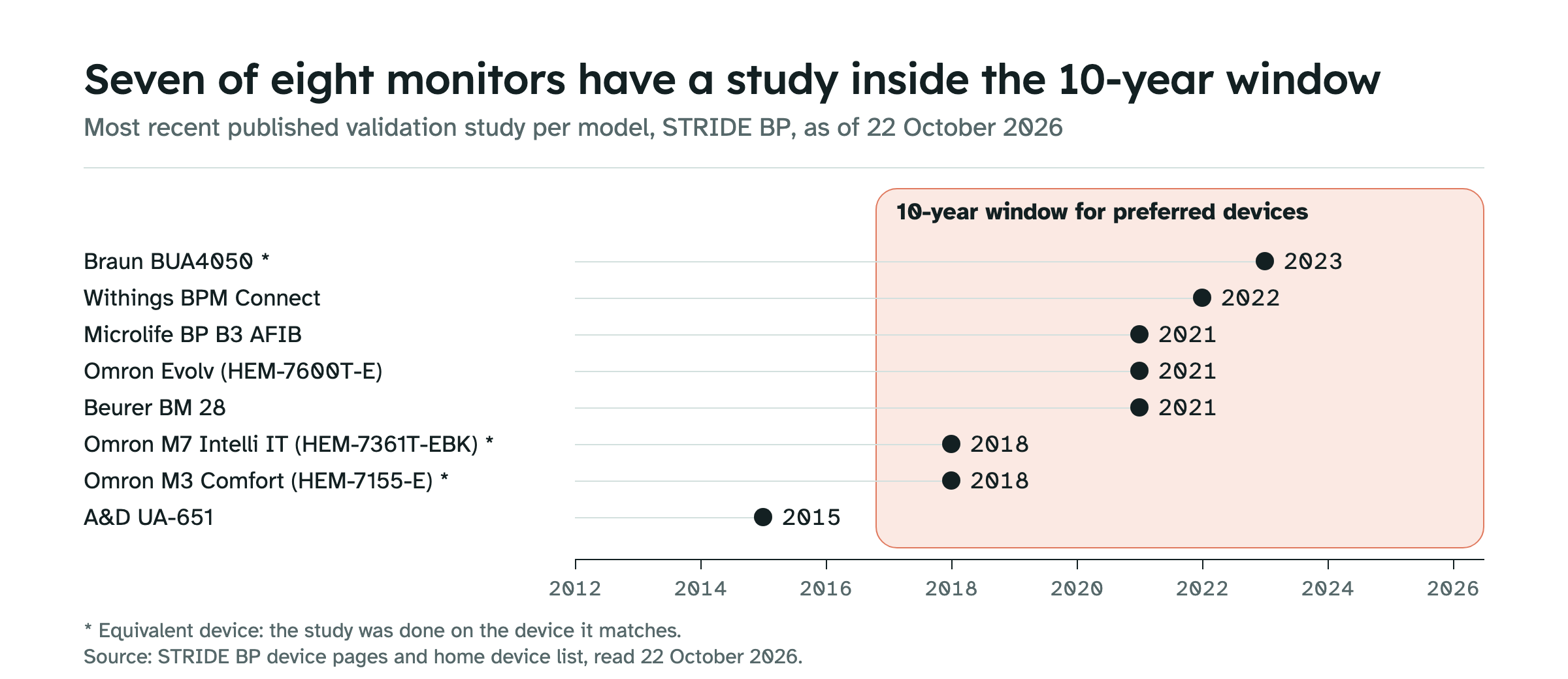
- Preferred: an upper-arm device with an approved validation study published within the last 10 years on a recent protocol, that also stores multiple readings or transfers them to a phone, PC or the internet.
- Equivalent or identical (marked \*): not validated itself, but shown to the board to match a validated device, or the same device under a new model name.[9]
One condition applies to particular groups: the Nationwide Children's Hospital guide advises checking that a monitor is approved for children, pregnant women and older adults if it will be used for them.[3] STRIDE BP records this per device, for example "Pregnancy / Preeclampsia" or "Diabetics" next to the study.
Home blood pressure monitor
The home blood pressure monitors below are eight widely sold upper-arm models, checked one by one on STRIDE BP's device pages on 22 October 2026. The eight models were chosen by the editors, and none was tested for this article. The protocol, cuff and feature columns come from STRIDE BP's device pages. The preferred column applies STRIDE BP's rule for preferred devices, as defined above, to those pages. Prices are left out because they vary by country and retailer.
| Model (as listed) | Preferred rule | Validation: protocol, year published | Validated cuff | Listed features |
|---|---|---|---|---|
| Withings BPM Connect | met[11] | ISO 81060-2:2018, 2022 (adults and pregnancy) | 22–42 cm | Wi-Fi and Bluetooth |
| Microlife BP B3 AFIB | met[12] | ISO 81060-2:2018, 2021 (adults); ANSI/AAMI/ISO 2013, 2018 (diabetics) | 22–42 cm | atrial fibrillation detection, multiple readings |
| Braun BUA4050 \* | met, equivalent device[13] | ISO 81060-2:2018, 2023 | 22–42 cm | stores readings |
| Omron Evolv (HEM-7600T-E) | met[14] | ANSI/AAMI/ISO 2013, 2021 (adults); ISO 81060-2:2018, 2018 (pregnancy) | 22–42 cm | Bluetooth, multiple readings |
| Omron M7 Intelli IT (HEM-7361T-EBK) \* | met, equivalent device[15] | ANSI/AAMI/ISO 2009, 2015 (adults); ESH-IP 2010, 2017 (diabetics) | 22–42 cm | atrial fibrillation detection, Bluetooth |
| Omron M3 Comfort (HEM-7155-E) \* | met, equivalent device[16] | ANSI/AAMI/ISO 2009, 2015 (adults); ISO 81060-2:2018, 2018 (pregnancy) | 22–42 cm | stores readings, cuff wrapping sensor |
| Beurer BM 28 | met[17] | ESH-IP 2010, 2020 and 2021 | not stated | wide-range cuff, mains adapter |
| A&D UA-651 | not met[18] | ESH-IP 2010, 2014 and 2015 | not stated | wide-range cuff, stores readings |
The rule needs only one study from the last ten years. The Omron M7 Intelli IT qualifies through validation studies published in 2017 and 2018, although its first study dates from 2015.[15] The Omron M3 Comfort qualifies the same way, through validation studies published in 2017 and 2018, although its first study dates from 2015.[16] The A&D row shows the opposite case. The UA-651 is validated by STRIDE BP, and its two validation studies were published in 2014 and 2015.[18] Both fall outside the ten-year window. That makes its evidence older, not the device inaccurate.
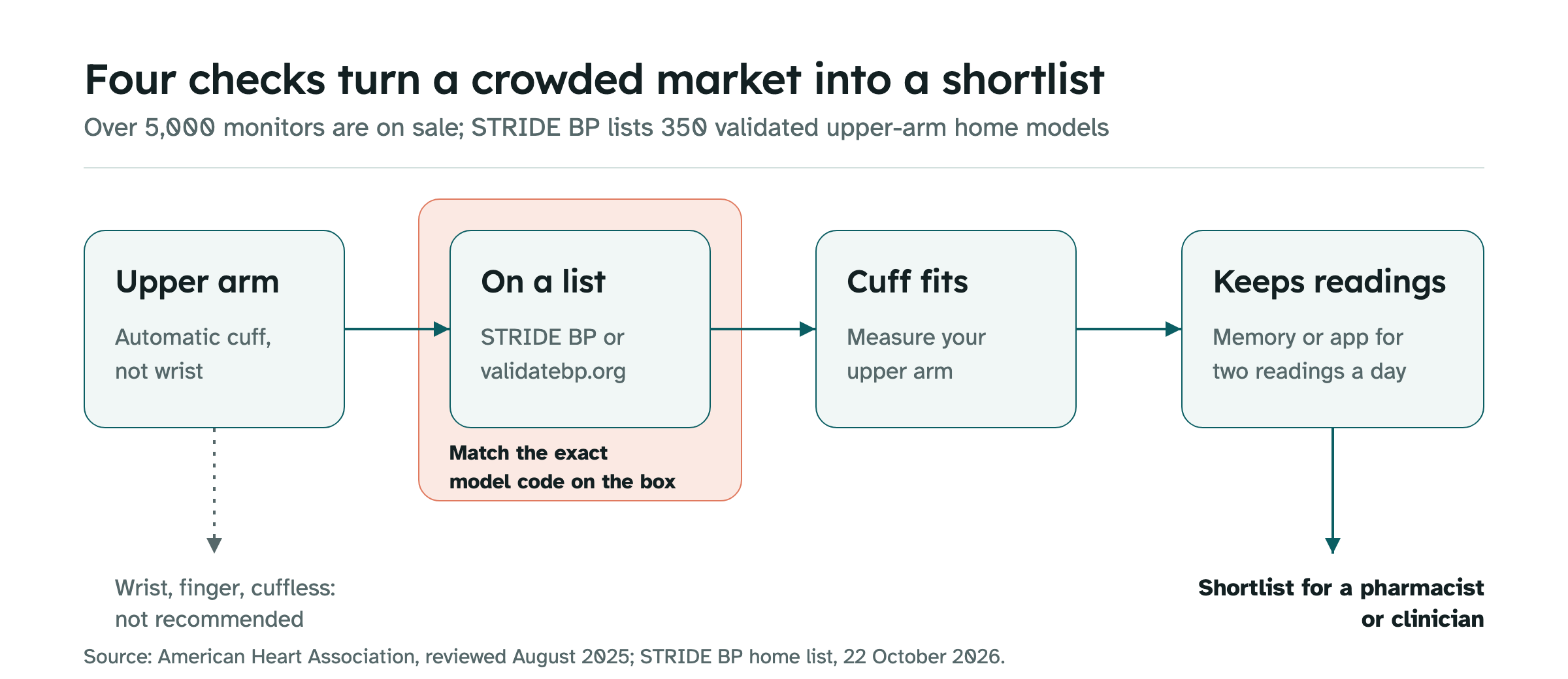
Three checks decide between models more than any feature list:
- The exact model code. The same monitor can carry a different name in another country, and STRIDE BP lists models by the name and code it validated. Match the code printed on the box, such as HEM-7155-E, against the list rather than the marketing name.
- The cuff. Measure around your upper arm and choose a monitor that comes with the correct cuff size.[3] The NHLBI notes that readings can be different if the cuff is too small or too big.[1] Most models above list a validated range of 22 to 42 cm.
- How readings leave the device. Memory or an app matters because MedlinePlus advises taking 2 or 3 readings at a sitting, 1 minute apart, and noting the time of the readings.[2] MedlinePlus describes a typical schedule of readings before breakfast and dinner for five days, which gives at least 10 readings.[2]
An irregular-rhythm warning on the display is not a diagnosis. Show the flagged readings to a clinician, who can decide whether a heart rhythm test is needed.
Blood pressure monitor
A blood pressure monitor for home use comes in three forms, and only one is recommended: the automatic upper-arm cuff. The AHA does not recommend wrist and finger monitors, because their results are not as reliable as those of upper-arm monitors.[3] STRIDE BP lists 55 validated wrist devices on the market but describes them as generally not recommended, citing lower accuracy in practice and the difficulty of holding the wrist at heart level without bending it.[9]
| Type | How it measures | Status for home use |
|---|---|---|
| Automatic upper-arm cuff | inflates a cuff around the upper arm | recommended by the AHA when validated |
| Wrist cuff | inflates a cuff around the wrist | not recommended by the AHA; validated models exist but STRIDE BP generally advises against them |
| Cuffless watch, ring or finger sensor | estimates pressure from optical or other signals | not recommended for diagnosis or management under European Society of Hypertension guidelines |
Cuffless devices are the newest group. A 2022 statement by the European Society of Hypertension's working group on blood pressure monitoring notes that the society's guidelines do not recommend cuffless devices for diagnosing or managing hypertension. According to the statement, fundamental questions about their accuracy, performance and implementation need to be addressed before they can be recommended for clinical use.[19]
Once you own a monitor, check its reading against your doctor's reading when the device is new and once a year after that.[3] If your blood pressure is 180/120 mm Hg and you have no symptoms, the NHLBI advises waiting 5 minutes and checking again, and calling your healthcare provider if it is still high.[20] If the second reading is also high and you have a sudden, severe headache, difficulty breathing, sudden, severe pain in the abdomen, chest or back, numbness or weakness, a sudden change in vision or problems talking, it advises calling emergency services.[20]
Home monitoring matters at population scale too: the NHLBI states that half of all American adults have high blood pressure and many do not know it.[21] If you are choosing a monitor, write down two or three models from the list that come with your cuff size, and take that shortlist to a pharmacist or clinician before you buy. More on readings and categories is in Elenra's blood pressure section, and how Elenra compares products is explained in its methodology.
Frequently asked questions
Are Omron blood pressure monitors validated?
Many Omron upper-arm models are on the STRIDE BP list, but not every model is. Check the exact model code, for example HEM-7155-E, rather than the brand name.
Is a more expensive blood pressure monitor more accurate?
Price is not part of validation. Whether a model is accurate shows in its validation study, so check the list rather than the price tag.
Can I use my smartwatch instead of a cuff?
European hypertension experts do not recommend cuffless devices for diagnosing or managing high blood pressure. A validated upper-arm cuff remains the reference at home.
Which arm should I use for home readings?
The American Heart Association says you can use either arm, because there is usually not a big difference. Use the same arm each time so readings are comparable.
How often should a home monitor be checked?
The American Heart Association suggests taking it to an appointment about once a year, or as the manufacturer directs, to compare it with the office equipment.
Sources
- nhlbi.nih.gov
- medlineplus.gov
- nationwidechildrens.org
- pubmed.ncbi.nlm.nih.gov
- pubmed.ncbi.nlm.nih.gov
- pubmed.ncbi.nlm.nih.gov
- nhlbi.nih.gov
- nhlbi.nih.gov
- stridebp.org
- stridebp.org
- stridebp.org
- stridebp.org
- stridebp.org
- stridebp.org
- stridebp.org
- stridebp.org
- stridebp.org
- stridebp.org
- pubmed.ncbi.nlm.nih.gov
- nhlbi.nih.gov
- nhlbi.nih.gov
Medical disclaimer. The content on Elenra is general information. It is not medical advice, diagnosis or treatment and does not replace a consultation with a doctor or another qualified health professional. Talk to your doctor before you start, change or stop any medication or treatment. In an emergency, call your local emergency number. Medical disclaimer
Related reading
All Heart Health →Blood pressure chart by age: what is normal and what is too high
Blood pressure chart by age with ACC/AHA, ESC and NICE thresholds: what counts as normal, where 140 over 70 falls, and how targets change after 80.