Enclomiphene vs clomiphene for men with low testosterone
Enclomiphene is one half of clomiphene. What the FDA label, guidelines and studies say for men with low testosterone, plus the myths around both drugs.
In this article9
- Does not ejaculating for 7 days increase testosterone?
- Will testosterone increase my size?
- How does clomiphene increase testosterone?
- Which is better for bodybuilding, enclomiphene or clomiphene?
- How much can clomiphene boost testosterone?
- What foods increase testosterone levels?
- Does vitamin D increase testosterone?
- Frequently asked questions
- Sources

Clomiphene citrate has been used for decades. The FDA label lists one use: ovulatory dysfunction in women who want to become pregnant.[1] Doctors also prescribe it to men with low testosterone, which is an off-label use.[2] The tablet is a mixture of two isomers, zuclomiphene and enclomiphene.[3] Enclomiphene is the isolated half.
That is the whole difference in chemistry. In practice it shows up in three places.
| Clomiphene citrate | Enclomiphene citrate | |
|---|---|---|
| What it is | Mixture of zuclomiphene and enclomiphene | One isomer only |
| FDA status | Approved for ovulatory dysfunction in women | No approved product |
| Use in men | Off-label, prescribed by a licensed clinician | Prepared by compounding pharmacies, prescribed by a licensed clinician |
| Typical US cash price | About $10 to $30 for 30 tablets of 50 mg | About $30 to $120 per month |
The prices come from a HealthRX cost report updated on 26 May 2026, which also states that no FDA-approved enclomiphene product exists.[4] The company sells in this market, so read the figures as estimates. In June 2022 the FDA's Pharmacy Compounding Advisory Committee voted 8 to 4, according to its meeting minutes, against putting enclomiphene citrate on the list of bulk substances that pharmacies may compound.[5] Several members cited a lack of clinical efficacy evidence. Check the current status with a pharmacist before you rely on any of this.
Both drugs only make sense after a proper diagnosis. The American Urological Association (AUA) calls a man testosterone deficient only when low levels come with symptoms or signs. Those symptoms are non-specific.[6] The Endocrine Society recommends confirming a low result with a repeat morning measurement.[7] The testosterone blood test guide explains the timing and the costs.
Does not ejaculating for 7 days increase testosterone?
No reliable evidence says so. The claim traces back to a 2003 study of 28 volunteers, which reported a peak on day seven that reached 145.7% of baseline.[8] The journal later retracted that paper. A 2021 review of ejaculation frequency and health concluded that the link to hormones remains poorly understood.[9]
So abstinence is not a treatment for low testosterone, and it does not replace either drug. If you suspect low testosterone, the guideline path is a repeat morning blood test and a clinician's assessment.
Will testosterone increase my size?
Testosterone raises muscle size, but the best-known trial used a very high dose. This section covers muscle and body size only. The sources used here do not address genital size, so that question belongs with a urologist.
In 1996, researchers gave 43 healthy men 600 mg of testosterone enanthate weekly for 10 weeks.[10] Men who took testosterone and did not exercise gained muscle size and strength compared with placebo. Men who took it and lifted weights gained the most, with fat-free mass up by 6.1 kg.[10] The authors called these doses supraphysiologic, meaning far above what replacement therapy aims for.
For men with diagnosed deficiency, the Endocrine Society recommends testosterone therapy to induce and maintain secondary sex characteristics and correct symptoms of deficiency.[7] Clomiphene and enclomiphene are not testosterone. Nothing cited here shows that they build muscle.
How does clomiphene increase testosterone?
Clomiphene acts on the brain, not the testes. It competes with estrogen for receptor sites in tissues that include the hypothalamus and the pituitary.[1] In men, the brain then reads less estrogen and releases more luteinizing hormone (LH) and follicle-stimulating hormone (FSH). The testes respond by making more of their own testosterone.
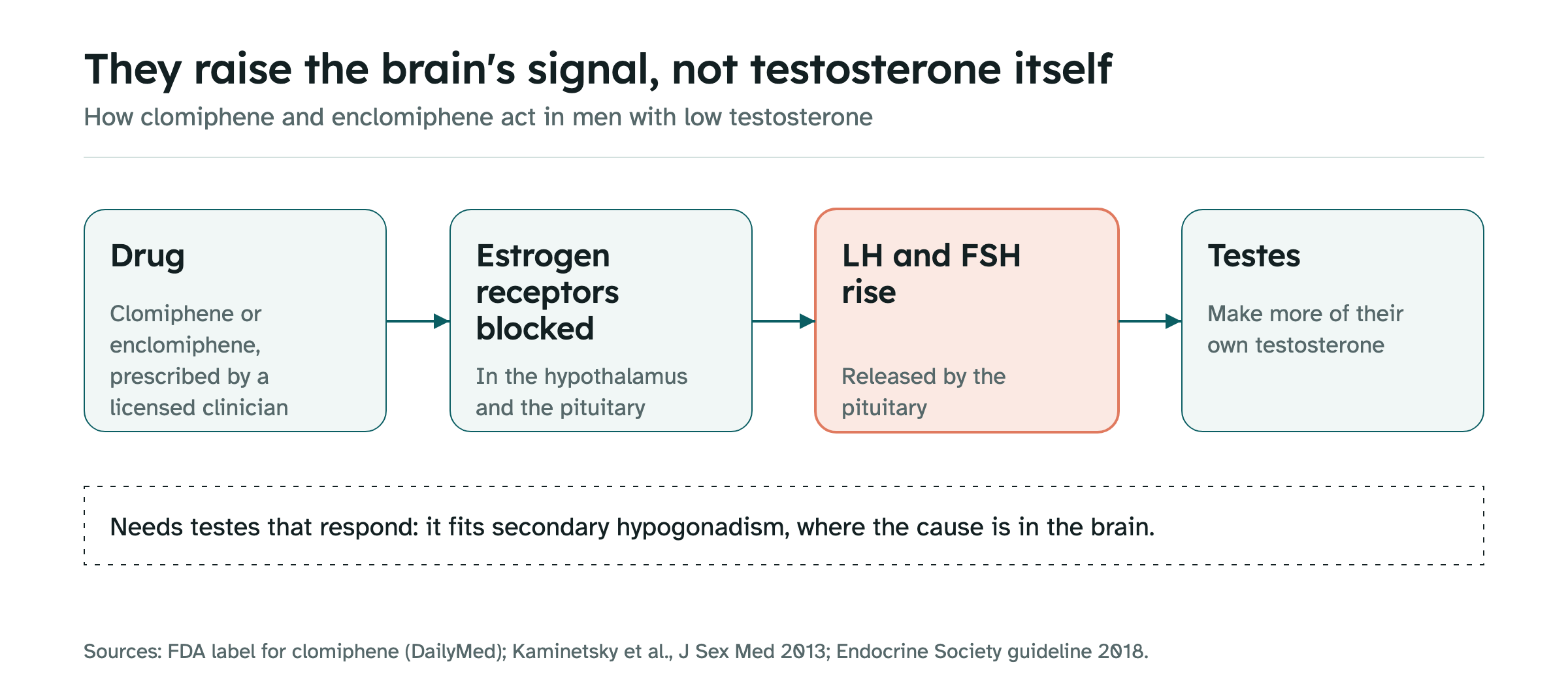
A trial of enclomiphene in 12 men with secondary hypogonadism showed that pattern. Testosterone rose to a level similar to topical gel. LH and FSH rose with enclomiphene only. Sperm counts rose in every man measured at 3 and 6 months.[3] A larger phase II trial reached the same conclusion: sperm counts were conserved while testosterone rose.[11]
That has one consequence. The approach needs a working signal chain, so it suits secondary hypogonadism, where the cause lies in the hypothalamus or pituitary. The Endocrine Society asks clinicians to separate primary (testicular) from secondary causes by measuring LH and FSH.[7] It also recommends against testosterone therapy in men who plan to have children in the near term.[7] That is why men with fertility plans are the ones most often offered these drugs. The guide on TRT vs enclomiphene covers that trade-off in detail.
Which is better for bodybuilding, enclomiphene or clomiphene?
Neither has been shown to be better, because neither has been tested for it in the sources used here. The randomized trials enrolled men with low testosterone, and their primary outcomes were hormone levels (total testosterone, LH and FSH), not muscle or performance.[12] The FDA label for clomiphene lists no use in men and says no adequate, well-controlled studies show it works for male infertility.[1]
The muscle gains in the 1996 trial came from testosterone at a supraphysiologic dose, which is a different drug acting in a different way.[10] A man with normal testosterone has no diagnosis that either drug treats. Both are prescription medicines for a diagnosed condition, and a licensed clinician decides whether that condition is present. If you compete in a tested sport, check your sport's anti-doping rules before you take any prescription hormone modulator.
How much can clomiphene boost testosterone?
On average, by a few hundred ng/dL in men with low testosterone, but the studies differ and none of them can predict one man's result.
A 2025 meta-analysis of randomized trials found that clomiphene or enclomiphene raised total testosterone by 273.76 ng/dL more than placebo, with wide variation between trials and no significant difference from testosterone gel.[12] Longer-term data come from retrospective reviews, which have no placebo group:
| Study | Design | Men | Finding |
|---|---|---|---|
| Moskovic 2012 | Retrospective, over 12 months of clomiphene | 46, mean age 44 | Testosterone 228 ng/dL at baseline, 612 at 1 year, 582 at 3 years |
| Krzastek 2019 | Retrospective, 2 centers | 400 | 120 of the 400 men were treated for over 3 years; the review reports testosterone and symptom outcomes for them |
| Saffati 2024 | Retrospective, same men on clomiphene then enclomiphene | 66 | Median rise 166 vs 98 ng/dL; difference not statistically significant |
In the Moskovic review, 46 men with a mean baseline of 228 ng/dL reached 612 ng/dL at one year.[13] In the Krzastek review, 88% of the 120 men treated for over three years reached normal levels.[2] The Saffati study compared both drugs in the same patients. Median testosterone rose 166 ng/dL on enclomiphene and 98 on clomiphene, with a P value of 0.20.[14]
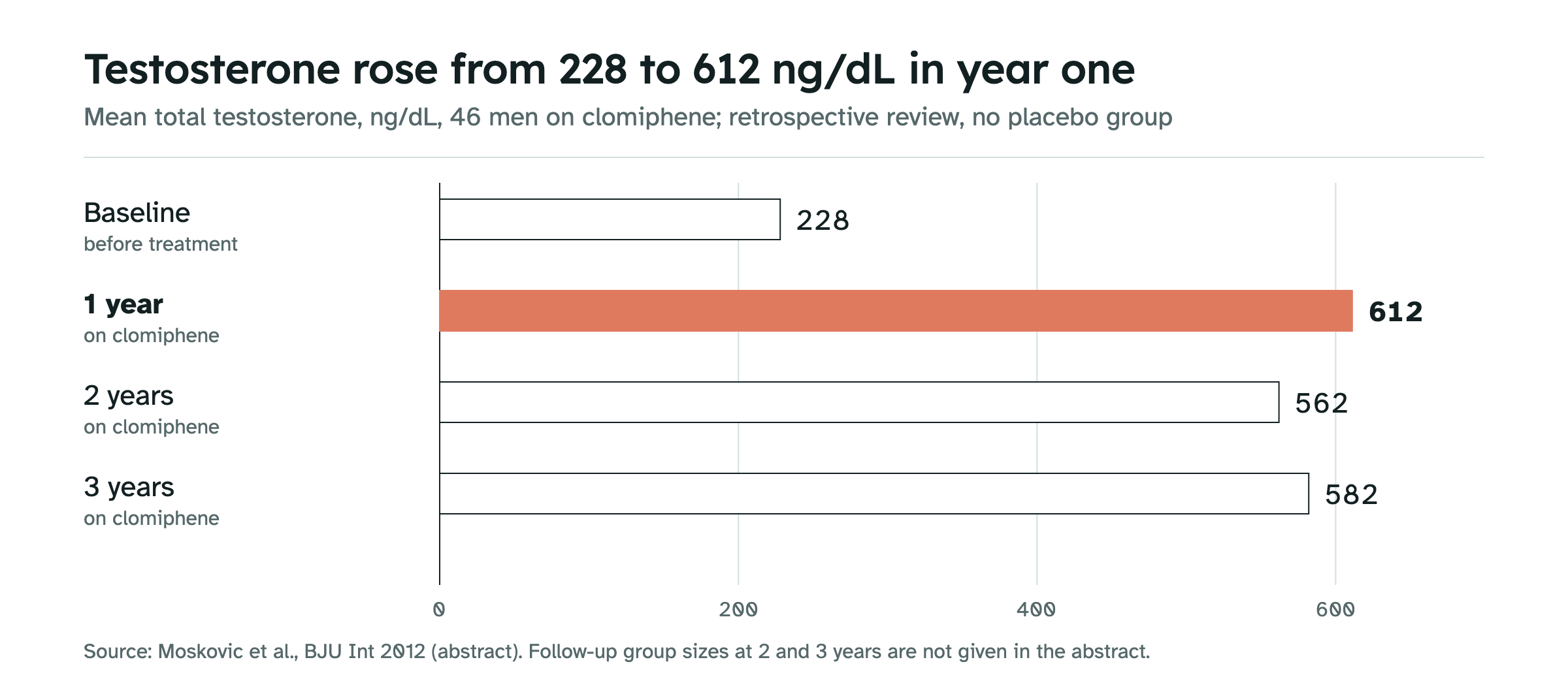
Read these as averages from men with low testosterone, not as a forecast. A number that rises on a lab report also says nothing by itself about how you feel. The guidelines link treatment to symptoms, and a clinician monitors both.
What foods increase testosterone levels?
The sources here name no single food that raises testosterone. Diet matters mostly through body weight and overall fat intake.
An umbrella review of systematic reviews found that weight-loss interventions improved sex hormone profiles in adults with obesity. Bariatric surgery had the strongest effect, and dietary changes improved testosterone and SHBG to a lesser extent.[15] SHBG is the protein that binds testosterone in the blood.
Fat intake points the other way. A meta-analysis of six intervention studies with 206 men found lower total testosterone on low-fat diets than on high-fat diets. Its authors say further randomized trials are needed.[16] The finding does not make a high-fat diet healthy. It suggests that very strict fat cutting is not a way to protect testosterone.
Food is not a replacement for diagnosis. Low testosterone with symptoms is a medical question, and changing your plate does not answer it.
Does vitamin D increase testosterone?
Probably not in men overall, though one trial pointed the other way. In one randomized trial, researchers gave overweight men a daily vitamin D supplement for a year, and total testosterone rose from 10.7 to 13.4 nmol/L, while it did not change on placebo. The men started with low vitamin D and were in a weight-loss program, and the authors called for more trials.[17] That dose is what the trial used, not a recommendation.
A recent meta-analysis of randomized trials pooled 11 comparisons and found no clear effect on total testosterone (mean difference 0.47 nmol/L, with a confidence interval that included zero). The certainty of the evidence was low.[18] Correcting a real vitamin D deficiency may be worthwhile for other reasons, but a supplement is not a testosterone treatment.
Before you see a clinician, bring this list:
- Your symptoms and how long you have had them.
- Two morning testosterone results, if you have them.
- Whether you plan to have children, since that changes which options apply.
- Every supplement and medicine you take.
- A question about whether the drug is FDA-approved for your use and where it would be prepared.
If cost is a concern, the Elenra guide on how to check whether your insurance covers a treatment[19] is a good next step. This article is general information. It does not replace a diagnosis or a prescription from a licensed clinician or pharmacist.
Frequently asked questions
Is clomiphene approved for men?
The FDA label for clomiphene covers ovulatory dysfunction in women who want to become pregnant. Its use for low testosterone in men is off-label, and a licensed clinician decides whether it fits.
Is enclomiphene or clomiphene better?
No trial in this article proves that one is better. The only direct comparison cited is a retrospective review of 66 men, where the testosterone difference was not statistically significant. Ask a licensed clinician which fits your diagnosis and plans.
What does a clinician check first?
Symptoms plus consistently low morning testosterone come first. The Endocrine Society then asks for LH and FSH to find out whether the cause is in the testes or in the brain's signal.
Sources
- dailymed.nlm.nih.gov
- pubmed.ncbi.nlm.nih.gov
- pubmed.ncbi.nlm.nih.gov
- healthrx.com
- fda.gov
- auanet.org
- endocrine.org
- pubmed.ncbi.nlm.nih.gov
- pubmed.ncbi.nlm.nih.gov
- pubmed.ncbi.nlm.nih.gov
- pubmed.ncbi.nlm.nih.gov
- pubmed.ncbi.nlm.nih.gov
- pubmed.ncbi.nlm.nih.gov
- pubmed.ncbi.nlm.nih.gov
- pubmed.ncbi.nlm.nih.gov
- pubmed.ncbi.nlm.nih.gov
- pubmed.ncbi.nlm.nih.gov
- pubmed.ncbi.nlm.nih.gov
- elenra.com
Medical disclaimer. The content on Elenra is general information. It is not medical advice, diagnosis or treatment and does not replace a consultation with a doctor or another qualified health professional. Talk to your doctor before you start, change or stop any medication or treatment. In an emergency, call your local emergency number. Medical disclaimer
Related reading
All Men's Health →Enclomiphene side effects and risks: what the evidence shows
Enclomiphene side effects in trials were mostly headache and hot flushes, but FDA and EMA found safety data too thin. What the evidence shows, October 2026.

TRT vs enclomiphene: which fits your goals and fertility plans?
TRT vs enclomiphene on testosterone, fertility, muscle, safety, FDA status and 2026 US cash prices, and what each means if you want children.

Best online TRT clinics 2026: prices and labs compared
Compare seven US online TRT clinics in 2026 by monthly price, plan length, lab costs, states served and how a licensed clinician prescribes.