Enclomiphene dosage: 12.5 mg vs 25 mg and how long men take it
Enclomiphene dosage in trials: 12.5 mg and 25 mg daily, with 25 mg raising testosterone most. What studies show on dose and how long men take it.
In this article9
- How long can a man stay on enclomiphene?
- Is 25 mg of enclomiphene a lot?
- How much can 12.5 mg of enclomiphene raise testosterone?
- How long should a man take enclomiphene?
- How long should a man stay on testosterone?
- Is 12.5 mg of enclomiphene good?
- Can I take 25 mg of enclomiphene?
- Frequently asked questions
- Sources

Enclomiphene citrate is a pill that raises a man's own testosterone. It blocks estrogen's feedback signal in the brain, so the pituitary gland releases more luteinizing hormone (LH) and follicle-stimulating hormone (FSH), and the testes make more testosterone and sperm. It is used for secondary hypogonadism, the form of low testosterone in which the testes work but the signal from the brain is weak.
Questions about dose come up because enclomiphene has no approved label to look them up in. Its developer ran trials for a marketing application, but the drug was approved neither in the US nor in the EU. In the US, licensed clinicians prescribe it off-label and compounding pharmacies prepare it. The numbers below come from those trials and from later clinic records. They describe what was studied, not what any one man should take.
How long can a man stay on enclomiphene?
There is no proven upper limit, because no study has followed men on enclomiphene for years. The two phase III trials, known as ZA-304 and ZA-305, treated overweight men aged 18 to 60 for 16 weeks.[1] In both, enclomiphene raised total testosterone into the normal range and kept sperm concentrations normal, while testosterone gel lowered them.[1] A smaller phase IIB trial in 12 men ran for six months.[2]
Real-world use runs longer than the trials. In a retrospective study at Baylor College of Medicine, 66 patients first took clomiphene and later enclomiphene; the median duration of enclomiphene treatment was 8.9 months.[3] The middle half of the group took it for 5.2 to 13.3 months.[3] That tells you how long men stayed on it in one clinic, not how long it is safe to take.
The British Society for Sexual Medicine (BSSM) draws the same line in its 2026 position statement.[4] It calls the current evidence "small, short-term studies with limited safety and fertility data". It does not recommend routine use outside specialist settings.[4] Long-term use is therefore possible but unstudied, and it depends on regular blood tests with a clinician.
Is 25 mg of enclomiphene a lot?
No: 25 mg a day is the highest dose tested in the main trials, not an unusual one. In the phase II dose study, men were randomized to 6.25 mg, 12.5 mg or 25 mg once a day, or to a testosterone gel.[5] In a retrospective series cited by the BSSM, 69.6 percent of men on enclomiphene took 25 mg a day and 30.4 percent took 12.5 mg.[4]
The BSSM statement describes a stepwise approach. Treatment begins at 6.25 mg a day, and the dose is raised weekly, as tolerated, up to 25 mg. It may go to 50 mg a day if the clinical or blood test response is inadequate.[4] Above 25 mg there are no trial data on safety.
That gap matters. A 2026 case report describes a 46-year-old man who took 50 mg a day by mistake instead of his prescribed 25 mg.[6] Atrial flutter, a fast heart rhythm, was found shortly afterwards.[6] He had a heart valve repair 20 years earlier, which on its own can cause this rhythm. The authors therefore present the drug as a possible trigger, not a proven cause. A single case proves nothing about risk, but it shows why a dose change belongs with the prescriber.
How much can 12.5 mg of enclomiphene raise testosterone?
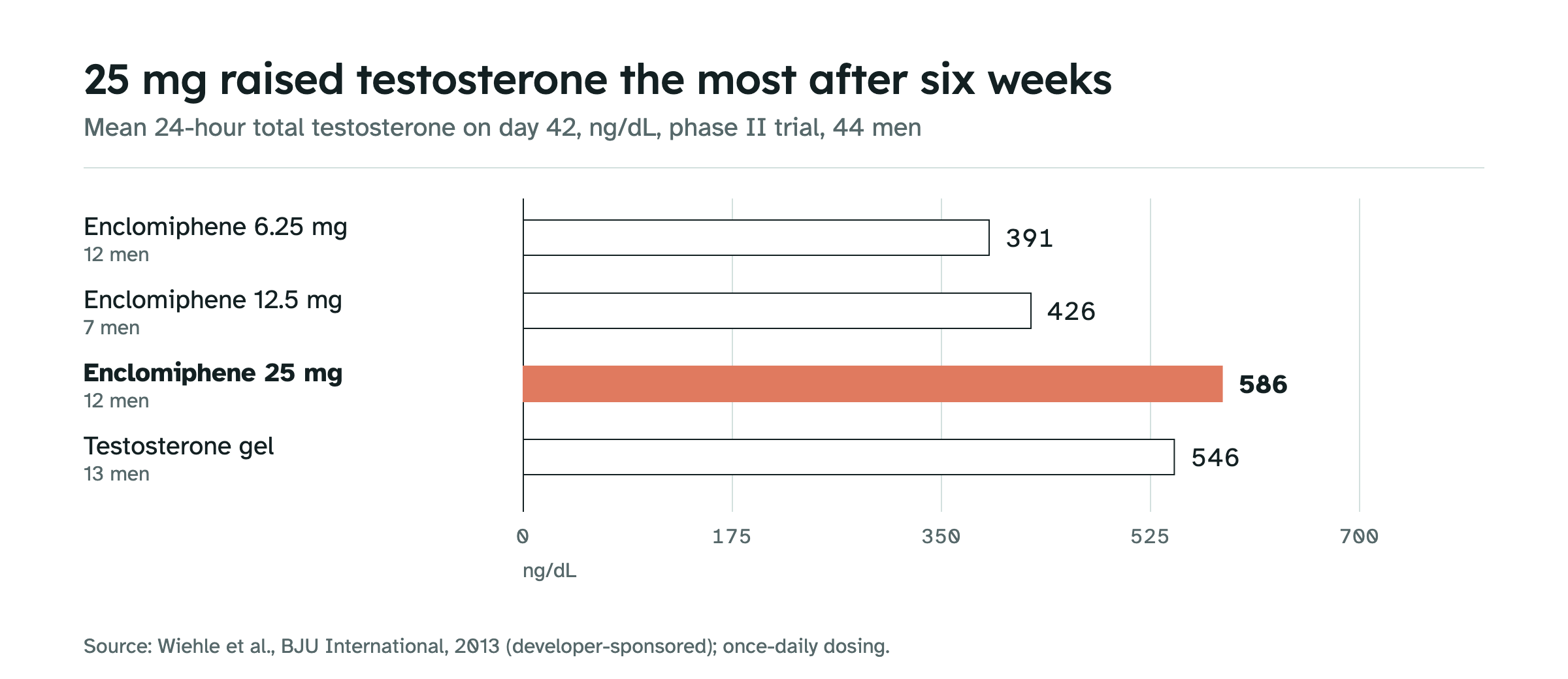
In the phase II dose study, the mean total testosterone with enclomiphene citrate 12.5 mg rose from 280 ng/dL on the first day of treatment to 426 ng/dL after six weeks.[5] The study was run by the drug's developer: forty-eight men with testosterone below 350 ng/dL were enrolled, and forty-four completed it per protocol.[7] Testosterone was assessed each hour for 24 hours on the first day and again after six weeks of daily treatment, on day 42.[5]
| Treatment (once daily, 6 weeks) | Mean 24-hour testosterone, day 42 | Men with a mean above 300 ng/dL |
|---|---|---|
| Enclomiphene 6.25 mg | 391 ng/dL | 7 of 12 |
| Enclomiphene 12.5 mg | 426 ng/dL | 5 of 7 |
| Enclomiphene 25 mg | 586 ng/dL | 12 of 12 |
| Testosterone gel | 546 ng/dL | 11 of 13 |
The effect rose with the dose. On 25 mg, the mean concentration of total testosterone at day 42 was 604 ng/dL in the morning, against 500 ng/dL with transdermal testosterone; these morning values differ from the 24-hour means in the table, and the gel raised testosterone with more variability.[5] The groups were small, though: the 12.5 mg arm had only seven men in the final analysis, so its result is the least certain of the four.
How long should a man take enclomiphene?
Trials gave enclomiphene for six weeks to six months, and its effect lasted only as long as men took it. In the six-month phase IIB trial, testosterone rose within three months and stayed up while treatment continued. One month after the last dose, it had fallen back to pretreatment values.[2] Enclomiphene does not repair the cause of low testosterone. It supports the body's own production while it is taken.
How long treatment lasts therefore depends on why it was started. A man who takes it while trying to conceive may stop once that goal is reached. A man treated for ongoing symptoms may need it for as long as the symptoms would otherwise return, with regular blood tests. The BSSM names men who want to keep or improve fertility as one of the main groups for whom enclomiphene may fit.[4]
Follow-up visits are what decide the duration in practice. Enclomiphene has no approved label, so there is no official monitoring schedule for it; the prescribing clinician sets which blood tests are repeated and when. Our guide to the testosterone blood test explains timing and cost.
How long should a man stay on testosterone?
Testosterone therapy is usually a long-term treatment, because low testosterone tends to return when it stops. The Endocrine Society's guideline recommends checking, after treatment starts, whether a man responds, has side effects and takes it as planned. It asks for a urology referral if, in the first 12 months, PSA rises by more than 1.4 ng/mL above baseline or exceeds 4.0 ng/mL.[8] After the first year, prostate monitoring follows standard screening for the man's age and background.[8]
The comparison with enclomiphene is mainly about fertility. The Endocrine Society recommends against testosterone therapy in men planning fertility in the near term.[8] According to the BSSM, testosterone usually suppresses sperm production within three to six months. After stopping, sperm counts generally recover within 6 to 24 months, sometimes longer.[4] The trade-offs between the two treatments are covered in TRT vs enclomiphene.
Is 12.5 mg of enclomiphene good?
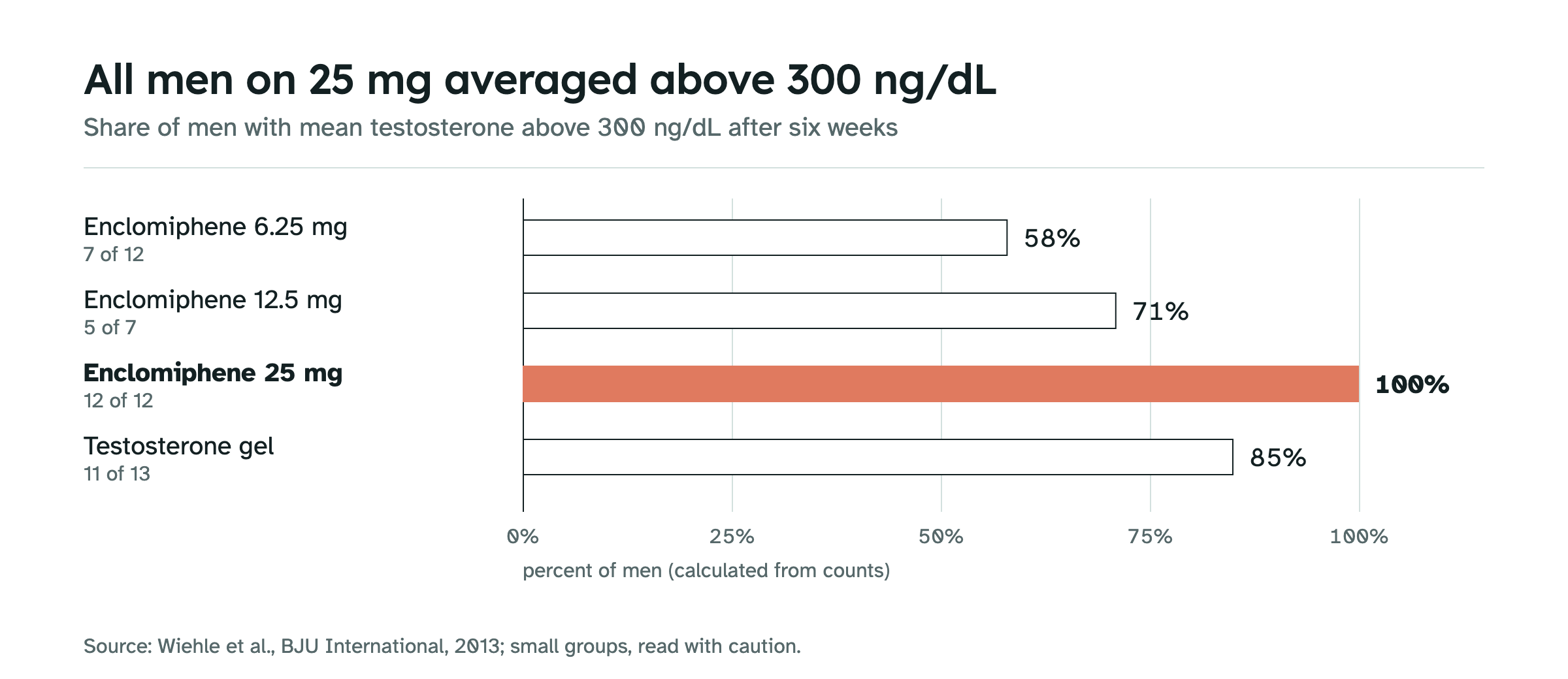
12.5 mg raised testosterone in every man who took it in the dose study, but not always enough. All seven men in the 12.5 mg group had some increase, and five of them reached an average above 300 ng/dL after six weeks.[5] That threshold matters because US urology studies define hypogonadism as two serum total testosterone levels below 300 ng/dL with clinical symptoms (Baylor series[3]).
Whether 12.5 mg is enough for a particular man depends on where he starts and how his body responds. A man close to the threshold may reach the normal range on the lower dose; a man further below it may not. The BSSM advises to begin with 6.25 mg daily and increase weekly as tolerated up to 25 mg daily, so 12.5 mg is a step on the way, not a fixed target.[4] A blood test after a few weeks on a dose is what shows whether it works.
Can I take 25 mg of enclomiphene?
Only a licensed clinician can decide that, and only after a diagnosis. Enclomiphene is a prescription medicine that is not approved by the FDA or the European Medicines Agency.[4] The Endocrine Society asks for low testosterone to be confirmed with a repeat morning, fasting measurement. It also asks for LH and FSH to be measured, to tell testicular from pituitary causes.[8] Enclomiphene only works when the testes can still respond, so that distinction decides whether it can help at all.
Cost is part of the decision. A cost report from HealthRX, a seller of compounded enclomiphene, puts a 30-day supply of 25 mg capsules from compounding pharmacies at $30 to $90.[9] Telehealth subscriptions that bundle the consultation, labs and medication cost $99 to $199 a month.[9] Because the source sells the product, read these figures as a range, not a quote. Insurance rarely pays for a drug without FDA approval.
Take these points to your clinician or pharmacist: your two morning testosterone results and your LH and FSH. Add whether you want to keep your fertility, the proposed dose and the follow-up schedule. For background on the drug itself, see enclomiphene side effects and risks and enclomiphene vs clomiphene.
Frequently asked questions
What is the usual dose of enclomiphene?
Trials used 6.25, 12.5 and 25 mg once a day. A 2026 BSSM position statement describes starting low and raising the dose up to 25 mg.
Is enclomiphene taken every day?
Yes, in the trials it was taken once a day, in the morning. Its effect on testosterone faded within a month of stopping.
Does a higher dose of enclomiphene work better?
In a six-week trial, testosterone rose more on 25 mg than on 12.5 or 6.25 mg. No trial has tested doses above 25 mg.
Sources
Medical disclaimer. The content on Elenra is general information. It is not medical advice, diagnosis or treatment and does not replace a consultation with a doctor or another qualified health professional. Talk to your doctor before you start, change or stop any medication or treatment. In an emergency, call your local emergency number. Medical disclaimer
Related reading
All Men's Health →Enclomiphene side effects and risks: what the evidence shows
Enclomiphene side effects in trials were mostly headache and hot flushes, but FDA and EMA found safety data too thin. What the evidence shows, October 2026.

Enclomiphene vs clomiphene for men with low testosterone
Enclomiphene is one half of clomiphene. What the FDA label, guidelines and studies say for men with low testosterone, plus the myths around both drugs.

TRT vs enclomiphene: which fits your goals and fertility plans?
TRT vs enclomiphene on testosterone, fertility, muscle, safety, FDA status and 2026 US cash prices, and what each means if you want children.