TRT Cost Per Month in 2026: With and Without Insurance
TRT costs $40 to $100 monthly for generic injections without insurance and about $30 to $80 with coverage. See what drives the price, from labs to formulation.
Contents
Is testosterone replacement therapy available in the USA?
Yes. Testosterone replacement therapy (TRT) is legally available in the United States, but only through a prescription from a licensed clinician. The FDA has approved several testosterone formulations for men, including oral capsules, topical gels, transdermal patches, buccal systems applied to the gum or cheek, and injections.[1] The FDA describes these products as approved for men whose low testosterone occurs together with an associated medical condition, such as testicular failure or pituitary problems. In June 2026, after reviewing new data including the TRAVERSE cardiovascular safety trial, the FDA requested that product labels drop the limitation of use stating that safety and efficacy in age-related hypogonadism have not been established.[2]
Professional guidelines add a second gatekeeper before any prescription. The American Urological Association advises clinicians to use a total testosterone level below 300 ng/dL as a reasonable cut-off, confirmed by two separate early-morning measurements, and to make the diagnosis only when low levels are combined with symptoms or signs.[3] The Endocrine Society likewise recommends diagnosing hypogonadism only in men with symptoms and signs of testosterone deficiency and unequivocally and consistently low serum testosterone, and recommends against routine screening of men in the general population for hypogonadism.[4]
- Prescription-only: every FDA-approved formulation requires a licensed prescriber; there is no over-the-counter route.
- Diagnosis first: symptoms plus two confirmed low morning testosterone measurements, per AUA and Endocrine Society guidance.
- Approval scope: the FDA ties approval to an associated medical condition; in June 2026 it asked labels to drop the age-related limitation-of-use statement, and the prescription requirement is unchanged.
Access has widened considerably through telehealth clinics, which can arrange testing and prescribe remotely, but the prescription requirement itself has not changed. The AUA notes that testing and prescribing have nearly tripled in recent years, while some studies estimate that up to 25% of men receiving testosterone were never tested beforehand and up to a third do not meet diagnostic criteria, which is why the guideline emphasizes proper assessment.[3] For readers outside the USA, availability, approved products and prescribing rules differ by country, so the US picture described here should not be assumed to apply elsewhere.
How much do 6 months of testosterone cost?
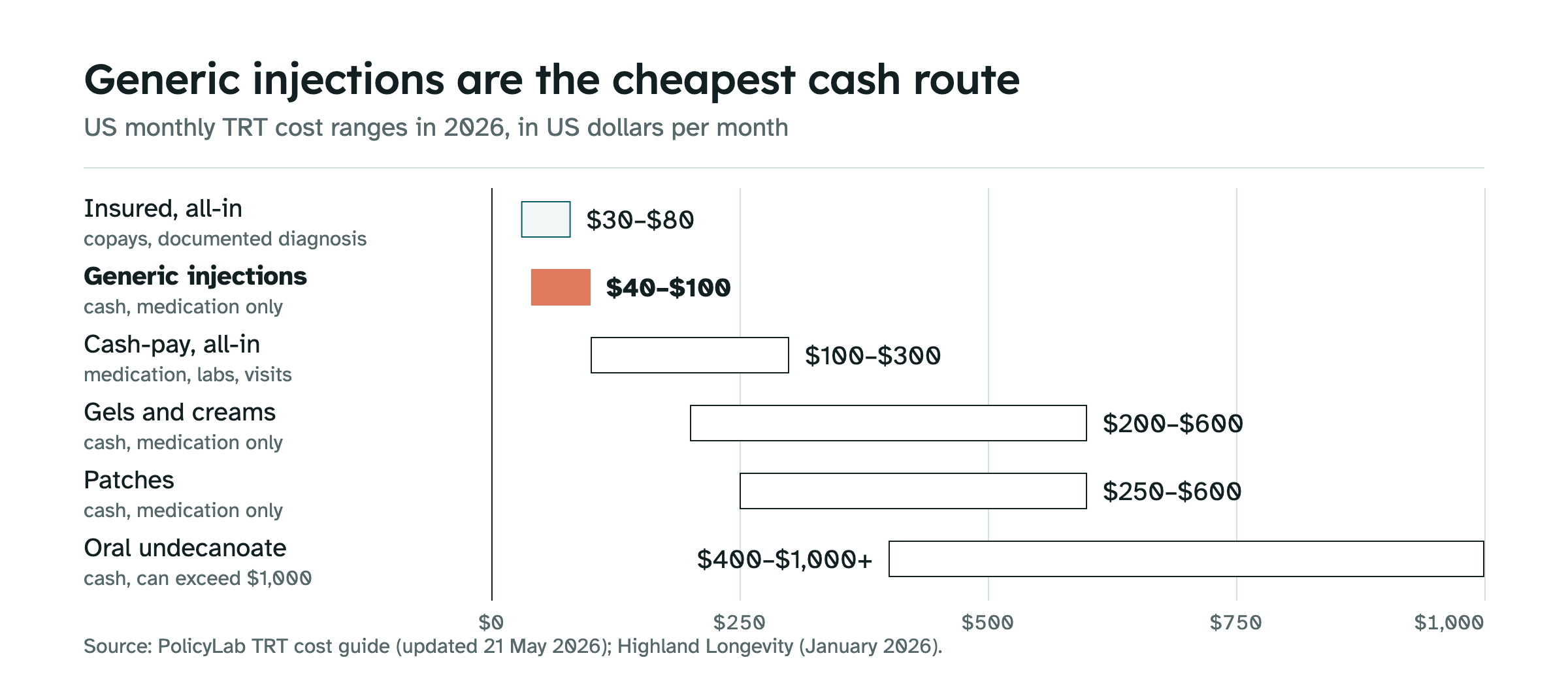
The medication alone, paid in cash without insurance, varies widely with the formulation. Generic injectable testosterone cypionate or enanthate is the least expensive option at about $40 to $100 per month, while oral testosterone undecanoate can exceed $1,000 per month, according to PolicyLab's TRT cost guide (last updated 21 May 2026).[5] Over six months, those differences compound into very different bills.
| Formulation | Typical cash price |
|---|---|
| Generic injections (cypionate or enanthate) | $40 to $100 per month |
| Gels and creams | $200 to $600 per month[5] |
| Patches | $250 to $600 per month[5] |
| Pellets | $800 to $1,200 per insertion, every 3 to 6 months[5] |
| Oral testosterone undecanoate | $400 to over $1,000 per month[5] |
Two details explain much of the spread. First, vial size matters: at a common dose of 100 mg per week, a single 10 mL multi-dose vial of testosterone cypionate at 200 mg/mL holds 2,000 mg and can last about 20 weeks, so a six-month supply may need only one or two fills.[6] Second, the route and the brand change the price: SingleCare (updated November 2025) puts two vials of testosterone cypionate at about $109 per month without insurance, a bottle of brand-name AndroGel at around $400 per month, and a bottle of Jatenzo oral capsules at roughly $1,014 before insurance.[7] As a rule, generic versions cost far less than their brand-name equivalents, and injections cost far less than topical or oral routes.
How much does Low T treatment typically cost?
Headline prices usually quote the medication alone, but the full treatment bill includes several recurring items that are easy to overlook. When consultation fees, lab work, supplies and follow-up visits are added together, all-in cash-pay treatment commonly runs $100 to $300 per month in Highland Longevity's January 2026 cost table.[8] That distinction between the drug price and the total cost of care is the single most useful thing to keep in mind when comparing offers.
- Initial consultation: about $150 to $250 via telehealth, or $250 to $800 for a new-patient visit with a urologist.[5]
- Baseline lab panel: roughly $150 to $300 for a comprehensive hormone panel before treatment starts.[5]
- Follow-up labs: typically ordered 6 to 12 weeks after starting, then every 6 to 12 months, at about $50 to $100 per panel.[5]
- Injection supplies: syringes, needles and swabs for self-injection add roughly $10 to $20 per month.[5]
- Ancillary medications: some men are prescribed hCG or an estrogen blocker alongside testosterone, adding $20 to $100 or more per month, and these are not always covered by insurance.[5]
These figures are US cash-pay estimates from PolicyLab's TRT cost guide (last updated 21 May 2026) and will vary with dose, location and provider model. They also explain why two clinics quoting the same monthly medication price can end up costing very different amounts over a year: the labs and monitoring are part of safe treatment, not optional extras, and they belong in any honest comparison.
Is testosterone replacement therapy illegal?
No, not when it is prescribed. TRT with a prescription from a licensed clinician for diagnosed testosterone deficiency is legal in the USA. Because testosterone products are prescription-only, however, obtaining them without a prescription, for example from an unregulated seller or without a clinical evaluation, is illegal. A legitimate prescription follows the diagnostic pathway described above: symptoms, two confirmed low morning testosterone measurements, and a clinician who has assessed the individual case.
- Legal: prescribed by a licensed clinician for diagnosed testosterone deficiency, using an FDA-approved product.
- Illegal: buying or using testosterone without a prescription, since these are prescription-only medicines.
- Approved scope: FDA approval covers low testosterone with an associated medical condition, not low levels alone; the June 2026 label change is described below.
The safety picture has also evolved in ways that matter for legality and access. The FDA reviewed cardiovascular safety in the TRAVERSE trial, which followed more than 5,200 men and found no meaningful difference in serious cardiovascular events between testosterone and placebo (7.0% versus 7.3%).[2] These were two distinct regulatory steps. In February 2025, the FDA directed that TRAVERSE results be added to all testosterone product labels, removed language about increased cardiovascular risk from the boxed warning, and added warnings about increased blood pressure, while retaining the limitation of use for age-related hypogonadism.[1] Then, in June 2026, after further review, the FDA requested removal of that limitation of use for age-related hypogonadism.[2]
What does testosterone replacement therapy include?
Understanding what a treatment plan contains is the best way to judge what a quoted price actually covers. Both major guidelines define a minimum diagnostic workup before any prescription: a symptoms assessment plus two separate early-morning testosterone measurements, with the AUA using 300 ng/dL as a reasonable cut-off.[3] The Endocrine Society guideline additionally recommends confirming the diagnosis with a repeat morning measurement and lists exclusions to discuss before starting therapy, including plans for fertility in the near term.[4]
- Diagnostic workup: symptom review and two separate morning testosterone measurements before treatment begins.
- A chosen formulation with its dosing schedule: injection, gel, patch, buccal, oral or nasal, each with different costs and practical demands.
- A monitoring plan: an initial follow-up testosterone check after starting, then levels every 6 to 12 months, with dose adjustment toward the target range.[3]
- A discussion of exclusions and risks, including fertility plans, prostate monitoring and cardiovascular history.
How this is billed varies more than what is delivered. Bundled telehealth subscriptions typically charge $150 to $250 per month[5] and may include medication, consultations and sometimes labs, though what is included differs significantly between providers. Office-based care bills each service separately, which can be cheaper with good insurance but more expensive for cash-pay patients.[5] A quoted monthly fee may or may not include labs, supplies and follow-ups, so the itemized list above is worth checking line by line.
How much does TRT cost per month
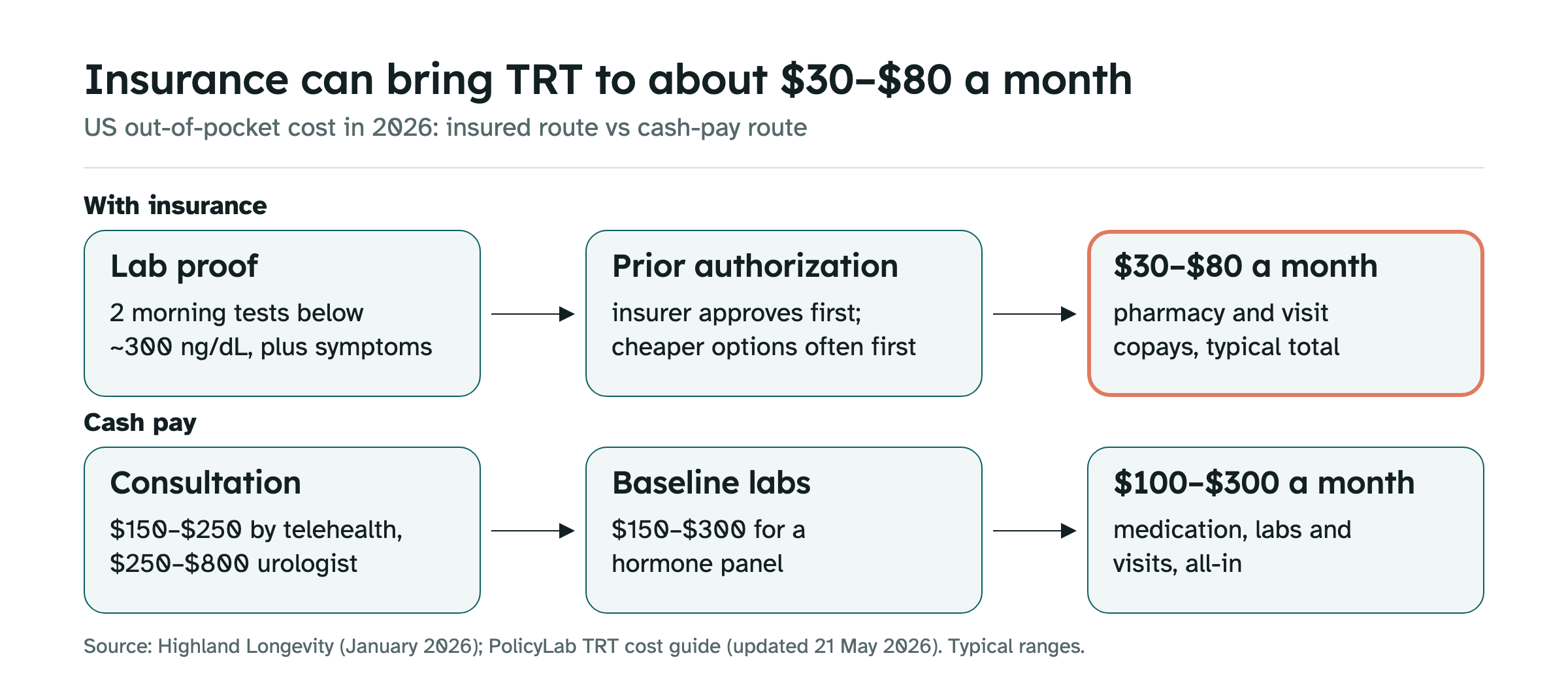
With insurance, and with documented hypogonadism, out-of-pocket costs often fall to a pharmacy copay. Generic testosterone injections typically carry a copay of about $10 to $40 per month[9], and once specialist visit copays are added, typical monthly totals come to roughly $30 to $80.[8] Brand-name gels and pellets are covered far less often, and their copays run higher when they are covered at all.[5]
| Cost item | Typical insured out-of-pocket |
|---|---|
| Generic testosterone cypionate copay | $10 to $40 per month[9] |
| Specialist visit copay | $30 to $80 per visit[5] |
| Lab work copay (in network) | $0 to $50[8] |
| Typical total per month | about $30 to $80[8] |
Coverage comes with conditions. Most insurers require two morning testosterone results below their threshold, commonly around 300 ng/dL, plus documented symptoms, and many plans require prior authorization and step therapy, meaning cheaper options must be tried first.[8] Medicare Part D may cover testosterone when medical-necessity criteria are met, and Medicaid coverage varies by state.[7] A denial is not final: appeals with additional documentation often succeed.[8]
How much does low testosterone treatment cost
Without insurance, cash-pay totals typically run $100 to $300 per month once medication, labs and monitoring are included.[8] The medication itself is the smaller part of that: one 10 mL vial of generic testosterone cypionate lasts about 20 weeks at a common dose of 100 mg per week, as shown above, and Highland Longevity lists it at roughly $30 to $60 in cash.[8] Other sources quote higher cash prices for the same drug, such as PolicyLab's $40 to $100 per month for injections and SingleCare's $109 for two vials, so ask the pharmacy for its own price. Prescription discount cards can reduce generic testosterone further at some pharmacies, though the discount applies only to the drug, not to labs or visits.[5]
- What exactly is included in the monthly price: medication only, or also labs, supplies and follow-up visits?
- Which formulation is being prescribed, and what it costs as a generic versus a brand name.
- What monitoring is planned, and how often labs will be repeated.
- What the insurer requires, if a claim will be submitted: which threshold, which tests, whether prior authorization applies.
Telehealth subscriptions bundle these services differently, so the same headline fee can cover very different things. HSA or FSA funds can usually be used for prescribed testosterone, lab testing and supplies with pre-tax dollars, which lowers the real cost.[8] The practical next step is to take a written list of questions like the ones above to a licensed clinician or pharmacist, who can check a specific plan and prescription against it. A general article can explain typical prices and coverage rules, but it cannot decide whether treatment is appropriate for any individual; that judgment requires a personal clinical evaluation.
Frequently asked questions
How much does TRT cost per month without insurance?
Without insurance, generic injectable testosterone cypionate costs roughly $40 to $100 per month for the medication alone, while gels run about $200 to $600 and oral testosterone can exceed $1,000 per month. Once labs, consultations and monitoring are added, all-in cash-pay treatment commonly totals $100 to $300 per month. Discount cards can reduce the medication price further at some pharmacies.
How much does TRT cost per month with insurance?
With insurance and a documented diagnosis of hypogonadism, out-of-pocket costs often drop to a pharmacy copay of roughly $10 to $40 per month for generic injections, plus visit copays, bringing typical totals to about $30 to $80 per month. Brand-name gels, pellets and compounded products are covered far less often, and prior authorization is usually required.
Is TRT covered by insurance?
Often, yes, but only with documentation. Most insurers require two separate morning testosterone results below their threshold (commonly around 300 ng/dL, with some plans using 250 to 350 ng/dL), symptoms consistent with low testosterone, and prior authorization. Generic testosterone cypionate is the formulation most commonly covered; brand-name gels, nasal gel and pellets frequently are not. Medicare Part D may cover it under medical-necessity criteria, and Medicaid coverage varies by state.
What testosterone level do insurers require before they will pay?
Most insurers set their coverage threshold at 300 ng/dL, requiring two morning measurements below it on different days, along with documented symptoms and a formal diagnosis. Some plans use 250 to 350 ng/dL instead. This can leave men with symptoms at slightly higher levels without coverage, which is one reason some turn to cash-pay clinics.
Is testosterone replacement therapy legal?
Yes, when prescribed by a licensed clinician for diagnosed testosterone deficiency. In the USA, testosterone products are prescription-only and anabolic steroids are controlled substances, so buying testosterone without a prescription is illegal. FDA-approved products are approved for low testosterone associated with a medical condition; in June 2026 the FDA requested removal of the age-related hypogonadism limitation of use from labels. Rules and approved products differ in other countries.
Can you buy testosterone without a prescription?
No. In the USA, all FDA-approved testosterone products require a prescription from a licensed clinician, and testosterone is a controlled substance, so purchasing it without a prescription is illegal. Telehealth clinics can issue prescriptions, but only after a licensed clinician reviews symptoms and lab results. Be cautious of any site selling testosterone without a prescription.
Why do TRT prices vary so much between providers?
Because the quoted price rarely tells the whole story. A clinic advertising a low monthly fee may exclude labs, supplies and follow-up visits, while a higher fee may bundle everything. Delivery method matters too: generic injections cost a fraction of brand-name gels or oral capsules. Provider model (insurance-billed specialist versus cash-pay telehealth), dosage, vial size and location all shift the total, so always ask for an itemized breakdown before starting.
Does insurance cover the lab tests needed for TRT?
Often yes, when ordered as part of diagnosing or monitoring a documented condition, though you may still owe a portion depending on your deductible. Without insurance, a baseline hormone panel typically costs $150 to $300, follow-up panels $50 to $100, and retesting is usually needed every 6 to 12 months to stay on treatment. These costs are frequently omitted from advertised monthly prices.